
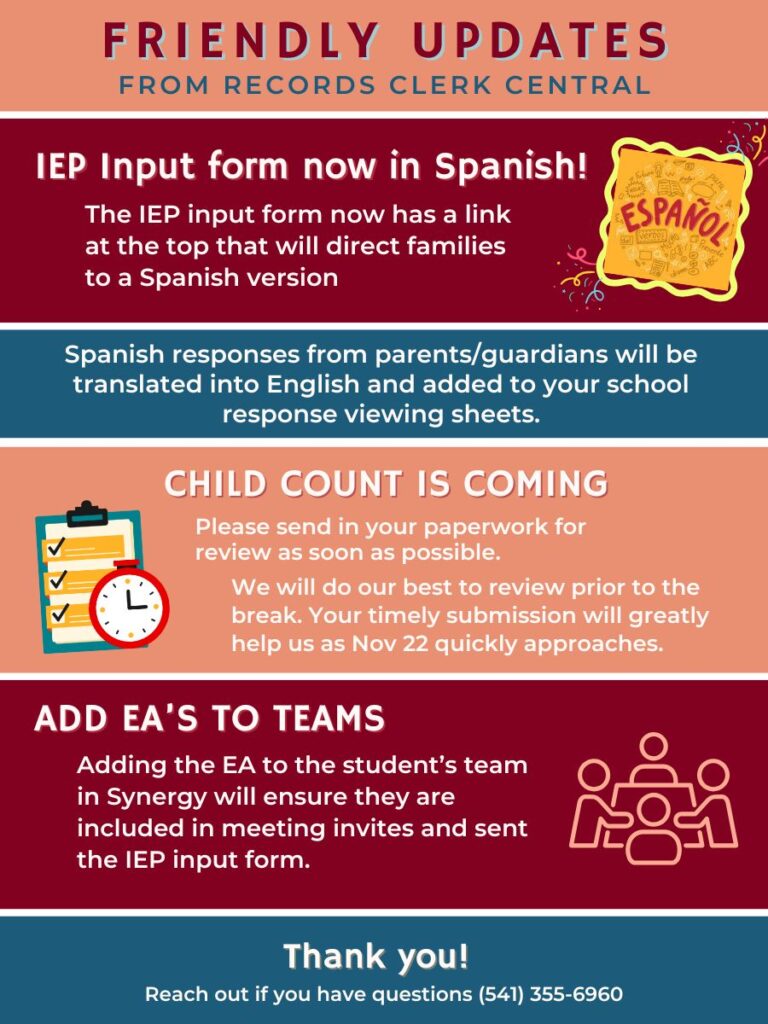
UPDATES FROM RECORD CLERK CENTRAL
STUDENT SERVICES TEAM
Did you know that Magic School AI has a Text Leveler feature? You can copy and paste any text into the leveler and set the criteria by grade level. This is an easy way to modify text. Check it out!
REMINDERS FROM SHANNON WATERS
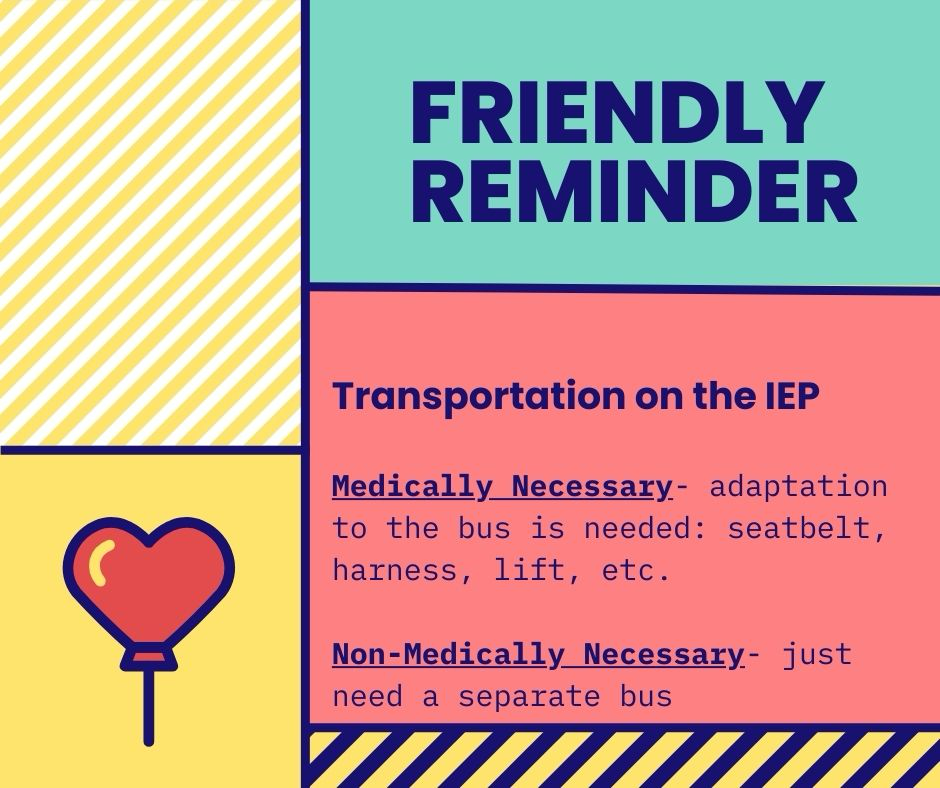
REMINDER FOR DECEMBER CHILD COUNT:
I hope this message finds you well. Thanksgiving Break is almost here. I want to express my gratitude for your continued dedication to our students and the Special Education process.
This is a friendly reminder to please send your validated paperwork to Records Clerks Central as soon as possible. It is essential that all paperwork for any meetings held before December 1st, REGARDLESS of the actual IEP or Reevaluation date, is completed, reviewed, and finalized before our Thanksgiving break on November 22nd.
As you know, December 1st is the Special Education Child Count date. We are required to provide the state with a list of every student enrolled and receiving Special Education services as of that date. This child count is part of the Oregon Department of Education’s requirements for all districts and is directly related to our special education funding.
Thank you for your attention to this matter and for your hard work in supporting our students.
SPECIAL EDUCATION INCLUSION QUESTIONS AND ANSWERS
BLS Special Education Inclusion Questions and Answers
Is Bend-La Pine Schools (BLS) a “Full Inclusion” District?
No, BLS is not a “Full Inclusion” District and the majority of our schools offer a full continuum of support from the general education setting to self-contained classrooms. In BLS, we support the inclusion of students with disabilities into the general education setting “to the extent that there is an educational benefit.” This determination is individualized through the IEP meeting process. The extent to which a student is included in the general education setting is discussed at every IEP meeting by looking at a student’s present level of performance, setting goals, determining the amount and type of specially designed instruction that the student needs to reach the goal, determining the location in which the specially designed instruction will occur, and then deciding the students “placement.” The IEP team (typically made up of a SPED teacher, gen ed teacher(s), related service providers, specialists, and a district representative) is tasked with determining the most appropriate educational placement in the least restrictive environment (LRE) that meets the student’s unique needs arising from their disability. The “non-participation justification” articulates why and how much time they are to be removed from the general education setting to receive their special education services.
Are we ONLY allowed to do “push-in” special education services?
No, BLS delivers special education services in a variety of settings and there is no edict stating that all services need to be “push-in”. As stated above, the majority of our schools provide a continuum of supports and settings from pushing into the general education classroom to self-containment in a separate classroom. Some students may access the general education classroom for certain parts of the day and be pulled out of the general education setting for part of the day. When and why a student is removed from the general education setting is an IEP team decision.
What is Specially Designed Instruction (SDI)?
SDI is a service, not a place. It involves instruction in which the content, methodology, or delivery of the instruction is individually adapted to address the student’s disability-related needs so the student can access, engage, and make progress in the general education curriculum and meet the standards and expectations that apply to all students of the same age or grade. This is
true irrespective of where the instruction is provided. SDI is instruction tailored to an individual student. SDI is provided to explicitly and systematically address a student’s area(s) of disability-related need and is always linked to one or more IEP goals. SDI may be provided to address any academic or functional skill need determined by the IEP team. SDI may be provided in any learning environment including school, home, community, or other setting
Legal Definition of Specially Designed Instruction (OAR 581-015-2000)
“Specially designed instruction” means adapting, as appropriate to the needs of an eligible child, the content, methodology, or delivery of instruction:
- To address the unique needs of the child that result from the child’s disability; and
- To ensure access of the child to the general curriculum, so that he or she can meet the educational standards that apply to all children.
Who can legally deliver SDI?
- A Special Educator OR
- A General Education Teacher or Instructional Assistant (EA) if a Special Educator is involved in the planning and progress monitoring of the instruction.
- The case manager should keep records to document ongoing planning and progress monitoring for Specially Designed Instruction for all of the student’s goals.
What types of services count as SDI?
The Learning Specialist is responsible for planning, communicating, and delivering specially designed instruction (SDI) for students. If an EA or General Education teacher delivers SDI, the Special Educator must be involved in planning and reviewing student progress data.
SDI is more than accommodations used to support student access and engagement in instruction. Here are some examples below:
- Reading, math, or other academic instruction and teacher-guided practice
● Language and communication skill building including sign language and braille instruction
● Instruction in targeted social and emotional learning skills
● Instruction in skills needed for independence and self-determination such as how to use social narratives, visual schedules, and self-regulation strategies
● Generalization training in natural environments
● Instruction in using accommodations or other supplementary aids and services such as:
○ Teaching student cues and reminders that will be used by teachers
○ Teaching a student how to effectively and independently use assistive technology
Do we have to follow the IEP as written?
Yes, the IEP is a written “contract” that outlines the goals, services, location of services, and types of accommodations and modifications. If any changes are necessary, the IEP can be revised through an IEP team meeting.
Does BLS have self-contained programs to serve students with challenging behaviors?
Yes, BLS has several programs designed to support this population. For K-5 students, BLS partners with the High Desert ESD to operate “The Nest,” a self-contained program for students facing significant social, emotional, and/or behavioral challenges. The Nest is a half-day program, allowing students to spend the other half of their day at their home school. There are eight slots available in both the morning and afternoon sessions. Students are placed in The Nest through the IEP team process, with input from a district representative.
For 6-12 students, BLS hosts a similar program called “Special Programs Secondary” (typically referred to as the Ed Center program). This program can serve 12 students in the AM and 12 students in the PM. This program is accessible via the IEP team process with consultation from an administrative district representative or for students who are expelled from their home school.
Further, as a district, we have the ability to support students with social, emotional, and behavioral challenges in all but 5 schools through the Student Success Intervention.
What training do we have for general education staff as it relates to serving students with disabilities?
This is an area that we would like to improve and we agree that more training for general education staff would be beneficial. That said, the student services department has provided training and aims to make progress in offering further training opportunities for general education teachers. Over the past several years, we have offered training in the areas of accommodations and modifications at the secondary level. When requested, this training has happened through general training or at a specific coaching level in a classroom setting. In education, time is one of our most valuable resources and we will continue to advocate for more opportunities to train general education staff. Additionally, we have purchased online learning opportunities through Hungerford Online. All certified special education staff and building admin have access to this training module and can be shared with all building staff. There are specific trainings directed toward general education staff, and if asked, we would be happy to help customize and facilitate training(s) for schools. The article below illustrates the need and desire for general educators to receive training on how to serve students with disabilities at the national level and could help facilitate further dialogue.
I’m unsure of how to utilize an Inclusion EA supporting students in my classroom. What should I do?
Inclusion EAs can provide SDI, modifications, and accommodations to students in the general education setting. They should enter the classroom having had direction and communication from their supervising Learning Specialist. If you have questions about how to utilize an Inclusion EA in your classroom contact their supervising Learning Specialist.
Why don’t we hire any more inclusion EAs?
The short answer is that all staffing decisions are made in the context of our budget and the variety of services that need to be delivered. Hiring more of one position means hiring less of another position. We believe we need to hire more of several different positions, including inclusion EAs. This year, due to the 4% across-the-board cut, we had to cut 5 inclusion EA positions. We can’t stress enough the importance of the inclusion EA role when it comes to serving our students with disabilities, particularly when it comes to providing inclusive and safe environments. We agree that more inclusion EAs are needed to fill out our staffing plans and we continue to seek more funding for these roles. We also see the need for more learning specialists and other positions so we can deliver services beyond simply maintaining safety. That said, we do have open positions that are posted to fill out staffing plans at schools and we continue to have hiring challenges for these positions.
Another important aspect of staffing inclusion EAs is ensuring there is a substitute available when an Inclusion EA is out. As of this draft, we have a posting up to hire 3 rover inclusion EAs to support schools that can’t get subs. We are also working through a project to understand the larger context of the Inclusion EA substitute shortage and seek a long-term solution, which may include running our own EA sub-pool.