
From Behavior Coaches

SIGN UP FOR THE CLASSROOM 180 WINTER BOOK CLUB!
This winter, join educators across the Bend-La Pine School District who will be reading Classroom 180 by Heather Forbes. Heather Forbes is the owner of the Beyond Consequences Institute . She has worked in the field of trauma and healing since 1999. She is an internationally published author and speaker on the issues that arise when children and young adults are impacted by trauma. Heather’s signature style is to bridge the gap between scientific research and real-life application. The purpose of this book study is to provide educators with a comprehensive framework to create, implement, and sustain a trauma-informed classroom. We will learn how trauma impacts the brain and how we can create an environment to support all our students during these uncertain times. (Note: You are responsible for the purchase of the book. Cost is 54.00) Draft of Classroom 180 Syllabus Watch for registration link coming soon in Performance Matters. To register for credit through OSU email: [email protected] Class starts Monday January 4th, followed by a group WebEx on Tuesday January 12th from 4:00-5:00.
Reduce Demand in the Classroom:
Each week we are highlighting one of our Top 10 Behavior Coaching Tools for reducing challenging behavior. This week, our topic is REDUCING DEMAND, couldn’t we all use a little less on our plate these days?
Tool #4: Reduce Demand: What are the academic and/or social demands that the student is having difficulty with?
- Kids (and adults) do well if they can. What we know is that challenging behavior emerges when there is a mismatch between the expectations we put on a student and their skills to meet those expectations.

- Set up lower demand activities (lower level independent work; jobs in the classroom, etc.). If needed, due to lagging skills with social demands, consider smaller or more individualized settings.
- Tools: 3-Step Bin Setup Sheet; 3-Step Bin Video; Continuum of Placements/Supports: Secondary, Continuum of Placements/Supports: Elementary, Step Up Plan
Virtual Tools for Reducing Demand:
- Review the student’s schedule and prioritize essential and nonessential meetings and learning activities. Keep in mind that students who struggle the most tend to have the most academically demanding schedules between their GenEd and Intervention expectations. Create a personalized visual schedule or daily/weekly checklist to help the student predict what is coming next (Blank Visual Schedule; Example Weekly Checklist). As the student finds success, you can add back meeting times and/or expectations.
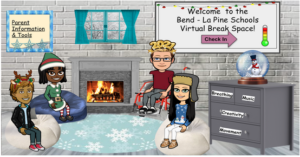
- Remind students to take a break in the Bend – La Pine Virtual Break Space if they are feeling overwhelmed with CDL.
 NEUROSEQUENTIAL MODEL – Regulating Yourself And Your Classroom
Episode 4: Regulating Yourself And Your Classroom Over the last several weeks, we have been highlighting Dr. Bruce Perry’s work, The Neurosequential Model in Education. Dr. Perry’s work is based on an understanding of the structure and sequential nature of the brain, which can help educators increase their students’ engagement in learning and mitigate behavioral problems. In this video Dr. Perry explains how students and teachers can often impact each other’s mood and brain function, and shares effective classroom strategies that help keep students and adults calm and regulated, decrease behavior challenges, and improve academic engagement. The video is 8-minutes long and will change how you think about your students.
ODE New Mental Health Resources:
Mental health refers to the emotional, social, cognitive, behavioral, physical and relational thriving of individuals and systems. The Oregon Department of Education has recently created 2 valuable resources that are designed to assist school district leaders, administrators, staff, school-based mental health professionals and community partners in promoting the mental health and well-being of school communities.The first resource, ODE Mental HealthTool Kit addresses six, primary content areas: (1) Leading from Strength to Promote Mental Health; (2) Addressing Traumatic Stress; (3) Elevating Student Voice; (4) Centering Racial Equity and Anti-racism; (5) Promoting Inclusive School Environments; and (6) Delivering Multi-tiered Systems of Support.
The second resource, ODE Mental Health and Well-Being Page includes information about ODE’s current mental health-related activities and initiatives such as Adi’s Act (suicide prevention) and the Strengthening Mental Health in Education initiative with OHA, as well as providing many tools and resources for students, families, school staff and leaders.
”Tier 1 and More” Blog
The Behavior Coaches blog is full of resources for PBIS, Social-Emotional Learning, Trauma-Informed Practices and more.