
By Dean Richards
Last week’s blog focused on feedback and moving students forward in their learning. This week we look at John Hattie’s levels of Feedback.
Types of Feedback
The content of the effective feedback that we provide students falls into 3 helpful categories.
- Feedback about the task
- Feedback about the process
- Feedback about the thinking during the task
“For the teacher, the art is knowing when to add in/move to the next level of feedback.”
Visible Learning
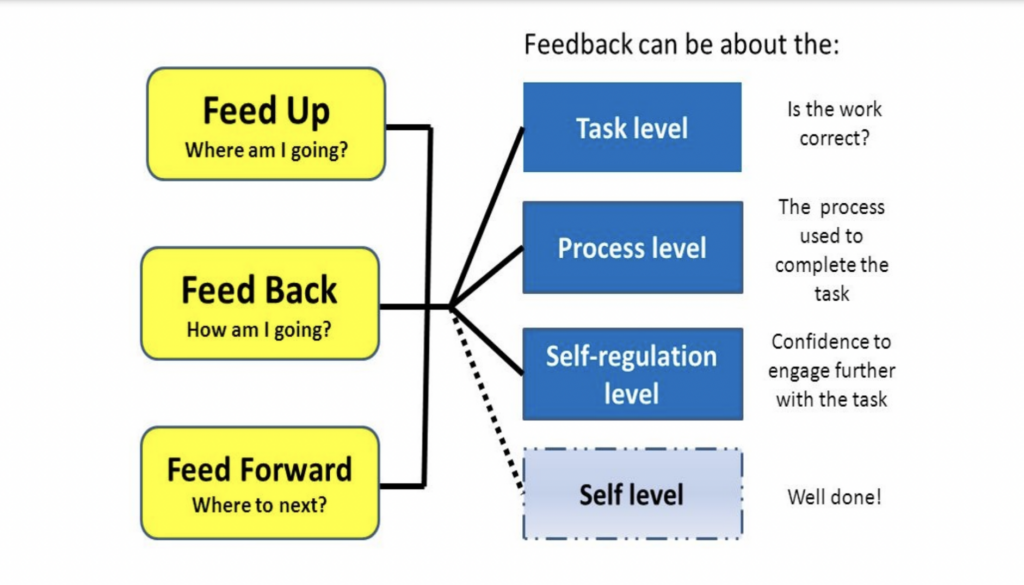
Task Level
Feedback about the task may be the most common and easiest feedback to provide to students. This includes information about the errors that a student produces in the task. A teacher may also give feedback about the quality of the work. A rubric is a great way to provide that explicit feedback. The drawback of providing feedback only on the task is that the misconception(s) that are evident may be transferred to the student’s next task, thus the misconception continues.
Examples of prompts at the task level:
• Did you meet the success criteria?
• Is your correct/incorrect?
• How can you elaborate on the answer?
• What did you do well?
• Where did you go wrong?
• What other information is needed to meet the criteria?
Process Level
Some students, particularly those who are often the most successful in schools, will be able to transfer the feedback from the task to the process. Providing feedback on the process, the steps taken to reach the final product, is a powerful way to move students to generalization. Providing feedback on the quality of the process and giving alternative actions can be more powerful for students’ next task than feedback on the task alone.
Examples of prompts at the process level:
• What is wrong and why?
• What strategies did you use?
• What is the explanation for the correct answer?
• What other questions can you ask about the task?
• What are the relationships with other parts of the task?
Thinking/Self-regulation Level
The next powerful feedback, and possibly the most difficult, is to provide feedback on the thinking that occurred while the student engaged in the task. This helps students monitor their thinking and learning process. This is most commonly done in conversations with students. One of my favorite moves I used while tutoring students for the SAT was to say, “You got that right. What were you thinking about when you did that?” Students often looked at me strangely, as they were not used to explaining their thinking. Often they talked about their process, then I would ask about how they thought. I would ask about their level of confidence. Forcing a student to metacognate about the task and process increases their self-efficacy.
Examples of prompts at the self-regulation level:
• How did you monitor your own work?
• What did you do to …?
• How can you account for …?
• What justification can be given for …?
• What further doubts do you have about?
• How does this compare with …?
• How have your ideas changed?
• Can you now teach another student how to …?