
From Colleen Funderburg
Educator Network Resources
Thank you for participating in our 1st Educator Network Day. Please click HERE to access the presentation from I/DD and CODSN.
Additionally, below is the content from Margie Blackmore, TNF, that was showcased in our Special EDge last week.
As your Transition Network Facilitator (TNF) at the High Desert Education Service District (HDESD). I support districts, teachers, families, and students (14-21 years old) in the area of transition. My work includes transition programming (programs and students), person-centered planning, transition planning in the IEP (new 23-24 Transition Handbook), community agency collaboration, student summits, resource events, etc.
In collaboration with agency partners, I want to share about Deschutes County Intellectual and Developmental Disability Services. If you have students receiving Intellectual/Developmental Disability (I/DD) Services (you will not if the parent did not sign a release), you will be receiving a list including the student, their I/DD service coordinator, and contact information this week. If you are interested in learning more about I/DD services, be sure to attend this week’s Educator Network Day. Shanna Nunes, Deschutes County I/DD Eligibility and Quality Assurance Specialist will be presenting on I/DD services.
If you or a student’s family member are unfamiliar with DD services and need more information:
- Deschutes County Transition Tri-Fold Deschutes County I/DD Services Brochure and How to Access Services
- Reach out to your Transition Network Facilitator at the HDESD, [email protected]
- Watch Community Partners & Agency Videos – General information not specific to Deschutes County
How you as a teacher can collaborate with I/DD coordinators
DD Services Coordinators can:
- Can assist with problem-solving and connecting the student/families with resources for – behavior, mental health, safety, and legal involvement.
- Can assist with resources for support at home and in the community.
- Can assist with Person-Centered, IEP, and transition planning.
- Can assist with resources for funding sources for assistive technology and software.
THINGS TO KNOW
Meeting Notes and Attendance:
A new form has been created and inserted into all Synergy Special Education process. Currently it is optional, not mandatory. We encourage you to try it out as it will be mandatory after Christmas break.
Some things to know:
- If you use the form in Synergy, you do not need to have a physical copy of notes or attendance
- You can still use a physical copy of your meeting notes and upload it to the document in Synergy
- only Word and PDF documents can be uploaded
- There are no signature requirements on the new document. You list who was in attendance, just like on the IEP.
- The Participants tab populates from the student’s Team, so make sure the team is up to date
A How-to and explanation of the document is on the website.
Synergy Processes and the IEP
Just a reminder, please DO NOT complete IEPs in the Re-evaluation process if you are not completing the evaluation at the same time.
For example, the IEP is due 10/15/23 and the Reevaluation is due 3/15.
You have two Options:
- move up the Reevaluation to be completed by the IEP date (fewer meetings)
- have RCC move the student to the Annual Process BEFORE you start any paperwork. (more meetings, and you have to complete the IEP again when the evaluation is completed)
CPI TRAINING
Thursday Oct. 26th.
We wanted to announce that we are offering an INITIAL CPI Training (De-escalation/Restraint) on
This is a non-contract day for classified employees. IF you are a Student Services employee, we are offering to timesheet you to attend this training. IF you are not a Student Services employee, you will need to go through your building admin for approval to attend and also to agree on compensation.
This course requires a MANDATORY 2.5 hour online portion that must be completed prior to attending the training. We WILL be time sheeting you for this time as well.
Sign up is in UKG and will close on Oct. 20th. Once you have signed up in UKG, we will send you an email notifying you we have signed you up for the online portion at which time you will receive an email directly from CPI. We will also get your training book to you prior to your online training.
From Dean Richards
SECONDARY Teachers:
We are again providing professional development support for teachers who are seeking ways to accelerate the learning of students who are currently performing below expectations in mathematics. This day-long professional development class is designed to support evidence-based instructional moves that teachers can give to accelerate learning. The main audience is the classroom teachers. Special Education teachers may also benefit from professional learning. Ideally, a team is sent to the professional development day.
Substitute costs will be covered by buildings.
October 25th from 8:00 to 2:00 (This is a teacher directed SIW, teachers may stay and work with colleagues or return to buildings) at the East Side Library.
Topics to be discussed:
- The role of manipulatives in instruction
- Determining the content for math support
- Ways to deliver explicit and systematic instruction to increase conceptual understanding.
To attend this professional development, please email Dean Richards with a request to attend
IDEAS’ FOR STUDENTS LEFT OVER CANDY
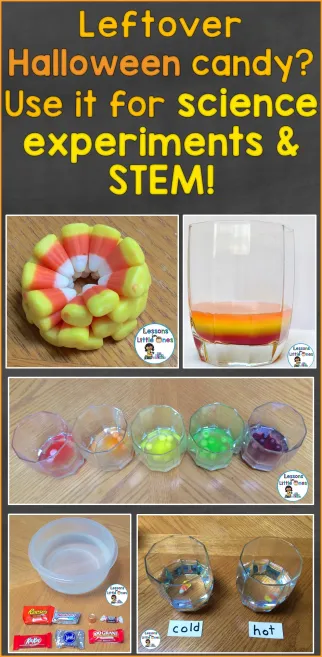
These science experiments are the perfect way to get rid of leftover Halloween candy or to just add something sweet to your science curriculum!
Skittles Density Rainbow
In this fun science experiment you use Skittles candy to create a rainbow in a clear glass or jar. It’s perfect to do after Halloween with leftover candy or in the spring around St. Patrick’s Day. It is a simple way to teach students about density.
Materials Needed:
Skittles candy
6 small glasses or jars
eye dropper
hot water
a tablespoon
Place 2 Tablespoons of hot water in each of 5 glasses.
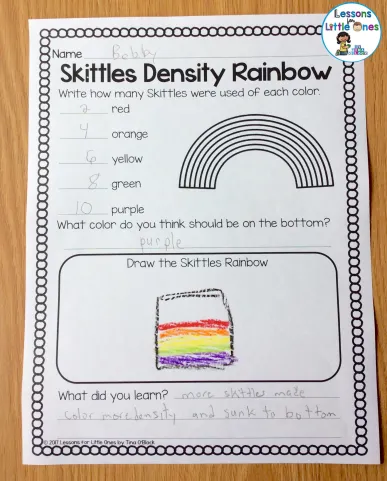
Place the following number of Skittles in each of the 5 glasses:
2 red
4 orange
6 yellow
8 green
10 purple
Wait for the Skittles to dissolve. If you need to speed up the process, microwave each cup up to 30 seconds.While the Skittles are dissolving, I have students record how many Skittles of each color we are using for the experiment.We then discuss which color they think has the most sugar and would therefore be the most dense. I then have students predict what color they feel should be on the bottom of the rainbow (the purple because it is the most dense and therefore the heaviest).Once the candy is dissolved, allow the water to cool (cold water is more dense than warm water).
Have students help you arrange the glasses from most dense to least dense.
Using the eye dropper, transfer the purple water to a new glass or jar.
Then add the green water to the new jar using the eye dropper and SLOWLY dribble the water along the inside of the glass. If you dump the water in or add it too quickly they will mix together and the rainbow will not form.
Once the candy is dissolved, allow the water to cool (cold water is more dense than warm water).
Have students help you arrange the glasses from most dense to least dense.
Using the eye dropper, transfer the purple water to a new glass or jar.
Then add the green water to the new jar using the eye dropper and SLOWLY dribble the water along the inside of the glass. If you dump the water in or add it too quickly they will mix together and the rainbow will not form.
After the experiment, I have students draw pictures of the rainbow and write what they learned (The water with the most Skittles was the most dense because it had the most sugar. The water layered from most dense to least dense.)
ENJOY!