BLS Nurse Blog

ACUITY TOOL
From Ely Sanders, ODE School Health Services Specialist
The Oregon Department of Education (ODE) is pleased to announce the updated Student Acuity Tool. This tool is designed to assist school nurses in assessing student medical acuity and determining whether a student qualifies as medically complex, medically fragile, or nursing-dependent.
Each school district must submit student acuity data to ODE annually. This data plays a vital role in ODE’s School Nurse Annual Report, which is presented to the State Board of Education and the State Legislature.
Accurate acuity data is essential for ensuring adequate nursing services in schools. This data is used to inform policy decisions, determine resource allocation, advocate for student well-being, and promote equitable access to education for all students. To ensure the effective use of the updated tool, school nurses are strongly encouraged to complete the School Nurse Acuity training on ODE’s Health, Safety, and Wellness: School Nurse Resources website.
*Please remember that this tool is not used to evaluate school nurse workload nor is it designed to determine placement of an individual student. The acuity tool collects data for the Annual Nursing Services in the Oregon Public Schools Report in which data is considered in aggregate.
**Hannah usually submitted this data on behalf of BLS. However, since she is out, I will let you know which nurse to submit this data to.
CHOKING SUPPORT
American Red Cross Statement vs. Life Vac Claim
Life Vac – “An anti-choking device is now part of the recommended guidelines to be used in the event of protocol failure or when traditional methods cannot be administered, such as in cases involving individuals in wheelchairs.”
The American Red Cross – “There are many weaknesses in the available data and few unbiased trials that test the effectiveness of anti-choking suction devices resulting in insufficient evidence to support or discourage their use. Practitioners should continue to adhere to guidelines authored by local resuscitation authorities which align with ILCOR recommendations.”
Bend-La Pine Schools will continue to follow established choking rescue protocols approved by the American Red Cross and the American Heart Association. (Included in the BLS HSI CPR/first aid training.) Suction based airway clearing devices have not been approved by ARC and AHA.
Protocol to rescue choking infants
Protocol to rescue adultsExternal Link Disclaimer
Protocol to rescue choking childrenExternal Link Disclaimer
Read the NASN discussion here.
DEI
From Kinsey Martin – Policy, Advocacy, & Office of DEI
Emergency contacts:
We’ve learned from other districts across the country who have experienced immigration raids, or smaller-scale detention/deportation actions in their community, the importance of having up-to-date emergency contacts in Synergy for each student. If parents/guardians suddenly become unavailable, we rely on emergency contacts–outdated information adds stress to an already traumatic situation.
With conferences coming up, please encourage families (all families, not just those to whom the above situation might apply) to update their emergency contacts. This might look like a station in your lobby with iPads and instructions (I’m working on getting some we can provide you), a reminder by classroom teachers, etc.
Day of Silence:
The 2025 Day of Silence is coming up (student-led advocacy day to support the LGBTQ community). I have asked your DEI-ICCL rep and/or GSA advisor to send a message to staff about this day, so staff are aware and know how to navigate.
If you haven’t seen that message come out to your staff, or if you’d like to re-send it in your staff memos, please reach out to your DEI-ICCL rep. Teachers should plan for nonverbal or written means of participation in class that day, if possible.
FLU
Central Oregon Weekly Flu Report – 4/7/25
MEASLES
FYI – From OHA
Q: If we drop significantly below herd immunity for measles in the coming years, what is the risk to older people, say, someone born about 1962 who never caught the measles, who was vaccinated only as a small child and has the typical risk factors of older Americans? Is there research that tells us whether these unexposed, older adults will need to be vaccinated again?
OHA Answer: Because measles was nearly universal at that time, we presume that people born before 1957 have had measles (whether they remember it or not) and are therefore immune for life. Someone born in 1962 who never had the measles, however, may have some vulnerability for a couple of reasons. One—when the measles vaccine was introduced in 1963, it was a one-shot deal, and the need for a second dose (boosting effectiveness from 93% to 97%) wasn’t recognized until around 1990. And two—one of the two measles vaccines available in those early years was not very effective, and the immunity it provided did not last very long. That vaccine was discontinued in 1968.
Although the CDC data don’t address this question head-on, of 338 cases reported in the U.S. from Jan. 1, 2020, to March 28, 2024, only four have been 50 years old or older. So the risk in middle-aged and older adults is very low indeed. At the same time, most of the cases during this time had either been traveling to regions of the world where measles had been spreading, or had a contact who had. So, if you’re an adult born during or after 1957 and planning to travel to such a region, we recommend you make sure you’ve received a total of two doses of the MMR vaccine at some point in your lifetime, given at least one month apart, before traveling. The same goes for if you’re exposed to measles here, in the U.S.
Certainly, if measles becomes endemic here again (occurring regularly), we’ll see more cases among older adults.
Q: I keep reading about the measles and different shots for different people ages and such. But nowhere have I seen it mentioned that adults who are presumed immune either through infection or vaccination should get their vaccine titers checked. My friend had hers checked with her primary care doctor for other reasons and found that she had no immune reaction to measles any longer. She is only 35! She had the two-shot series when she was a kid. What would be your recommendation for me? I also had the two-shot series when I was a kid.
OHA Answer: A: If your friend had two doses of measles vaccine as a child, she’s highly likely to be protected – even if she no longer has detectable antibodies in her blood. The vaccine will induce immune “memory” so that if she’s exposed, she’ll rapidly mount a response. So, we don’t recommend re-vaccination for her.
There aren’t many reasons to get your measles titer checked. If it’s positive, it means you’re protected, but as noted above, you may be protected even if your antibody levels have fallen off – so a negative result doesn’t really tell you much. If you’ve been exposed and you’re not sure whether you’ve been vaccinated, we’d usually recommend that you just get vaccinated now. The only people for whom we’d recommend checking a titer are those who have been exposed to measles, aren’t sure whether they’ve been vaccinated and can’t be vaccinated now (because they’re pregnant or severely immune compromised) or are under 6 months old.
NASAL STICKS/INHALERS
A school inquired about the use of Essential Inhalers and Boomboom Natural Nasal Sticks at school. Below is my response after researching these products.
For safety reasons, I feel that a health care provider should sign the Authorization for Medication Administration form (attached) with instructions for use. They should be kept in the school health office rather than self-carrying.
If you receive any questions about the use of these products at school, a health care provider signature/note is required with administration details listed in the medication authorization forms.
VISION SCREENING RESULTS
IT will be uploading all of the vision screening results into Synergy on May 19th.
CALENDAR
| DATE | TIME | EVENT | INFO |
| 4/10 | All day | Purple Up for Military Kids | Show support to our military youth by wearing purple. |
| 4/16 – 4/17 | NO SCHOOL ALL MIDDLE AND ELEMENTARY SCHOOLS | These are workdays for regular nursing staff. | |
| 4/18 | NO SCHOOL ALL SCHOOLS | This is a workday for regular nursing staff staff. | |
| 4/23 | 2-330 | NURSE MEETING | Location: TBD |
| 5/7 | 2-330 | NURSE MEETING | Location: TBD |
| 5/14 | 6-9PM | TRIVIA NIGHT |
LINKS
Link to Links
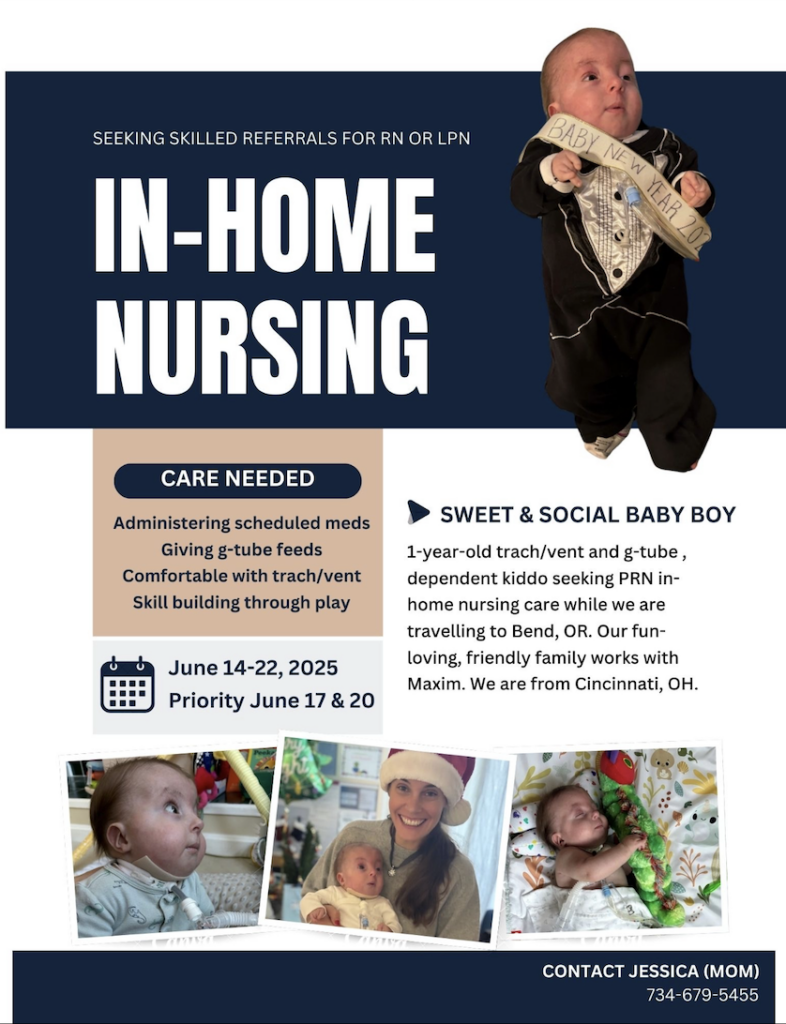
NON-BLS NURSING SUPPORT NEEDED IN JUNE
This is for an infant visiting from out of state in June.