

As we attempt acclimation to a new school year, educators, students, and families continue to experience changes and conditions that are unexpected and unwanted – to hold the unknown as a chronic state instead of a “fun Friday” freedom. Equipped with nervous systems designed to operate briefly at crisis response (also known as “surge capacity”) levels, days can feel like weeks and each month, a year. Chronic exposure to unmanageable and unpredictable stress is at the heart of what makes the pandemic a slow-moving, traumatic experience for everyone involved with schools.
BRYT is honored to work with BLS coaches and leaders to support school-based Student Success teams in developing an intensive intervention for some of the district’s most seriously struggling students and families. At the same time, we recognize that all students, families, and educators are experiencing significant challenges, and teachers are facing the realities of dysregulation every period of every day. Dr. Bruce Perry’s core message is instructive in this regard: if we are to work with students in a way that fosters their ability to reason and reflect (critical for internalizing, retaining, and applying new knowledge), we first need to make sure that they are emotionally regulated and able to relate to their teachers and each other. Here is our mantra for this work:
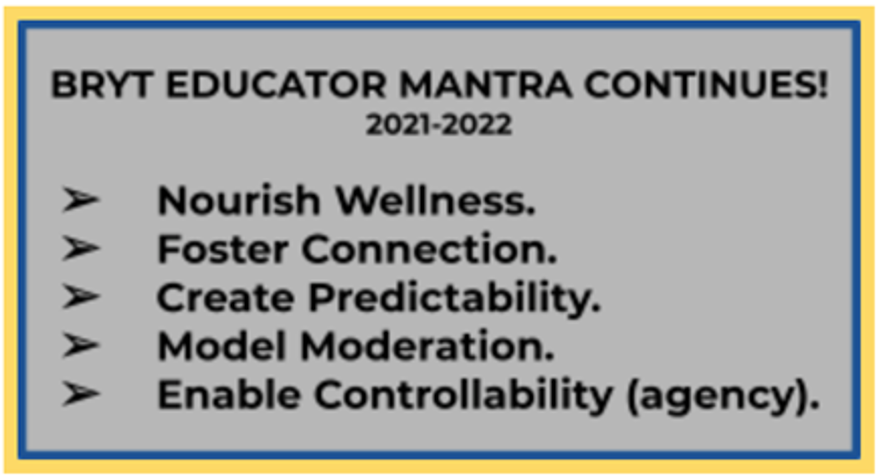
Nourishing Wellness & Modeling Moderation: Educators are dealing with more challenges and stressors than ever. While healthy levels of stress help us grow and become stronger, we cannot expect to work effectively and sustainably with students over the course of this school year if we are not afforded the time and resources to take care of ourselves and each other. Wellness doesn’t just happen—it depends on leaders and educators alike to set and sustain intention, making it not just okay, but an integral part of a systematic culture of care among school staff. As we work to support the students in front of us every day, we must also continue to increase our awareness of how systems either promote wellness or perpetuate disease and suffering, especially for those who are marginalized with less privilege and power—and as we increase our awareness, we can and must continue to engage in the kinds of uncomfortable reflections and conversations that address the inequitable distribution of wellness that too consistently characterizes our communities. When educators are cared for, a culture of care is then naturally extended to students and their families.
Fostering Connection: Consider integrating consistent, semi-structured non-academic check-ins with all students. These might happen in the context of advisory programs, or on a rotating basis during class. It is essential that all educators understand each school’s mental health infrastructure and referral process, in order to know exactly how to access support for students. Based on observations and information collected in check-ins, educators can provide basic support and care to students facing mild challenges. When there is heightened concern for wellbeing (perhaps due to a sudden change in behavior, appearance, or function) teachers can quickly notify administrators and support staff.
Create Predictability and Enable Agency: After so much inconsistency and time away from school, many students continue to be disoriented. Ongoing focus on orienting students to people, places, and routines/use of time is critical—even when it feels like they “should” be fully oriented and even if this means pushing back against pressure (whether real or internalized) about the need for academic catch-up. Providing achievable opportunities for students to choose how they engage with learning offers a sense of control. Additionally, this is the time for all educators to expand their tactics for helping themselves and students regulate emotionally through consistent rituals and routines, movement breaks, mindfulness, intentional transitions, and integrated SEL skills. For those interested in broader understanding and tactics, Dr. Perry’s team provides many resources.
In building relationships and fostering powerful connections, entire communities benefit. When our interactions are full of compassion, grace, and hope, there is profound potential to heal, strengthen, regulate, and create belonging—whether it’s holding a door, negotiating an extension on an assignment, or reassuring an exhausted parent or colleague that they are not alone.


Pingback: October 8, 2021 | High School Rock Stars!
Pingback: 10.8.2021 | The Fish Basket