
by Linda Adams and Colleen Behrens
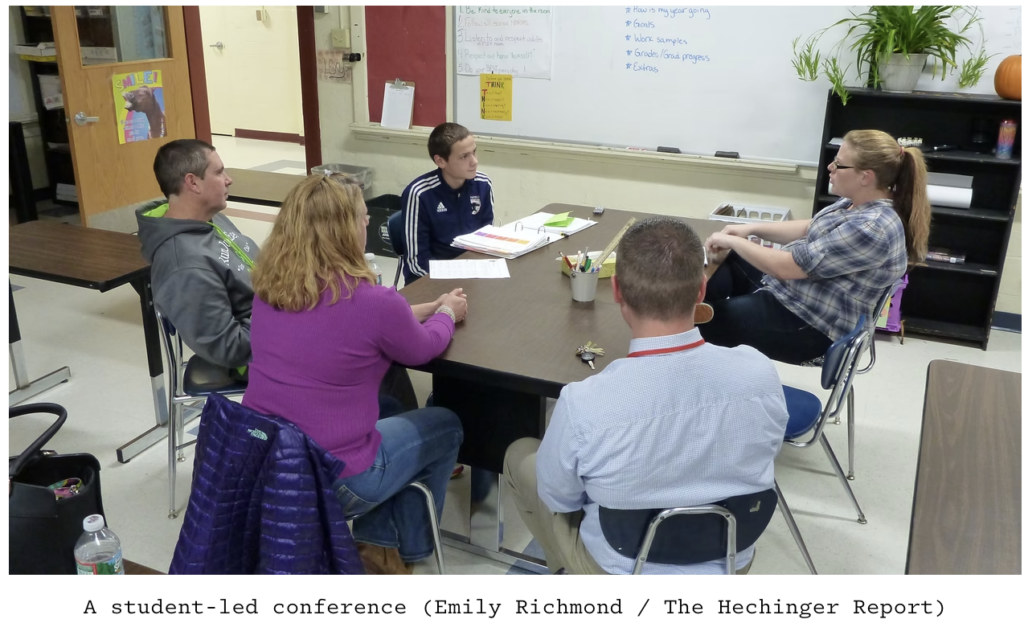
“It’s not about us as teachers! The student is the center of the conference, so the student gets to be the one who facilitates the conference.”
Once our schools went to student-led conferences we were hooked. Parents no longer had to wait in line to talk to the teacher, students were more involved and the responsibility for the conversation shifted from the teacher to the student and parents. Students had conversations that were targeted on their learning, challenges and successes. Students were very honest and reflective and we were observers that answered questions and provided feedback when needed.
One thing to note, setting up student-led conferences does take some time up front, however, the reward is worth it, and once students are conferencing with their families you can relax a bit. We found it far less tiring to conference this way than the traditional ways of having the teacher lead the conference. Every student conferences, either at school or at home if they don’t come in. Watch this 5 minute video about Student-Led Conference.
Student-led conferences can be set up a few different ways. One option is a conference with the teacher, the student and the parents with the student taking the lead as the teacher observes. Another option is setting up your classroom 4 to 6 conference areas. Direct families to sit at an available table when they enter the room. Give parents/guardians the option to have you sit with them and answer any questions. Many times parents/guardians are satisfied with the student conference alone but others really want to “talk with the teacher”. As much as possible let the student share their learning, struggles and goals with their families, it’s a lovely process to watch, even for the students that have not done as well as they might have as families can now set goals or intervene as necessary.
Prepare Ahead of Time
- Determine student work: Create a list of student work that shows student learning overtime or consider letting students choose the work they are most proud of or the learned the most from. In Canvas, students can refer back to assessments that were submitted in previous quarters. If you choose assessments with the same skills then you can show growth. For example, graphing analysis and interpretation from an assessment in October and a different assessment in January.
- Reflect on learning and growth: Complete a student self-reflection ahead of time and keep the hard copy in case a student forgets their iPad conferences. Self-reflections on learning are meaningful and open the door discussions about strengths, challenges and goal setting.
- Provide a script: Create a simple script for students to follow if they choose. Make sure they know where to find their self-reflection and Canvas assessments. It might be helpful for students to make a digital presentation for parents/guardians ahead of time. This can also be viewed at home if families can’t attend a conference.
- Practice: Model how to do a conference and then pair up students so they can practice ahead of time. Provide directions at the table and encourage students to get started. Pre-teach this to students before conferences occur.
The following resources contain another video example, this one at the high school level, as well as a link to another awesome Edutopia blog article, a student google slide templet and a student reflection script. Be sure to check them out!