
Student-Led Conferences Means Empowering Student Voice

by Linda Adams and Colleen Behrens
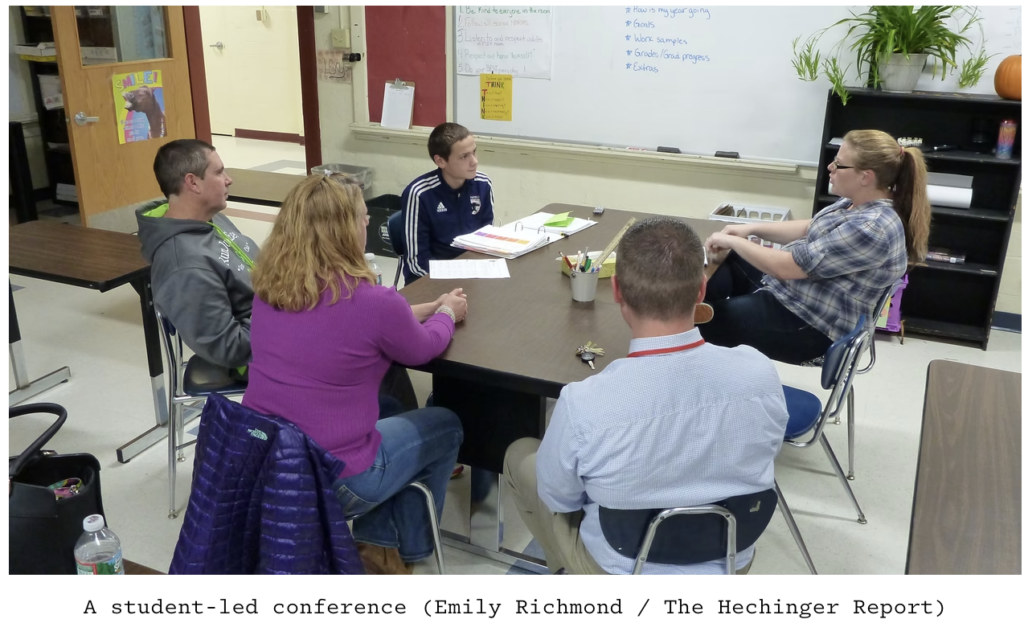
“It’s not about us as teachers! The student is the center of the conference, so the student gets to be the one who facilitates the conference.”

Once our schools went to student-led conferences we were hooked.  Parents no longer had to wait in line to talk to the teacher, students were more involved and the responsibility for the conversation shifted from the teacher to the student and parents. Students had conversations that were targeted on their learning, challenges and successes.  Students were very honest and reflective and we were observers that answered questions and provided feedback when needed. 

One thing to note, setting up student-led conferences does take some time up front, however, the reward is worth it, and once students are conferencing with their families you can relax a bit. We found it far less tiring to conference this way than the traditional ways of having the teacher lead the conference. Every student conferences, either at school or at home if they don’t come in. Watch this 5 minute video about Student-Led Conference.

Student-led conferences can be set up a few different ways.  One option is a conference with the teacher, the student and the parents with the student taking the lead as the teacher observes. Another option is setting up your classroom 4 to 6 conference areas.  Direct families to sit at an available table when they enter the room. Give parents/guardians the option to have you sit with them and answer any questions. Many times parents/guardians are satisfied with the student conference alone but others really want to “talk with the teacher”. As much as possible let the student share their learning, struggles and goals with their families, it’s a lovely process to watch, even for the students that have not done as well as they might have as families can now set goals or intervene as necessary.

Prepare Ahead of Time

  1. Determine student work: Create a list of student work that shows student learning overtime or consider letting students choose the work they are most proud of or the learned the most from. In Canvas, students can refer back to assessments that were submitted in previous quarters. If you choose assessments with the same skills then you can show growth.  For example, graphing analysis and interpretation from an assessment in October and a different assessment in January.  
  2. Reflect on learning and growth: Complete a student self-reflection ahead of time and keep the hard copy in case a student forgets their iPad conferences. Self-reflections on learning are meaningful and open the door discussions about strengths, challenges and goal setting.
  3. Provide a script: Create a simple script for students to follow if they choose.  Make sure they know where to find their self-reflection and Canvas assessments.  It might be helpful for students to make a digital presentation for parents/guardians ahead of time. This can also be viewed at home if families can’t attend a conference.
  4. Practice: Model how to do a conference and then pair up students so they can practice ahead of time. Provide directions at the table and encourage students to get started. Pre-teach this to students before conferences occur.

The following resources contain another video example, this one at the high school level, as well as a link to another awesome Edutopia blog article, a student google slide templet and a student reflection script. Be sure to check them out!

Resources

Students Have Been Learning from Home for a Year. How Do We Bring Them Back?

There is no question: students and their families are feeling all of the same things we are about returning to the classrooms. Like us, they have been submerged in the stresses of home environments relentlessly; unlike us, they have not been protected by the same job stability, self-advocacy tools, or ability to go into the school building if that would work best.

Welcoming them back into our classrooms is offering them the chance to re-start their independent lives. But it’s been such a long time for them, there may well be some issues we would do well to consider.

Below, is a list of relevant readings you may find helpful.

1. The website We Are Teachers recognizes that, even when students are back on the classroom, they will likely still be engaging in remote sessions with us as a matter of routine. Therefore, it caters it’s suggestions to keep ourselves well-supported and moving forward despite the shifting locations and platforms: “2020’s New Rhythm: Moving from Virtual to In-Person (and Back Again)”

2. The National Association of School Psychologist put together this two-page article reflecting on student socio-emotional re-entry needs, and articulating what teacher practices will support their transition most effectively. “School Re-entry Consideration: Supporting Student Social and Emotional Learning and Mental and Behavioral Health Amidst Covid-19.” School-Reentry-Considerations-NASP.pdf

3. Edutopia’s brief blog post is action-oriented and to the point: “5 Tips for a More Efficient Transition from Virtual to In-Person Teaching”

4. Lexia Learning authored this blog post coaching teachers and administrators on what to prepare for and what to expect. A quick read with some helpful tips you may want to consider. “Returning to the Classroom after Covid-19 Shutdowns: What to Expect and How to Be Prepared.”

5. And, finally, I want to include an open letter that has lived on my desktop for months. Long-time community counselor, Kathy Ngel Hood, offers this advice for parents but I think we may also find its perspective helpful. There are no instructional tips here, but some excellent and compassionate thinking about the Covid lives of our students. “Observations from a Counselor”

============================================================

Standards of Practice: How They Can Help Us and How They Can Help Bend-La Pine Families


WE HEAR YOU.

Whether teacher or administrator, we hear that you are putting more time into this new version of a school year than you thought possible.  Whether you’re in your first five years, or your first twenty-five, this is HARD.

As much as we wish – for ALL our sakes – that we had a clear freeway exit coming up, we all know we must continue forward.  We must continue to deliver the best education we can teach ourselves to deliver in this new medium.

To support your efforts to guide and create, we’re committed to providing a small, but creative, variety of strategies each week.  We’ll anchor our work in the Secondary Standards of Practice, which were thoughtfully and conscientiously created by myriad district voices, to be a kind of operating manual for the demands of this year.  Sometimes we’ll build the content you’ll find here, sometimes other district teachers will; sometimes it will come from the Canvas support team, sometimes it will come from the internet.

We’re committed to continuing to listen to you, and trying to provide ideas you’re looking for.  And trying to build a ladder through this year, one rung at a time.

INCREASING FAMILY ENGAGEMENT

  1. Standards of Practice #1: Intro and Family Engagement  (5:25). Written by our district, this video introduces the Standards of Practice for Virtual Instruction and provides motivation and rationale for reaching out to families with more frequency than in traditional school years.  Also provided is a brainstorm of many possibilities for doing this efficiently

    1. Standards of Practice #1: Intro and Family Engagement – Slideshow  Here is the PowerPoint that lines up with the video.  Administrators or ICCL leaders, you may want to present this yourself and then discuss with your staff accordingly.
  2. 5 Ways to Build Connections with Students Online This article, written by a high school English teacher, gives 5 quick things he does to stay connected with students in remote learning environments.  

  3. How Teachers Can Maintain Positive Parent Relationships During School Closure  The article proves several simple, yet clear ideas about how to keep parents in the loop during CDL. 

        .