EXCITING NEWS FOR FAMILIES WHO UTILIZE DSP’S DIRECT SUPPORT PROFESSIONALS!
Rally Recreation is an indoor play space with several ping pong tables, air hockey, foosball, pool, shuffleboard, and darts. They encourage groups of all kinds – work teams, families, friends – to come in and enjoy playing together.
The cherry on top of this new recreation opportunity is that DSPs are welcomed with FREE entry when they accompany a paying individual and show proof of employment (like a name tag).
We still have space available for our upcoming Restorative Conferencing training on 1/30/25 (8:30am-12:30pm at COCC Redmond). This is the tier 3 formal, scripted circle used to repair specific and significant harm between individuals. This session is free and open to educators and our partners.
Please remember to include your school nurse in 504/IEP meeting invites. Nurses bring crucial health expertise to the meeting, ensuring that student’s medical needs are considered and addressed within the accommodations/educational plan.
NURSES WHO AND WHERE
Nurse assignments can be found in the “Who is Where 24/25” Google spreadsheet
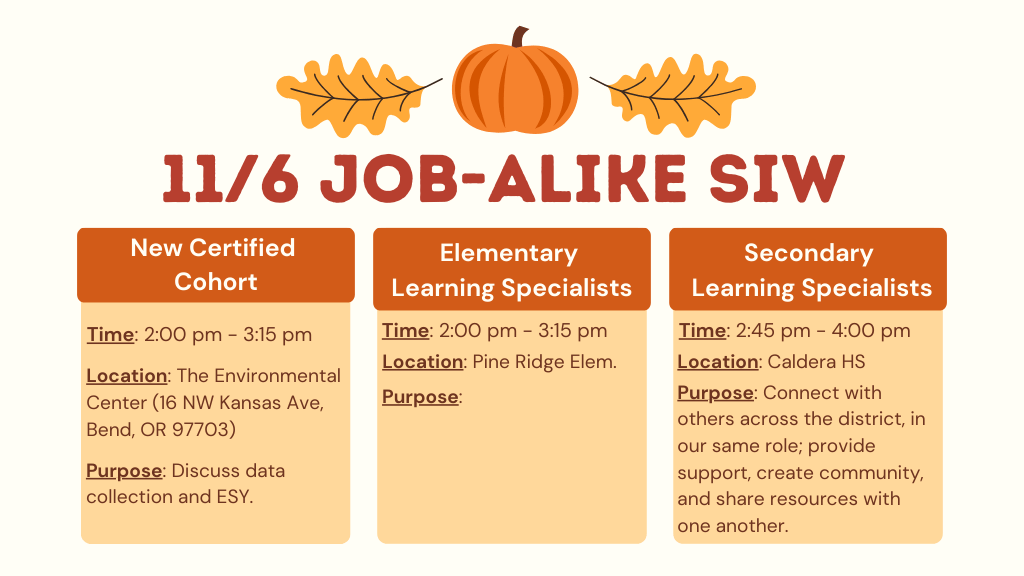
*Please register in UKG: My Career > My Learning > Access Learning (button at the top) > Training > Events > Set the date > Click on the Training > Register
Initial:
Date: Tuesday, February 11
Time: 8-4
Location: Trinity Episcopal
Refresher:
Date: Tuesday, February 25
Time: 8-11:30
Location: Trinity Episcopal
Verbal De-Escalation:
Date: Tuesday, March 11
Time: 8-11:30
Location: Trinity Episcopal
The Medicaid Minute-April Diehl
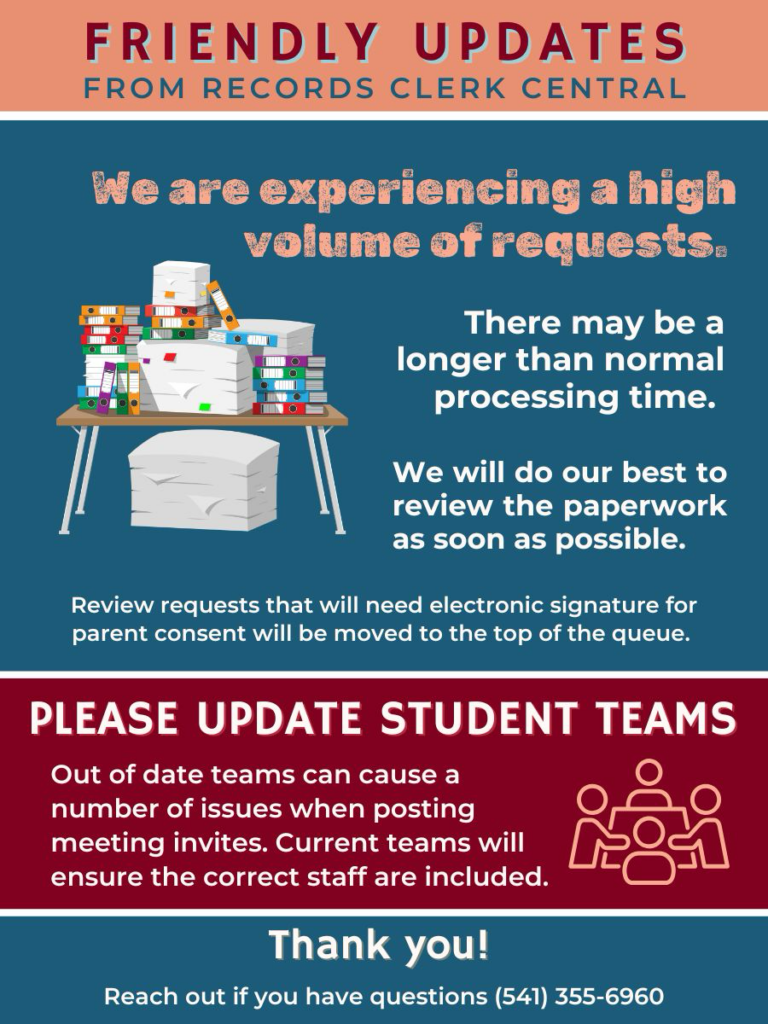
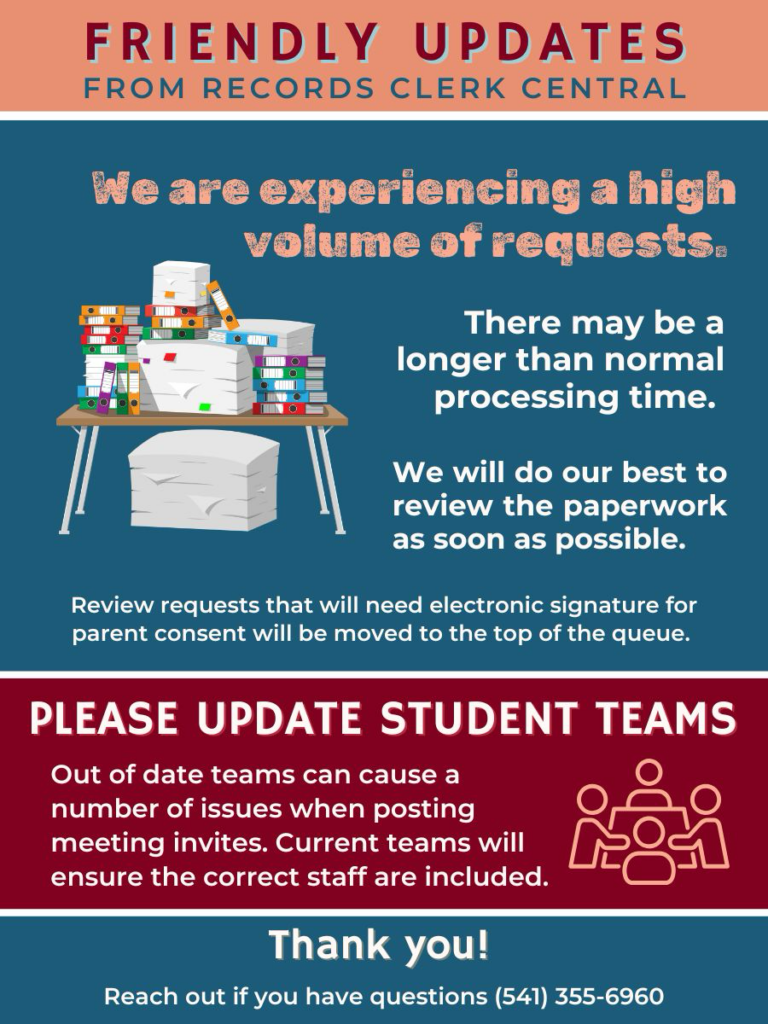
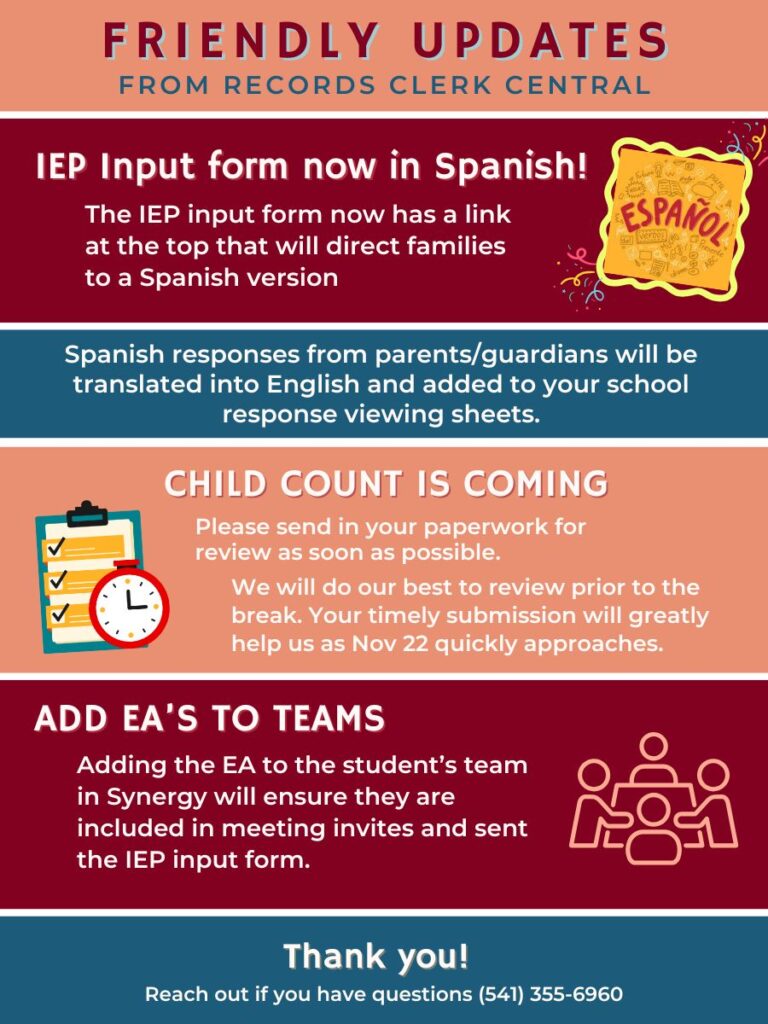
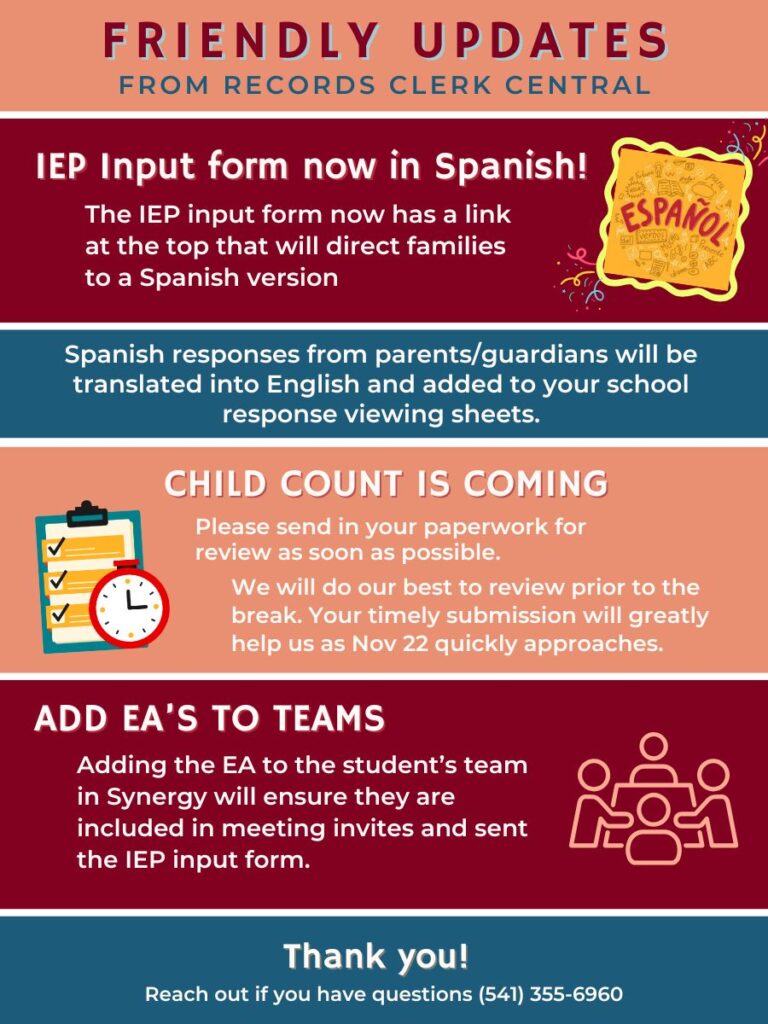
Notes from Records Clerks
Restorative Practices
Happy 2025 from HDESD’s Culture of Care Team!
We still have space available for our upcoming Restorative Conferencing training on 1/30/25 (8:30am-12:30pm at COCC Redmond). This is the tier 3 formal, scripted circle used to repair specific and significant harm between individuals. This session is free and open to educators and our partners.
HAPPY NEW YEAR EVERYONE! I am coming into the new year with some renewed energy and looking forward to the days ahead. I hope you all had a great break too.
We are excited that Kristan Shobe has joined the student service support team staring this week. Kristan will be taking over for April Diehl as the Student Services Accounting Specialist. Kristan has worked in BLS for 11 years in nutrition services as a staff accountant. Kristan is currently training for her new role and you will receive information about her transition into the role over the next few days and weeks.
April Diehl’s New Role – Medicaid Program Manager
As a reminder, April Diehl has taken on a new role as the Medicaid Program Manager for BLS. In her new role, April will develop and implement all aspects of our Medicaid billing program. This includes expanding billing into a variety of everyday services that we provide to students and including new areas such as behavioral health and delegated nursing services. Additionally, April will optimize systems and find areas of improvement in our Medicaid reimbursement system in line with new rules from the state that will allow us to expand Medicaid billing.
Child Find 2024
Thank you for your commitment to getting IEPs finalized so that the district can be compensated from the state for the great work that we do in service of students with disabilities. You can find a table with 2024 data, as well as historical trends HERE.
Here are a few highlights:
Total students on IEPs is 2027 (up from 1931 in 23/24)
Total IEPs district percentage is 12.1% (slightly up from last year and up 3% since 20/21)
No remarkable trends up or down in disability type last year
EXTENDED SCHOOL YEAR
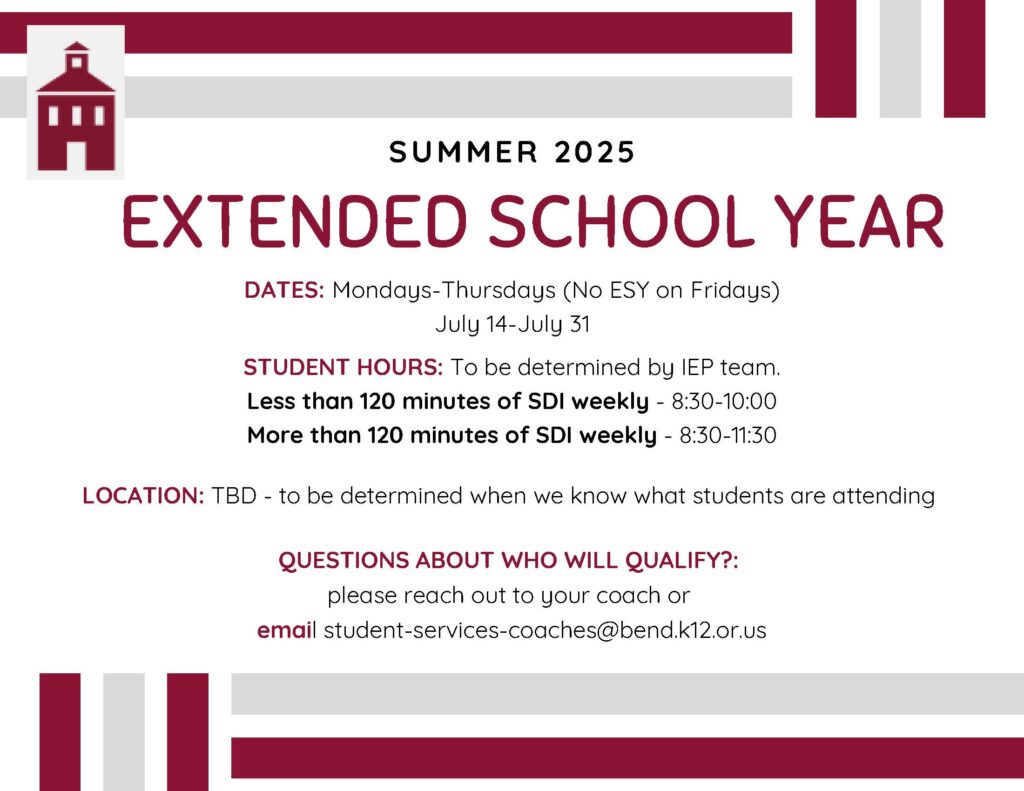
EXTENDED SCHOOL YEAR
DATES: Mondays-Thursdays (No ESY on Fridays) July 14-July 31
STUDENT HOURS: To be determined by IEP team. Less than 120 minutes of SDI weekly – 8:30-10:00 More than 120 minutes of SDI weekly – 8:30-11:30
LOCATION: TBD – to be determined when we know what students are attending
COIC is paying tuition for anyone wanting to enroll in the winter term if they are currently enrolled in the Bend-La Pine School District!
COACHES CORNER
DIPLOMA OPTIONS
Please discontinue using the District tri-fold brochure for diploma options. This brochure does not contain the most up to date information. At this time, TLC is waiting to create an updated brochure/visual due to the changing graduation requirements over the next couple of school years.
Moving forward, invite your school counselors to IEP meetings when discussing diploma options!
COIC is paying tuition for anyone wanting to enroll in the winter term if they are currently enrolled in the Bend-La Pine School District!
COACHES CORNER
DIPLOMA OPTIONS
Please discontinue using the District tri-fold brochure for diploma options. This brochure does not contain the most up to date information. At this time, TLC is waiting to create an updated brochure/visual due to the changing graduation requirements over the next couple of school years.
Moving forward, invite your school counselors to IEP meetings when discussing diploma options!
GINGERBREAD COOKIES
ere is my favorite gingerbread cookies recipe and one of the most popular Christmas cookie recipes on this website. Soft in the centers, crisp on the edges, perfectly spiced, molasses and brown sugar-sweetened holiday goodness.
Whenever I think of Christmas cookies, gingerbread cookies come to mind first. Well, after Christmas sugar cookies of course! Their spice, their molasses flavor, their SMILES, and their charm are obviously irresistible. Gingerbread cookies, you have my heart. The full written recipe is below, but let’s review a few key ingredients here first. Gingerbread cookie recipes all start the same and mine comes from my mom. To her recipe, I add a little more molasses and increase the amount of spice flavors (cinnamon, ginger, cloves, and allspice). Because of the added sticky sweetener (molasses), I add a little more flour to help soak it all up. Just like when we are making pinwheel cookies, a bit of extra flour helps the cookies can keep their shape.
Egg so the gingerbread cookies have structure and richness
Brown sugar instead of white granulated sugar. I always use brown sugar when its flavor fits.
How to Make Gingerbread Cookies
Let’s walk through the gingerbread cookie recipe so you feel confident when you begin baking.
Chill the dough: The dough is sticky once it’s all beaten together in your mixing bowl and therefore, it absolutely MUST be chilled for at least 3 hours. Give yourself enough time in the kitchen or make the cookie dough and chill it overnight. You want your cookie dough firm so the cookies hold their shape and you want your cookie dough manageable so you can work with it. You won’t have either unless you have chilled cookie dough!
Wrap up the dough: It’s easiest to wrap the dough in plastic wrap before chilling. Scoop out 1/2 of the prepared cookie dough, plop it onto a long sheet of plastic wrap, wrap it up, and flatten it out into a disc. Repeat with the other 1/2 of dough. Then chill. See that photo above? That’s what you’re doing, but you’ll have 2 discs. Why are you doing this? It’s easier to roll out the chilled cookie dough when it is in a disc shape. Also, the cookie dough chills faster when there is less volume. And it’s just easier to work with smaller portions when rolling/shaping!
Roll it out: After chilling, roll out the chilled cookie dough discs until about 1/4-inch thick. Don’t be afraid to flour your hands, rolling pin, work surface, and everything in the world. By that, I mean: the cookie dough can become sticky as you work. So, don’t be scared to add more flour to the work surface. The flour spots on top of your shaped cookie dough will bake off.
Place the cut-out cookies onto a lined baking sheet about 1 inch apart. The cookies won’t really spread, but you want to make sure they have enough room to breathe. They are gingerbread people, after all. 😉
How to Decorate Gingerbread Cookies
After they’ve baked and cooled, it’s time to decorate the cookies. We’re talking smiles, eyes, bow-ties, buttons, squiggles, whatever your gingerbread cookie loving heart desires. This is when it’s really fun to have a friend or little baker in the kitchen with you. You can use the easy cookie icing or my traditional royal icing recipe, whichever you prefer.
Tint the icing with a couple drops of food coloring to spice things up, too.
Many of the tools I include in my list of favorite cookie decorating supplies will be helpful for decorating these cookies.
Did you know that Magic School AI has a Text Leveler feature? You can copy and paste any text into the leveler and set the criteria by grade level. This is an easy way to modify text. Check it out!
REMINDERS FROM SHANNON WATERS
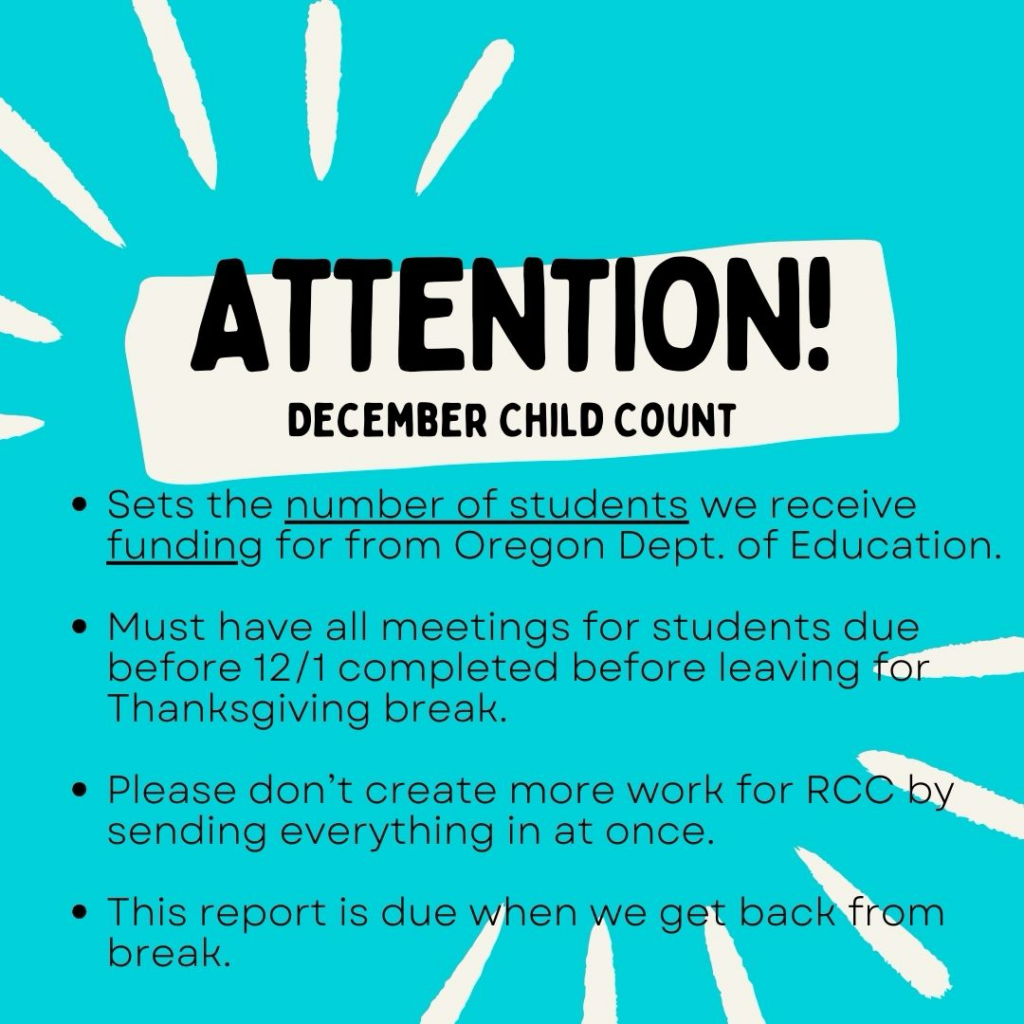
REMINDER FOR DECEMBER CHILD COUNT:
I hope this message finds you well. Thanksgiving Break is almost here. I want to express my gratitude for your continued dedication to our students and the Special Education process.
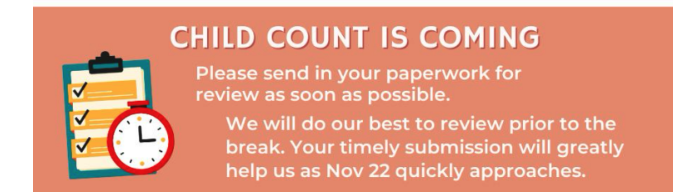
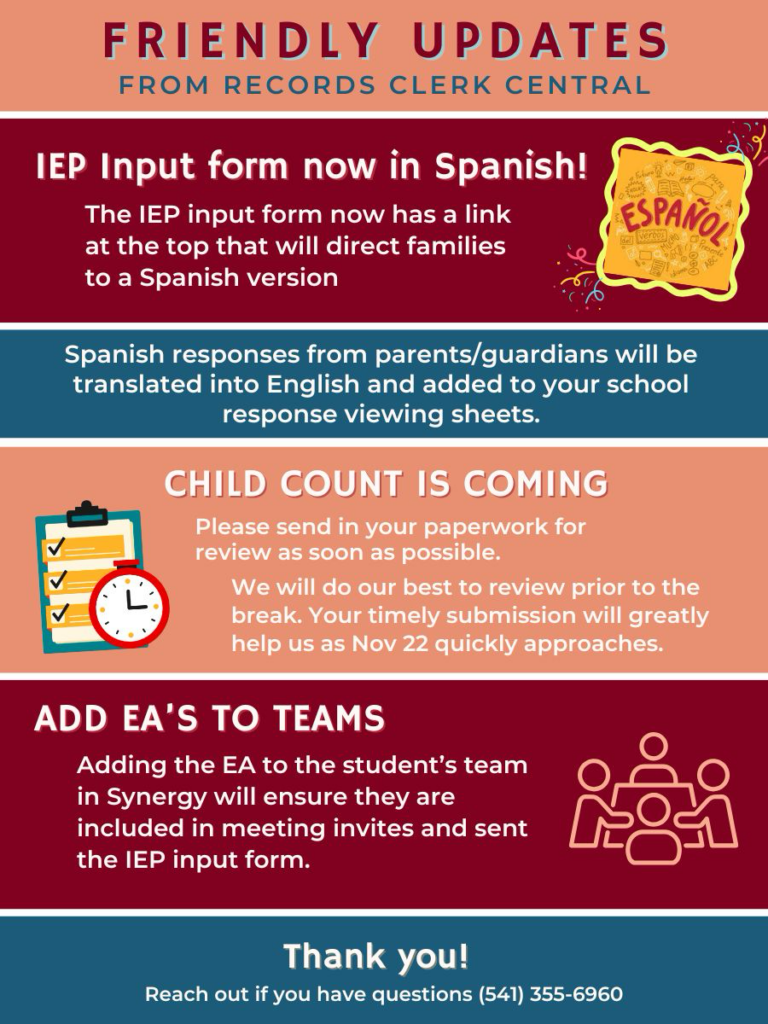
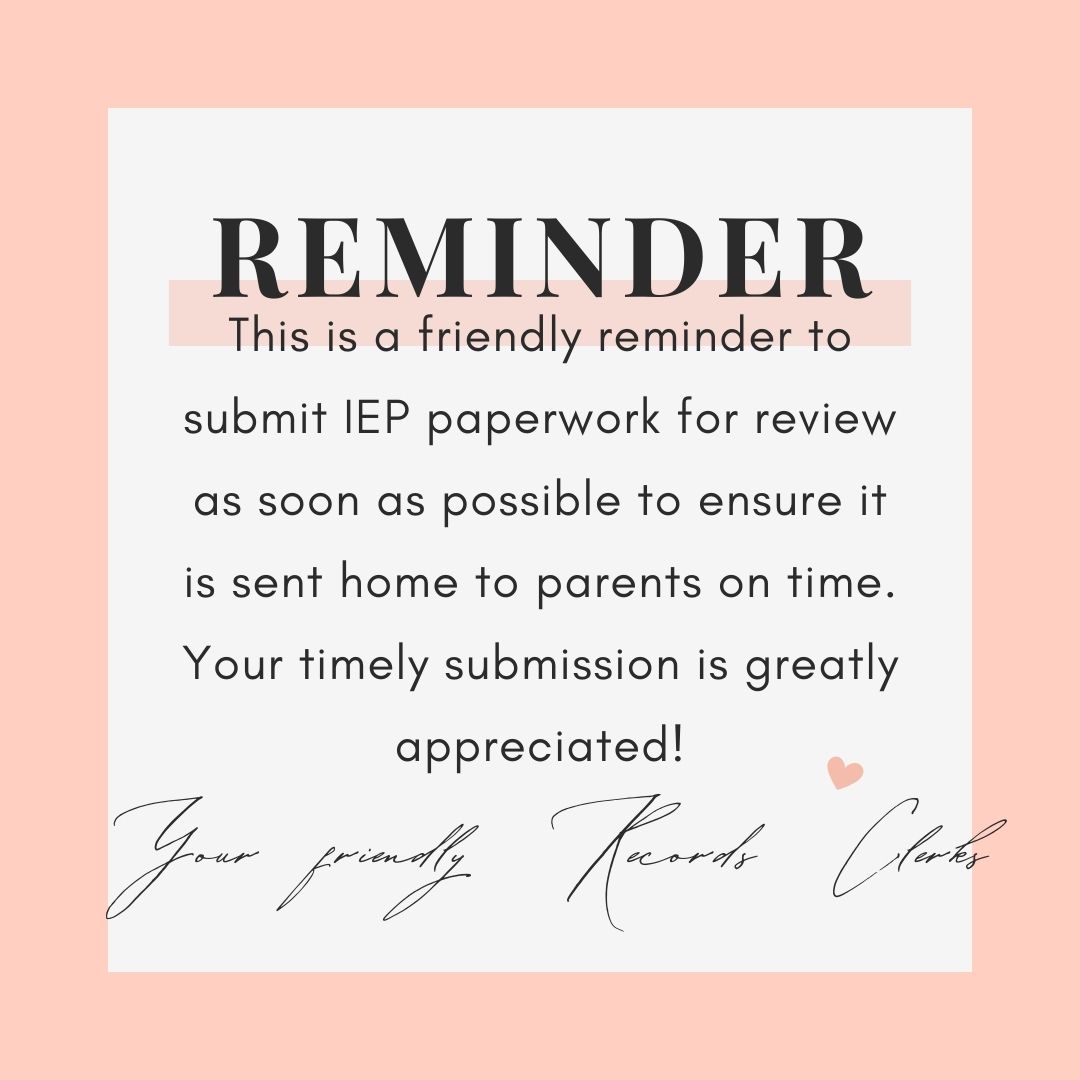
This is a friendly reminder to please send your validated paperwork to Records Clerks Central as soon as possible. It is essential that all paperwork for any meetings held before December 1st, REGARDLESS of the actual IEP or Reevaluation date, is completed, reviewed, and finalized before our Thanksgiving break on November 22nd.
As you know, December 1st is the Special Education Child Count date. We are required to provide the state with a list of every student enrolled and receiving Special Education services as of that date. This child count is part of the Oregon Department of Education’s requirements for all districts and is directly related to our special education funding.
Thank you for your attention to this matter and for your hard work in supporting our students.
SPECIAL EDUCATION INCLUSION QUESTIONS AND ANSWERS
BLS Special Education Inclusion Questions and Answers
Is Bend-La Pine Schools (BLS) a “Full Inclusion” District?
No, BLS is not a “Full Inclusion” District and the majority of our schools offer a full continuum of support from the general education setting to self-contained classrooms. In BLS, we support the inclusion of students with disabilities into the general education setting “to the extent that there is an educational benefit.” This determination is individualized through the IEP meeting process. The extent to which a student is included in the general education setting is discussed at every IEP meeting by looking at a student’s present level of performance, setting goals, determining the amount and type of specially designed instruction that the student needs to reach the goal, determining the location in which the specially designed instruction will occur, and then deciding the students “placement.” The IEP team (typically made up of a SPED teacher, gen ed teacher(s), related service providers, specialists, and a district representative) is tasked with determining the most appropriate educational placement in the least restrictive environment (LRE) that meets the student’s unique needs arising from their disability. The “non-participation justification” articulates why and how much time they are to be removed from the general education setting to receive their special education services.
Are we ONLY allowed to do “push-in” special education services?
No, BLS delivers special education services in a variety of settings and there is no edict stating that all services need to be “push-in”. As stated above, the majority of our schools provide a continuum of supports and settings from pushing into the general education classroom to self-containment in a separate classroom. Some students may access the general education classroom for certain parts of the day and be pulled out of the general education setting for part of the day. When and why a student is removed from the general education setting is an IEP team decision.
What is Specially Designed Instruction (SDI)?
SDI is a service, not a place. It involves instruction in which the content, methodology, or delivery of the instruction is individually adapted to address the student’s disability-related needs so the student can access, engage, and make progress in the general education curriculum and meet the standards and expectations that apply to all students of the same age or grade. This is
true irrespective of where the instruction is provided. SDI is instruction tailored to an individual student. SDI is provided to explicitly and systematically address a student’s area(s) of disability-related need and is always linked to one or more IEP goals. SDI may be provided to address any academic or functional skill need determined by the IEP team. SDI may be provided in any learning environment including school, home, community, or other setting
Legal Definition of Specially Designed Instruction (OAR 581-015-2000)
“Specially designed instruction” means adapting, as appropriate to the needs of an eligible child, the content, methodology, or delivery of instruction:
To address the unique needs of the child that result from the child’s disability; and
To ensure access of the child to the general curriculum, so that he or she can meet the educational standards that apply to all children.
Who can legally deliver SDI?
A Special Educator OR
A General Education Teacher or Instructional Assistant (EA) if a Special Educator is involved in the planning and progress monitoring of the instruction.
The case manager should keep records to document ongoing planning and progress monitoring for Specially Designed Instruction for all of the student’s goals.
What types of services count as SDI?
The Learning Specialist is responsible for planning, communicating, and delivering specially designed instruction (SDI) for students. If an EA or General Education teacher delivers SDI, the Special Educator must be involved in planning and reviewing student progress data.
SDI is more than accommodations used to support student access and engagement in instruction. Here are some examples below:
Reading, math, or other academic instruction and teacher-guided practice
● Language and communication skill building including sign language and braille instruction
● Instruction in targeted social and emotional learning skills
● Instruction in skills needed for independence and self-determination such as how to use social narratives, visual schedules, and self-regulation strategies
● Generalization training in natural environments
● Instruction in using accommodations or other supplementary aids and services such as:
○ Teaching student cues and reminders that will be used by teachers
○ Teaching a student how to effectively and independently use assistive technology
Do we have to follow the IEP as written?
Yes, the IEP is a written “contract” that outlines the goals, services, location of services, and types of accommodations and modifications. If any changes are necessary, the IEP can be revised through an IEP team meeting.
Does BLS have self-contained programs to serve students with challenging behaviors?
Yes, BLS has several programs designed to support this population. For K-5 students, BLS partners with the High Desert ESD to operate “The Nest,” a self-contained program for students facing significant social, emotional, and/or behavioral challenges. The Nest is a half-day program, allowing students to spend the other half of their day at their home school. There are eight slots available in both the morning and afternoon sessions. Students are placed in The Nest through the IEP team process, with input from a district representative.
For 6-12 students, BLS hosts a similar program called “Special Programs Secondary” (typically referred to as the Ed Center program). This program can serve 12 students in the AM and 12 students in the PM. This program is accessible via the IEP team process with consultation from an administrative district representative or for students who are expelled from their home school.
Further, as a district, we have the ability to support students with social, emotional, and behavioral challenges in all but 5 schools through the Student Success Intervention.
What training do we have for general education staff as it relates to serving students with disabilities?
This is an area that we would like to improve and we agree that more training for general education staff would be beneficial. That said, the student services department has provided training and aims to make progress in offering further training opportunities for general education teachers. Over the past several years, we have offered training in the areas of accommodations and modifications at the secondary level. When requested, this training has happened through general training or at a specific coaching level in a classroom setting. In education, time is one of our most valuable resources and we will continue to advocate for more opportunities to train general education staff. Additionally, we have purchased online learning opportunities through Hungerford Online. All certified special education staff and building admin have access to this training module and can be shared with all building staff. There are specific trainings directed toward general education staff, and if asked, we would be happy to help customize and facilitate training(s) for schools. The article below illustrates the need and desire for general educators to receive training on how to serve students with disabilities at the national level and could help facilitate further dialogue.
I’m unsure of how to utilize an Inclusion EA supporting students in my classroom. What should I do?
Inclusion EAs can provide SDI, modifications, and accommodations to students in the general education setting. They should enter the classroom having had direction and communication from their supervising Learning Specialist. If you have questions about how to utilize an Inclusion EA in your classroom contact their supervising Learning Specialist.
Why don’t we hire any more inclusion EAs?
The short answer is that all staffing decisions are made in the context of our budget and the variety of services that need to be delivered. Hiring more of one position means hiring less of another position. We believe we need to hire more of several different positions, including inclusion EAs. This year, due to the 4% across-the-board cut, we had to cut 5 inclusion EA positions. We can’t stress enough the importance of the inclusion EA role when it comes to serving our students with disabilities, particularly when it comes to providing inclusive and safe environments. We agree that more inclusion EAs are needed to fill out our staffing plans and we continue to seek more funding for these roles. We also see the need for more learning specialists and other positions so we can deliver services beyond simply maintaining safety. That said, we do have open positions that are posted to fill out staffing plans at schools and we continue to have hiring challenges for these positions.
Another important aspect of staffing inclusion EAs is ensuring there is a substitute available when an Inclusion EA is out. As of this draft, we have a posting up to hire 3 rover inclusion EAs to support schools that can’t get subs. We are also working through a project to understand the larger context of the Inclusion EA substitute shortage and seek a long-term solution, which may include running our own EA sub-pool.
Did you know that Magic School AI has a Text Leveler feature? You can copy and paste any text into the leveler and set the criteria by grade level. This is an easy way to modify text. Check it out!
REMINDERS FROM SHANNON WATERS
REMINDER:
REMINDER FOR DECEMBER CHILD COUNT:
I hope this message finds you well. Thanksgiving Break is almost here. I want to express my gratitude for your continued dedication to our students and the Special Education process.
This is a friendly reminder to please send your validated paperwork to Records Clerks Central as soon as possible. It is essential that all paperwork for any meetings held before December 1st, REGARDLESS of the actual IEP or Reevaluation date, is completed, reviewed, and finalized before our Thanksgiving break on November 22nd.
As you know, December 1st is the Special Education Child Count date. We are required to provide the state with a list of every student enrolled and receiving Special Education services as of that date. This child count is part of the Oregon Department of Education’s requirements for all districts and is directly related to our special education funding.
Thank you for your attention to this matter and for your hard work in supporting our students.
SPECIAL EDUCATION INCLUSION QUESTIONS AND ANSWERS
BLS Special Education Inclusion Questions and Answers
Is Bend-La Pine Schools (BLS) a “Full Inclusion” District?
No, BLS is not a “Full Inclusion” District and the majority of our schools offer a full continuum of support from the general education setting to self-contained classrooms. In BLS, we support the inclusion of students with disabilities into the general education setting “to the extent that there is an educational benefit.” This determination is individualized through the IEP meeting process. The extent to which a student is included in the general education setting is discussed at every IEP meeting by looking at a student’s present level of performance, setting goals, determining the amount and type of specially designed instruction that the student needs to reach the goal, determining the location in which the specially designed instruction will occur, and then deciding the students “placement.” The IEP team (typically made up of a SPED teacher, gen ed teacher(s), related service providers, specialists, and a district representative) is tasked with determining the most appropriate educational placement in the least restrictive environment (LRE) that meets the student’s unique needs arising from their disability. The “non-participation justification” articulates why and how much time they are to be removed from the general education setting to receive their special education services.
Are we ONLY allowed to do “push-in” special education services?
No, BLS delivers special education services in a variety of settings and there is no edict stating that all services need to be “push-in”. As stated above, the majority of our schools provide a continuum of supports and settings from pushing into the general education classroom to self-containment in a separate classroom. Some students may access the general education classroom for certain parts of the day and be pulled out of the general education setting for part of the day. When and why a student is removed from the general education setting is an IEP team decision.
What is Specially Designed Instruction (SDI)?
SDI is a service, not a place. It involves instruction in which the content, methodology, or delivery of the instruction is individually adapted to address the student’s disability-related needs so the student can access, engage, and make progress in the general education curriculum and meet the standards and expectations that apply to all students of the same age or grade. This is
true irrespective of where the instruction is provided. SDI is instruction tailored to an individual student. SDI is provided to explicitly and systematically address a student’s area(s) of disability-related need and is always linked to one or more IEP goals. SDI may be provided to address any academic or functional skill need determined by the IEP team. SDI may be provided in any learning environment including school, home, community, or other setting
Legal Definition of Specially Designed Instruction (OAR 581-015-2000)
“Specially designed instruction” means adapting, as appropriate to the needs of an eligible child, the content, methodology, or delivery of instruction:
To address the unique needs of the child that result from the child’s disability; and
To ensure access of the child to the general curriculum, so that he or she can meet the educational standards that apply to all children.
Who can legally deliver SDI?
A Special Educator OR
A General Education Teacher or Instructional Assistant (EA) if a Special Educator is involved in the planning and progress monitoring of the instruction.
The case manager should keep records to document ongoing planning and progress monitoring for Specially Designed Instruction for all of the student’s goals.
What types of services count as SDI?
The Learning Specialist is responsible for planning, communicating, and delivering specially designed instruction (SDI) for students. If an EA or General Education teacher delivers SDI, the Special Educator must be involved in planning and reviewing student progress data.
SDI is more than accommodations used to support student access and engagement in instruction. Here are some examples below:
Reading, math, or other academic instruction and teacher-guided practice
● Language and communication skill building including sign language and braille instruction
● Instruction in targeted social and emotional learning skills
● Instruction in skills needed for independence and self-determination such as how to use social narratives, visual schedules, and self-regulation strategies
● Generalization training in natural environments
● Instruction in using accommodations or other supplementary aids and services such as:
○ Teaching student cues and reminders that will be used by teachers
○ Teaching a student how to effectively and independently use assistive technology
Do we have to follow the IEP as written?
Yes, the IEP is a written “contract” that outlines the goals, services, location of services, and types of accommodations and modifications. If any changes are necessary, the IEP can be revised through an IEP team meeting.
Does BLS have self-contained programs to serve students with challenging behaviors?
Yes, BLS has several programs designed to support this population. For K-5 students, BLS partners with the High Desert ESD to operate “The Nest,” a self-contained program for students facing significant social, emotional, and/or behavioral challenges. The Nest is a half-day program, allowing students to spend the other half of their day at their home school. There are eight slots available in both the morning and afternoon sessions. Students are placed in The Nest through the IEP team process, with input from a district representative.
For 6-12 students, BLS hosts a similar program called “Special Programs Secondary” (typically referred to as the Ed Center program). This program can serve 12 students in the AM and 12 students in the PM. This program is accessible via the IEP team process with consultation from an administrative district representative or for students who are expelled from their home school.
Further, as a district, we have the ability to support students with social, emotional, and behavioral challenges in all but 5 schools through the Student Success Intervention.
What training do we have for general education staff as it relates to serving students with disabilities?
This is an area that we would like to improve and we agree that more training for general education staff would be beneficial. That said, the student services department has provided training and aims to make progress in offering further training opportunities for general education teachers. Over the past several years, we have offered training in the areas of accommodations and modifications at the secondary level. When requested, this training has happened through general training or at a specific coaching level in a classroom setting. In education, time is one of our most valuable resources and we will continue to advocate for more opportunities to train general education staff. Additionally, we have purchased online learning opportunities through Hungerford Online. All certified special education staff and building admin have access to this training module and can be shared with all building staff. There are specific trainings directed toward general education staff, and if asked, we would be happy to help customize and facilitate training(s) for schools. The article below illustrates the need and desire for general educators to receive training on how to serve students with disabilities at the national level and could help facilitate further dialogue.
I’m unsure of how to utilize an Inclusion EA supporting students in my classroom. What should I do?
Inclusion EAs can provide SDI, modifications, and accommodations to students in the general education setting. They should enter the classroom having had direction and communication from their supervising Learning Specialist. If you have questions about how to utilize an Inclusion EA in your classroom contact their supervising Learning Specialist.
Why don’t we hire any more inclusion EAs?
The short answer is that all staffing decisions are made in the context of our budget and the variety of services that need to be delivered. Hiring more of one position means hiring less of another position. We believe we need to hire more of several different positions, including inclusion EAs. This year, due to the 4% across-the-board cut, we had to cut 5 inclusion EA positions. We can’t stress enough the importance of the inclusion EA role when it comes to serving our students with disabilities, particularly when it comes to providing inclusive and safe environments. We agree that more inclusion EAs are needed to fill out our staffing plans and we continue to seek more funding for these roles. We also see the need for more learning specialists and other positions so we can deliver services beyond simply maintaining safety. That said, we do have open positions that are posted to fill out staffing plans at schools and we continue to have hiring challenges for these positions.
Another important aspect of staffing inclusion EAs is ensuring there is a substitute available when an Inclusion EA is out. As of this draft, we have a posting up to hire 3 rover inclusion EAs to support schools that can’t get subs. We are also working through a project to understand the larger context of the Inclusion EA substitute shortage and seek a long-term solution, which may include running our own EA sub-pool.
Did you know the district has bought Magic School AI for trialing purposes? You can sign in as an educator through the Google process using your district account. There are a variety of tools for IEP goal writing and accommodations. Check it out!
⅓ cup (80ml) pure pumpkin puree, blotted to reduce to ¼ cup (*see notes above in the EXPERT TIPS section)
1 ¼ cups (180g) all purpose flour
1 teaspoon pumpkin pie spice(or make your own – the recipe is in the article above)
½ teaspoon baking soda
heaped ¼ teaspoon salt
For rolling:
3 tablespoon (42g) granulated sugar
1 tsp teaspoon ground cinnamon
NOTE: for best results, use a kitchen scale to weigh the ingredients.
Instructions
First brown the butter. Follow the instructions in this post here to learn how to brown butter. It’s easy! Let the butter cool to room temperature. It should still be liquid, but it should not be hot.
Prepare the pumpkin puree. Spread ⅓ cup of canned pumpkin on a plate. Fold a paper towel in half and lightly press or blot the pumpkin puree with the folded paper towel to absorb the excess moisture. Repeat this step 2 more times so that you’ve used 3 paper towels. The pumpkin should be dry enough that it goes from being ⅓ cup down to ¼ cup. Measure the puree after you’ve blotted 3 times and if it is still too much, use one more paper towel to remove more water.
Combine cooled brown butter and brown sugar in a large bowl and stir to blend. It will look like clumpy wet sand. Add egg yolk, honey and vanilla and stir until it is smooth and glossy. Add dried pumpkin puree and stir to incorporate.
Add baking soda, salt and pumpkin pie spice to the wet ingredients and whisk to blend well. Add the flour and use a rubber spatula fold it in until just combined.
Cover the bowl and refrigerate for 30 minutes while you preheat the oven.
Mix together the sugar and cinnamon in a small bowl. Use a 1 ½-oz cookie scoop to portion mounds of dough and roll into smooth balls about 1 ½ inch diameter. If you don’t have a scoop, divide the dough into 12 equal balls. If the cookies are too small, they won’t spread enough.
Combine sugar and cinnamon in a small bowl and stir to blend evenly. Drop the dough balls into the cinnamon sugar mixture and roll them around to coat evenly. Place them onto the baking sheet, spaced about 3 inches apart from each other and flatten slightly with the palm of your hand.
Bake for 9-12 minutes or until the edges are browned and the centers looks puffed and slightly cracked. They will still be soft in the middle. Allow them to rest on the baking sheet for a 2 minutes, then transfer to a wire rack to finish cooling.
Did you know the district has bought Magic School AI for trialing purposes? You can sign in as an educator through the Google process using your district account. There are a variety of tools for IEP goal writing and accommodations. Check it out!
From the desk of Colleen Funderburg
Waiver, now what? If your school psychologist has recommended that you waive a reevaluation and you need guidance on what to do next, please refer to this one-page document for assistance.
Are you currently collaborating with the District Evaluation team? Please consult the attached document outlining the 10 steps involved in working with the team.