
Many of us have used the jigsaw method with students in our classroom, or during professional development. If you are like me, you’ve wondered if the jigsaw method really works to increase student learning. Here’s the good news. John Hattie’s Visible Learning meta-analysis reveals that the Jigsaw Method has an astounding effect size of 1.20…if done right! Remember, the larger the effect size the stronger the impact on student learning. The average effect size of Hattie’s research is 0.40, or one year’s growth. This means that jigsaw can accelerate learning 3 times faster than average.
Jigsaw Refresher
In this 6 minute video, Jennifer Gonzalez from Cult of Pedagogy describes ways to organize your Jigsaw groups. Although the video does not include this last step discussed by Douglas Fisher and Nancy Frey in the article from ACSD.org Show & Tell: A Video Column / Let’s Get Jigsaw Right, it give an excellent overview of how to set-up and troubleshoot a Jigsaw.
Adding the Final Step
Puzzle pieces on their own have no meaning. Each piece can hint at a bigger picture but until the individual pieces fit together, we can only infer the meaning of the whole picture. The same is true of the Jigsaw Method. Students often miss the bigger picture without a step in the process that includes reflecting on how their piece contributes to understanding the whole text.
According to Douglas Fisher and Nancy Frey, one problem with using the Jigsaw strategy is the chance that a student might teach misinformation to the rest of the group. If the “expert” student has misunderstandings about their section of the text, then they inadvertently teach it wrong to the rest of their own group, thus compromising the full understanding of the text. Misconceptions can be difficult to remedy.
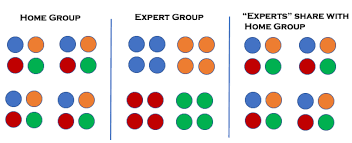
Some of the misunderstandings can be corrected if each group member meets with an” expert” group that reads the same section of text. With guiding questions, students are encouraged to work together to understand the text before returning to teach it to the rest of the group. If the teacher visits the “expert “groups while they are working, then correction can be caught early. This second step results in a much deeper understanding of the section of the text the expert learned about. The problem is that the “expert” does not necessarily understand how the section of text they learned about fits with the whole text. Fisher and Frey advocate for a third step when expert groups come back together a second time to discuss the question:
How does our part fit with what we have learned about the rest of the topic?
“The real learning power of this strategy lies in the critical third step, when students reconsider their assigned passage in light of the whole text…Students think about their thinking (metacognition) and synthesize and analyze ideas contained within the complete text. This process requires that students listen carefully to their peers and analyze the ways in which each part contributes to the entire text.”
Fisher and Frey
.
When students come back to their expert groups they must think about the connections, similarities and differences of their part to the newly learned content. As an example, each member of a home group receives a section of a data set about global temperature changes over time. Each member meets their expert group with the same data set for analysis and interpretation. When they return to their home group, each member shares their data set analysis with the group. The last step is for the group to determine the sequential order of all the data sets together through discussion with evidence and reasoning. Because of this last step, the student more deeply understands their own data set and whether their interpretation of a small set of data holds true when compared to the larger over-all picture.

Cooperative Learning Culture
The Jigsaw Method is a cooperative learning strategy created by Elliot Aronson in the early 1970’s as a way to break the racial tension in his classes after the desegregation of the schools in Texas. Aronson created a situation where the success of the group depended on the success of each student. Within a few weeks he saw a positive change in his class culture. The website Jigsaw Classroom.org has more about the history and success of cooperative learning as well as tips for implementation.
Suggestions for Success
- Discuss expectations for behaviors and outcomes with each transition from group to expert to group.
- Create a template or organizer for students to fill out while in the expert group. This ensures the same information is taken back to the group.
- For emergent bilinguals, annotate academic and figurative language to make it more accessible.
- Support discussions with guiding questions and sentence starters.
- Assign specific jobs for each member during the small group work: Discussion leader, Timekeeper, Team Captain, Materials Manager
- Add self-reflection time for students to monitor their contribution to the group and their understanding of the article content.
- Tell students they will return to expert groups to think about what they have learned in relation to what they taught.
Resources
- The Pedagogy in Action has tips for designing a successful Jigsaw at the high school
- Douglas Fisher and Nancy Frey’s article from Show & Tell: A Video Column / Let’s Get Jigsaw Right has a video of a high school class using the Jigsaw Method.
- Another excellent Cult of Pedagogy – 4 Things you Didn’t Know About the Jigsaw Method.