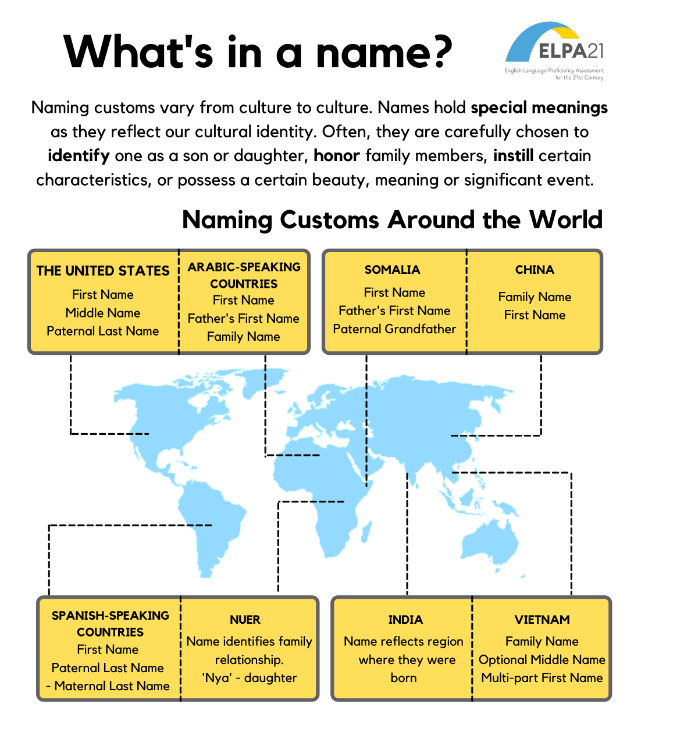
Learn how to pronounce and spell your students’ names correctly. When you learn how to pronounce your students’ names correctly you are doing two things; you are reaffirming their identities AND you are honoring and celebrating who they are. This is culturally responsive AND creates a sense of belonging. According to mynamemyidentity.org, by pronouncing names correctly you can build positive relationships in the classroom, which are crucial for healthy social, psychological and educational outcomes.
Greeting students at the door sets a positive tone and has been shown to increase engagement and reduce disruptive behaviors. In one study, when teachers started class by welcoming students at the door, academic engagement increased by 20 percentage points and disruptive behavior decreased by 9 percentage points. Why? Research shows that greeting students at the door bolsters a feeling of belonging and a readiness to learn. It’s also a great way to get to know your students and for language learners to practice their social skills in a safe and supportive way.
Looking for more support? Reach out to . . .
Liza Digiglio Huet
Secondary Instructional Coach
Office of Diversity, Equity & Inclusion – Multilingual Services
If you would like to add a shout out to a colleague, please do so here.
To Ron Crawford (BSHS)
“Ron is an excellent mentor. He goes above and beyond to help all colleagues and invest in this next generation of teachers. Thanks for always being there Ron and helping train up the next group of teachers. You inspire and you continue to grow yourself. Excellent example.” – Kathleen Glogau
To Amy Bruner (PBMS):
“Amy is our WEB leader, our Orchestra director, and is EXTREMELY good at organizing our student leaders in help our school community. She models patient and respectful behavior in ALL of her interactions.”
To Ben Jackson (LPMS):
“Way to remain calm, cool, and collected when talking with some of our most difficult students. You are very much appreciated!!”
To Spencer Wilson (LPMS):
“Way to be an outstanding 6th Grade Science teacher! You are a wonderful addition to our LPMS family and are doing a great job.”
To Summit High School English Teachers (SHS):
“I have twin boy/girl seniors this year! Together, they have taken many classes from Summit’s awesome English department. I want to thank that team for being amazing, and for meeting each student where they are. They took my son (“meh” reader/writer) and inspired him with books he loved, and he is arriving at being a college capable writer now, thanks to them. They also took my daughter (twin opposite!), a voracious reader and gifted writer, and helped her to hone those skills. One who didn’t say enough, now elaborates. One who said too much, can now trim down, and get to the point. This appreciation extends to the librarian, in the reading realm. Thank you all for helping my twins with lifelong learning.”
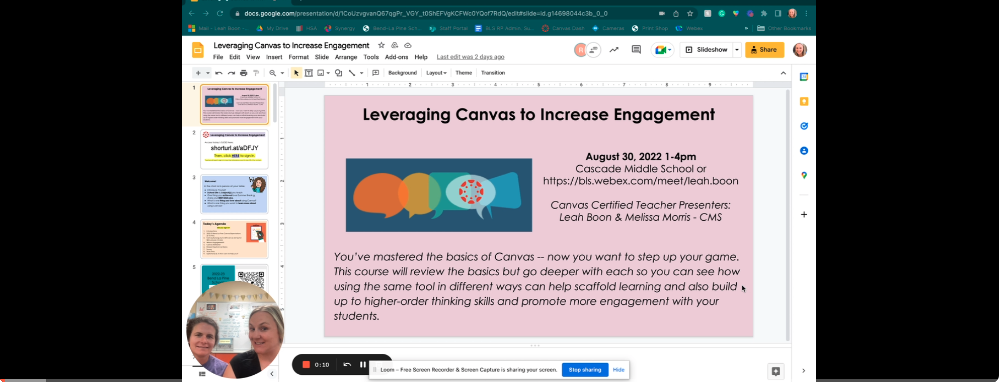
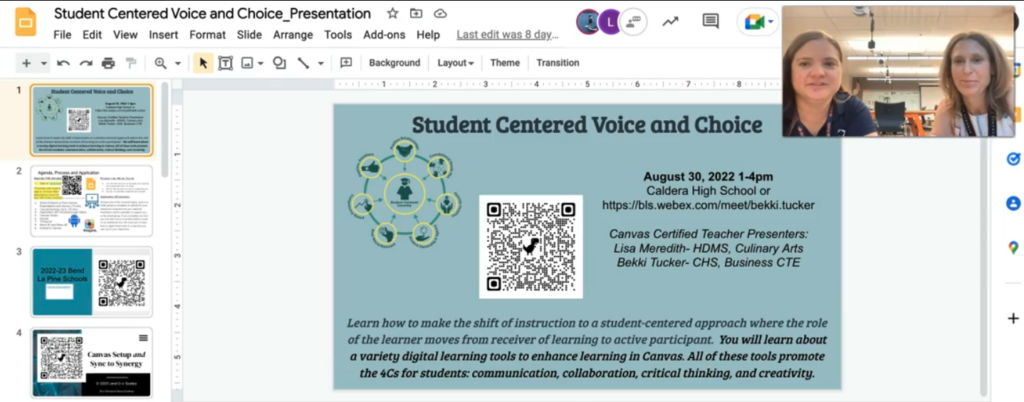
On August 30, you were provided a menu of options to increase your proficiency in Canvas. Attached are links to three of the trainings available. Each video is less than 30 minutes, and we hope you are able to take advantage of the opportunities for learning and reflection they provide.
You’ve mastered the basics of Canvas — now you want to step up your game. This course will review the basics but go deeper with each so you can see how using the same tool in different ways can help scaffold learning and also build up to higher-order thinking skills and promote more engagement with your students.
Learn how to make the shift of instruction to a student-centered approach where the role of the learner moves from receiver of learning to active participant. You will learn about a variety of digital learning tools to enhance learning in Canvas. All of these tools promote the 4Cs for students: communication, collaboration, critical thinking, and creativity.
Easy, readily applicable Canvas features you can use right now to make your classes more engaging and equitable, your grading easier and more accurate, and your life more fulfilling! (OK, at least a little less stressful?)
Where does Bend La Pine stand on teaching controversial subjects?
Are you covered?
One-in-four teachers reported being told by school officials to limit their speech about race or racism (Rand Corporation, 2022). The following post takes us through Bend La Pine’s commitment to critical thinking and protecting your work as a educator.
Why should I teach topics that are controversial subjects in my classroom?
Because I align my teaching to state and district standards.
Because I believe in teaching my students to think critically.
Because I am interested in and value the perspectives of all demographic groups.
All core subject areas have standards that address argumentation and critical thinking. Sample
Yes, if your material selection is in scope with the following Board policy on materials/resource selection in your classroom.
Additionally Bend La Pine has take this Equity Stance
Bend La Pine “…honors the different political beliefs, social values, and lived experiences our students, families, and staff bring to our classrooms and district. Our equity stance intentionally invites different values and viewpoints, as long as they do not promote racism, hate, or discrimination.”
LEAD Cohort Guidance
The LEAD cohort has developed a checklist that can help you prepare the climate and culture of your classroom for difficult conversations. No one, including our students, like to be brought into a difficult conversation that they are unprepared (cognitively or psychologically) to be discussing. Each of us bring our unique and personal experience to the classroom. Each experience has value that has led us to hold our values. This Preparation Checklist can help to honor everyone’s voice.
As learners, we have all had that feeling of cramming something into our head for the purpose of regurgitation on an exam. We had to learn it because the know-it-all teacher says that we do. Our only option for how to show our knowledge is on the test on that one day, that one time. This is the opposite of student agency. Student agency is the way that students feel that their learning is something that they own. Student Agency provides connection, relevancy, control and self awareness of what is being taught.
Like all pedagogy, student agency comes down to specific moves that teachers make to increase the engagement and ownership that students have with their content.
Strategies That Can Increase Student Agency
Knowing Strengths as a Learner
The old adage of “Know thyself” is the first step of agency. Do they know when they are confused? Do they know what help can look like? Do they know how to best get help when they don’t know what they know they need to know? When a student engages in self assessment and metacognition, there is an awareness of how learning occurs and next steps to be taken. Once the awareness of their “stuckness” is in place they can find ways to move through it.
Posing “Ungoogleable” Questions
Many of you begin a class, lesson or unit with an essential question. This strategy can increase engagement and purpose in the lessons in which students engage. These invitations to learning bring students in by bringing their voice to the solutions.
Flexibility in Showing What You Know
There are times and standards that fit well with giving students flexibility in displaying knowledge. With options in the artifacts of learning, students must make choices in showing how they demonstrate what they know. Allowing students to have a strength based approach to their own learning makes school more meaningful.
Self Assessment
When students engage in a self assessment prior to teacher assessment they must engage in reflection. Holding assignments, projects and assessments up to a mirror before handing them over to the teacher makes them reflect on the criteria for success one last time (we hope that they are also thinking about the criteria as they work!) Focusing students back to the criteria also leads to better peer assessment.
Exit Ticket on Process
One of my favorite generic exit tickets was 3 questions (ungraded)
What did we learn today?
What was easy?
What can I do differently to help you with the things that were difficult?
These three questions gave me a lot of information about how students were digesting the lessons and gave me insights into their thinking. I would begin the next day by sharing a few of the “what we learned” to anchor us in the new learning. I also acknowledged the new moves that I would take to bring everyone to the same place. It gave the students control over how I provided instruction that led to learning. This is the definition of agency!
Many of us have used the jigsaw method with students in our classroom, or during professional development. If you are like me, you’ve wondered if the jigsaw method really works to increase student learning. Here’s the good news. John Hattie’s Visible Learning meta-analysis reveals that the Jigsaw Method has an astounding effect size of 1.20…if done right! Remember, the larger the effect size the stronger the impact on student learning. The average effect size of Hattie’s research is 0.40, or one year’s growth. This means that jigsaw can accelerate learning 3 times faster than average.
Jigsaw Refresher
In this 6 minute video, Jennifer Gonzalez from Cult of Pedagogy describes ways to organize your Jigsaw groups. Although the video does not include this last step discussed by Douglas Fisher and Nancy Frey in the article from ACSD.org Show & Tell: A Video Column / Let’s Get Jigsaw Right, it give an excellent overview of how to set-up and troubleshoot a Jigsaw.
Adding the Final Step
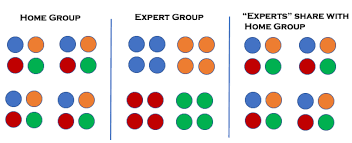
Puzzle pieces on their own have no meaning. Each piece can hint at a bigger picture but until the individual pieces fit together, we can only infer the meaning of the whole picture. The same is true of the Jigsaw Method. Students often miss the bigger picture without a step in the process that includes reflecting on how their piece contributes to understanding the whole text.
According to Douglas Fisher and Nancy Frey, one problem with using the Jigsaw strategy is the chance that a student might teach misinformation to the rest of the group. If the “expert” student has misunderstandings about their section of the text, then they inadvertently teach it wrong to the rest of their own group, thus compromising the full understanding of the text. Misconceptions can be difficult to remedy.
Some of the misunderstandings can be corrected if each group member meets with an” expert” group that reads the same section of text. With guiding questions, students are encouraged to work together to understand the text before returning to teach it to the rest of the group. If the teacher visits the “expert “groups while they are working, then correction can be caught early. This second step results in a much deeper understanding of the section of the text the expert learned about. The problem is that the “expert” does not necessarily understand how the section of text they learned about fits with the whole text. Fisher and Frey advocate for a third step when expert groups come back together a second time to discuss the question:
How does our part fit with what we have learned about the rest of the topic?
“The real learning power of this strategy lies in the critical third step, when students reconsider their assigned passage in light of the whole text…Students think about their thinking (metacognition) and synthesize and analyze ideas contained within the complete text. This process requires that students listen carefully to their peers and analyze the ways in which each part contributes to the entire text.”
Fisher and Frey
.
When students come back to their expert groups they must think about the connections, similarities and differences of their part to the newly learned content. As an example, each member of a home group receives a section of a data set about global temperature changes over time. Each member meets their expert group with the same data set for analysis and interpretation. When they return to their home group, each member shares their data set analysis with the group. The last step is for the group to determine the sequential order of all the data sets together through discussion with evidence and reasoning. Because of this last step, the student more deeply understands their own data set and whether their interpretation of a small set of data holds true when compared to the larger over-all picture.
Cooperative Learning Culture
The Jigsaw Method is a cooperative learning strategy created by Elliot Aronson in the early 1970’s as a way to break the racial tension in his classes after the desegregation of the schools in Texas. Aronson created a situation where the success of the group depended on the success of each student. Within a few weeks he saw a positive change in his class culture. The website Jigsaw Classroom.orghas more about the history and success of cooperative learning as well as tips for implementation.
Suggestions for Success
Discuss expectations for behaviors and outcomes with each transition from group to expert to group.
Create a template or organizer for students to fill out while in the expert group. This ensures the same information is taken back to the group.
For emergent bilinguals, annotateacademic and figurative language to make it more accessible.
Support discussions with guiding questions and sentence starters.
Assign specific jobs for each member during the small group work: Discussion leader, Timekeeper, Team Captain, Materials Manager
Add self-reflection time for students to monitor their contribution to the group and their understanding of the article content.
Tell students they will return to expert groups to think about what they have learned in relation to what they taught.
Resources
The Pedagogy in Action has tips for designing a successful Jigsaw at the high school
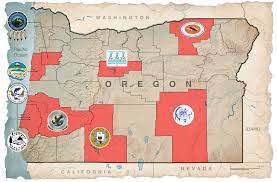
In 2017 SB13, Tribal History, Shared History was adopted into law. This act brings the Native Oregonian history and experience, through the lens of the nine federally recognized tribes, into the forefront of Oregon Schools.
The Department of Education has created a website that has lesson plans across several disciplines including Language Arts, Math, Social Studies, Science and Health in 8th grade and 10th grade.
This is an 8-minute video on the boarding school experience. There will also be corresponding curriculum written for 11th grade students that can be found at the Klamath Tribes website as well as Oregon Department of Education website.
This is a 5-minute video on the Termination and Restoration of the Klamath Tribes. There will also be corresponding curriculum written for 6th grade students that can be found at the Klamath Tribes website as well as Oregon Department of Education website.
OPB did a great show on the native people of Oregon on the show Oregon Experience, Broken Treaties, An Oregon Experience. It is an almost an hour long and rated G. Here is the summary:
Hundreds of books exist about the Lewis and Clark expedition and the decades of pioneers who followed them West. But even today, most Oregonians don’t know much about the people who had settled here centuries before “the settlers” came. “Broken Treaties” introduces viewers to the tribes of our state and explores a thread of the Oregon story that hasn’t been told very well over the years.
Teaching about Tribal History is not just a Social Studies thing! Here is a link about teaching STEM with Indigenous People in mind.
When thinking about the important pieces of our shared history, Leilani Sabzalian (Assistant Professor, Indigenous Studies in Education, University of Oregon) shares about the 6 P’s to keep in mind here.
This is a guest post by Tara Butler, Mathematics teacher at Cascade Middle School and finalist for the Oregon Presidential Award for Excellence in Mathematics and Science Teaching in 2021.
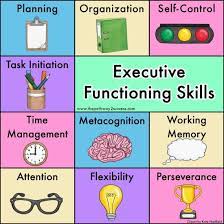
“Executive function is a set of mental skills that include working memory, flexible thinking, and self-control. We use these skills every day to learn, work, and manage daily life. Trouble with executive function can make it hard to focus, follow directions, and handle emotions, among other things.”
In addition to teaching middle school students math, I see my life’s work as the opportunity to develop problem solving, critical thinking, communication, creativity, and collaboration through the vehicle of mathematics. This charge also includes intentionally building Executive Function skills. We want to prepare students not just for our subject area but for every facet of their lives.
I’ve thought about the vitality to bring awareness to and to develop Executive Function skills in students, especially with the challenges the last year and a half has thrown their way. I came across this article in Edutopia by Sarah Kesty, “Supporting Executive Function Skills by Asking Questions.” I was inspired to deliver research based practices for my students to apply rather than my good faith efforts that weren’t giving each student what they deserve.
Following is a summary of what I uncovered:
Ask genuine questions rather than giving directives.
We don’t want students guessing what they are to be doing but if directions have been given and/or the expectations have been made clear, we can ask a question to jog their memory about their next best step. This relays high expectations and shows students we believe in their ability to solve problems and be self-sufficient.
Coach students to be their own coach.
For example, in solving a challenging math problem they can ask themselves:
It can seem easy or time saving in the moment to answer a student’s question or tell them how to do something rather than the long game of teaching them to turn to themselves first as a resource.
How is this structure similar to a simpler problem?
How can I draw this visually?
How can I look at this problem another way?
I will give myself time to think about this problem before asking for help.
Equip students with a set of general questions they can utilize in any situation*
What do you notice?
What parts do you understand?
What do you think you might need right now?
How can you tell?
Where could you look for that information?
How will you remember to use that strategy or take that action?
When we’re tired, overwhelmed, or stuck; what an honor for us to step back, put the content on the back burner for a moment, and remember that we play a critical role in shaping human lives.
Many teachers use some version of points in their grading system. Points may be given for assignments and assessments, extra credit, behavior, participation, and/or motivation. Most of us probably had teachers who used points in the classrooms we grew up in.
The downside to using points is that they can turn into a commodity that students use to get a grade, rather than an accurate representation of a student’s knowledge. Students may ask how to earn a few more points to get from an 87% to a 90%, but none would ask for those three points to move from an 84% to 87%. However, as long as the point increase is accompanied by an increase in learning, shouldn’t all increases be considered valuable?
Redos and Retakes
All of us have taught a lesson that did not go the way we’d hoped, only to get to try again the next period or the next day. What if our students stopped us and said, “Sorry, you can’t teach that to us again, you taught it yesterday!”
It is true that the world has timelines, but it also gives grace for learning. The ability to redo something happens all the time in our students’ lives. (Retaking a driving test is perhaps the most important retake our students will have in their adolescence! When our children don’t do a good enough job cleaning their room we don’t say “You got one chance to clean it!” We say, “Go back and do it until it is done correctly.” They – and us – get redos every day, when the first effort wasn’t successful.
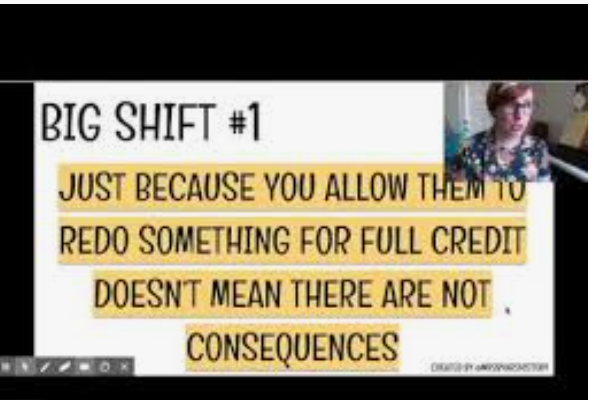
If the goal of a class is to impart knowledge to a student, then when the student demonstrates that knowledge must be flexible. The ability for students to try again to show their understanding of the content taught shows we value their learning, more than our timeline. Furthermore, if the students can represent full knowledge of course standards, they should earn 100% of the points available. Removing an artificial celling (i.e., student can only earn 80% of the original total may reward a student for persisting, but it also punishes them for not learning as fast as others. Why do we want to do that?
Retakes and redos as mandatory practices in classrooms provide an equal opportunity to all students to show what they have come to understand as a result of our instruction and purposeful tasks in the classroom. If a student has a history of low success in school, providing multiple opportunities to be successful breaks a cycle of low achievement. It tells the student the game is not won at halftime, but at the end – and that adjustments can be made along the way. We also send the message to the students “I will not let you fail!” We continue to push the students to learn the critical information that we have determined is worthy of their time and effort.
8:33
Extra Credit Points
By definition, extra credit points are not required. This means that is some extreme cases, the points may not even be related to the standards being taught in the course (extra points for bringing in supplies or cleaning the board.) Extra credit exacerbates school as a game. If the purpose is for your students to know and understand a set of standards and content, then providing extra credit does not move a student toward more knowledge, it makes a grade currency that some students look to collect.
Extra credit can also undermine the desired outcomes of student learning. Students who play the point chasing game can give less effort to important key learning only to “make up” points with less critical knowledge. If the extra credit points are tied tightly to the learning of the course, then shouldn’t they be available to all students, not just those who have the knowledge of how to navigate the educational system. If the work is important, require it; if it is not, don’t include it in the grade.
Q: Doug, when and how did you become interested in exploring inequities in grading practices?
During my teaching career, I was aware that different teachers had had wildly different grading policies. It was unfair that students – for the same performance – could get different grades.
Even though I had read the research, when I started doing the research, it became deeply alarming. The seminal piece of research was when I would take the same set of student scores, and I’d ask teachers what’s the difference between who gets A’s and B’s and who gets D’s and F’s: they would tell me work ethic, or work completion, or parental support, or intelligence – but it wasn’t any of those things. The distinguishing element was the grading scale the teacher used, which is the very definition of inequitable and unfair practices.
Q: Can you tell us about one of your biggest ah-ha equity moments?
When I was teaching, a lot of my students were new arrivals to the country. When a child entered the class halfway through the semester, and they didn’t have a cumulative folder under their arm, we would accept them as they were and proceed from there. But if another child with the same achievement profile had been with me the entire semester, that child would get systematically punished whereas the new arrival would get rewarded with a clean grade slate.
Q: Equity in education is such a frequent topic these days. What was the watershed moment for turning our attention towards equity?
I don’t think we’ve had it yet – we still have a deeply inequitable system. I’m from Topeka, Kansas, the home of Brown vs. Board of Education. People think everything must have gotten better after the case when, actually, things got worse. My father knew people involved on both sides and a number of schools serving African American students were not only shut down – some staying that way for an entire year – but, as many as 40% of African American teachers and administrators lost their jobs. Consequently, we know their descendents are under-represented in the teacher leadership pool. It’s not unusual for people who look like me to have two or three generations of teachers in the family, but when your memory is that your grandmother or grandfather, or maybe even a parent, was laid off in 1954 after Brown v. Board of Education, that doesn’t leave a very good taste in your mouth. I don’t think we’ve had a watershed moment yet – we’re still working towards equity, not very wisely in some cases.
Q: What do you think prevents us from having the watershed moment?
Deeply entrenched attachment to the bell curve of blue birds, robins, and blackbirds, specifically the people who are served very, very well by the present system. The people who most fight grading reform are not teachers – I think that’s an unfair reputation – but are privileged parents of privileged kids who see more kids qualifying for scholarships and more kids qualifying for college admission, and they don’t like that competition. I see that all over the United States.
Q: What are two key teaching moves you would love to see happen in every classroom in America?
#1: calling on students rather than asking students to raise their hands. The rule should be you raise your hand to ask a question, not to answer a question. Relying on raised hands to answer questions is a mark of grave inequity. Some people call this move ‘cold calling,’ but I would just call it good and fair engagement. You can do it with a smile, you don’t have to humiliate or embarrass anybody – there’s always time to phone a friend, give a student a minute of think time, or ask for a partial answer. What’s not okay is to have kids who are checked out, and kids check out when they know you’re not going to call on them. So #1 is calling on students fairly. #2 is evaluating students based on how they finish the semester, not the average.
If I could just pick two, those two things would be solid moves towards classroom equity.
Q: Let’s talk a little more about getting rid of the average. What are the steps a teacher would take?
The first topic I want to be clear about: I’m not saying to leave the gradebook blank – have all that practice in there, have the evidence in there. It’s all worth knowing and communicating. Oregon was an early adopter state, and has had standards for twenty year, and the essence of standards is that they are evaluated and then the grade gets rewarded.
You don’t assign a grade for the average achievement between the beginning and end of the standard. It’s just a fundamental principle of accuracy: if I am going to grade someone accurately, I grade them based on how they perform against the standard.
Think of it like this: we’re coming up on track season. If at the state track championship, a kid is wins and the race, but we take away his medal because he had some bad times back in February, that’s ludicrous.
If that student is proficient in May, yet we continue to grade them down for the mistakes they made earlier in the year, that’s inequitable.
The typical journey of a student is to struggle and struggle and then have a breakthrough. The breakthrough is that learning typically happens because of content or feedback delivered by the teacher. If we really believe in resilience and perseverance, if we really believe in social-emotional learning, then we ought to be rewarding the breakthrough. When we use the average, we say breakthrough doesn’t matter and resilience doesn’t matter, because I’m still going to punish you for what you did 2-3 months ago.
Q: We have been coached that can not evaluate according to standards unless we set it up appropriately in the system, and we can’t set it up in the system until we are trained how to do that. How do you respond to that?
In every grading system I know, teachers have the ability to override the algorithm that generates the automatic grade and enter their own evaluation on the final grade. In most systems, we’re talking about nothing more than disabling the average function. I think it’s good if teachers have a fundamental understanding of why the average is bad, and why the hundred-point scale is bad, but that doesn’t really require extensive training.
Q: So, you are arguing that teachers should have the gradebook as a piece of information but then, at grading time, enter their own evaluations?
That is exactly what I’m saying. It’s how you finish the race that counts.
Q: And then, for concerned parents, how do they defend those choices?
When you encounter those privileged parents that want to talk about someone else’s grade: how could that child earn the same grade as mine? Or when those same parents reach out to your administrator, the two of you have to be unified in your response: “Mrs. Jones, I’m not going to talk to you about anyone else’s grade besides your own. Number one: that’s unethical. And number two: we’re a standards-based district in a standards-based state.”
So you don’t need to defend how you grade someone else’s kid, you only need to defend how you grade that parent’s kid. And to the extent there is a hint of imperfection, those parents almost always find it to their advantage that you take into account how your child finished instead of letting the grade be held back by some of the challenges along the way.
Q: What are some of the pedagogical lessons you have learned from Covid-based education you hope to see brought forward to in-person classrooms?
The biggest lesson is relationships, relationships, relationships. Some of the best practices I saw during remote learning were teachers leaving their houses and going to find their students. Of course, they couldn’t do home visits, but they could do sidewalk visits or window visits. Some teachers used the telephone. The teachers that did that had the greatest impact. I saw schools that had 50% attendance rates in the fall of 2020, get up over 90% attendance with the same kids and the same parents. It was all about the human connection.
We also learned there is no way that technology can teach a six-year-old how to read. The promises of technology have always been overblown. All you have to do is look in the faces of students and teachers who came back in March and April for the first time in a year, and you saw what human connection can do. And not just in the classroom. In extracurricular activities, in play, in all of these other things that are the reason kids come to school…those are the social connections, and those are the things that really matter.
Finally, the lesson we should have learned, but I don’t think we really have is that not every standard is equal. This nonsense that says we’ll make up for lost time, by talking really fast and trying to frantically cover every standard. All you have time for is content exposure and there is zero evidence that says exposure leads to learning.
At the secondary level, schools are following one of two paths: path #1: in the fall of 2021, they are going to have the same schedule, the same time allocation they had in the fall of 2019. They are essentially saying: We learned nothing. I can not push strongly enough against someone who thinks we can have the same schedule in the future as we’ve had in the past.
Path #2: some schools are building interventions into their daily schedules. They are not afraid to identify the issues and recognize what we already know: if you don’t build interventions into the day – if you hold them after school, on Saturdays, or during the summer, the kids that need those interventions most, won’t come. There are schools who are building an hour, or two, or whatever is necessary, of content-area support into the daily schedule.
Let’s face it. We have students who are behind. But we had students who were behind before Covid – now they’re even more behind. Obviously, there was a large learning loss experienced by all but the most privileged students. The one question is: what are we going to do about it?
Dr. Douglas Reeves is the author of more than 40 books and 100 articles on education and leadership. Twice named to the Harvard University Distinguished Authors Series, Doug has shared his research in 50 states and more than 40 countries. He can be reached @DouglasReeves or at [email protected].
Would you like to learn more about these important topics? Here are some resources Doug recommends.
Here is the professional organization led by Dr. Reeves. In it you will find articles, research, videos and more. https://www.creativeleadership.net.
Q: Steve, what are 1-2 practices you would like to see embedded in every Bend-La Pine classroom?
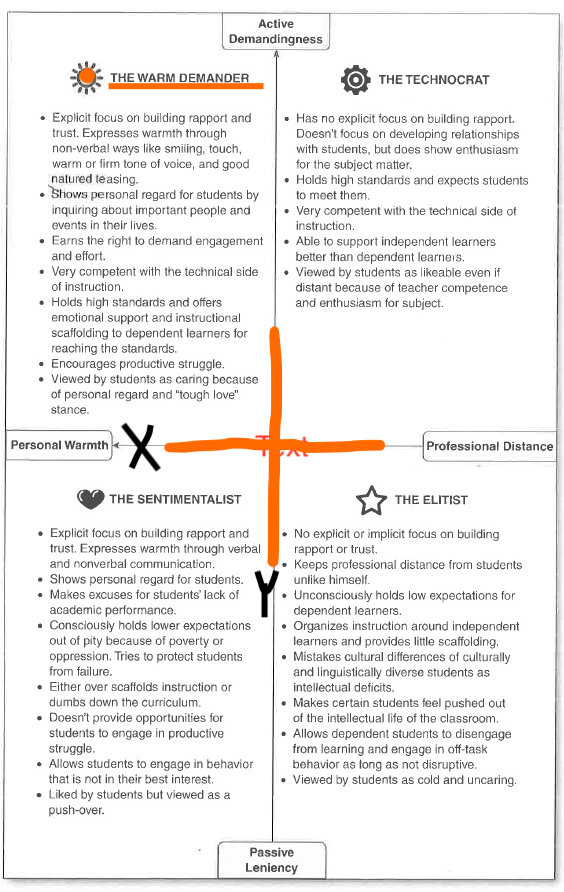
I would like to see a “Culture of Warm Demand” in every classroom – this is Zaretta Hammond’s work. Her approach is applicable in every classroom.
She has a graph that illustrates this concept: on the X-axis, is expectations; on the Y-axis, relationships (see below). And you want to have a classroom that has both high relationships and high expectations – those are the most effective classrooms.
When you’re holding kids to high expectations, you set a standard for them that you won’t accept anything less from them than their very best. But you also commit to pouring everything you have as an educator into that student as an individual person. It is because of that anchor in great relationship that you are able to ask for great things.
If you have that high expectations without that relationship, then you’re a drill sergeant. If you have the relationships without the high expectations, then you wind up creating a culture of low expectations that can wind up being bigoted. You lose kids in those scenarios.
Just loving kids is not enough. That’s the difference: we want to love them, but we also need to hold them to such high expectations, they activate their potential.
And if nothing more, you have to make the commitment: I’m going to get to know you and I’m going to care about you. If kids are struggling, that has something that may have to do with the state their world is in right now. Recognizing that for what it is and not taking it personally as an educator, is an important step. I have to decide that I am going to care about each student in all circumstances, and never give up on those expectations. That’s how you transform lives.
To me, that’s the starting place. You don’t have to know specific strategies, you don’t have to read tons of books – the starting place is the relationships. We’ve all had students triggers us emotionally, and we’ve all triggered students. We have to be able to go back to that situation and see it for what it is, and then figure out how we can talk about it, how we can get through it so our relationship can still be established and move on. When I hold a student to high expectations, it can not be oppressive, but must still be based in the care I have for you as a human being.
Q: Can you tell us a little more about the concept of bigotry? If both aspects of the Culture of Warm Demand are not in place, how does the relationship begin to possess the characteristics of bigotry?
If you have high expectations and no relationships, Hammond describes you as a technocrat. We’ve all had teachers who demand and demand and demand. But they don’t reach out or try to connect with me. I had a biology teacher during my sophomore year of high school that never ever – in 180 days of school – learned my name. The feeling you get when someone doesn’t even know who you are – your name, let alone any details about your life – is one that communicates both parties are not equally valued in this system. If we aren’t both equally valued, then the power imbalance is one of oppression.
Take it the other direction – if you have this culture that you’re just going to love kids and be emotionally available to them, and be supportive, then you’re only attending to the relationships and there are not high expectations. Those students are being oppressed similarly – they aren’t achieving the potential they could. And you’re creating an environment in which students may not know those opportunities exist for them. If you don’t push them towards opportunities, that is its own version of bigotry. It’s a balancing act on both ends of the spectrum.
How do I have high expectations AND strong relationships? That’s what we always have to ask ourselves with each individual student in our care.
Q: These concepts are obviously very important to you. How have they played out in your own life?
With my children, I had to take a very different disciplinary approach with one son versus the other. It was a delicate walk and, to nurture the relationship, I had to approach one on an adult level, with adult language. If I did that with my other son, he would have been confused and wondered what I was doing. That goes back to the platinum rule – I had to know and interact with my sons in different ways because they had different personalities; they were different people. I was more effective if I treated them how they wanted to be treated.
In another example, I know that bigotry can come from a lack of engagement opportunities, or during instruction. One of the most offensive things I ever said to a student was a glib, sexist remark that she had the courage to call me out on later. I had never thought about the moment through that lens, but for me to do anything but be respectful, and apologize, and own it would have meant I failed. She stepped up to her challenge – she came to me and told me I hurt her feelings and gave me the opportunity to grow from it. My challenge was to be respectful and accepting, and honor her courage.
Q: We’ve talked a lot about relationships and expectations. Let’s think about the larger educational systems in place that support or prevent those outcomes. What are the most important components of an educational system that is able to identify and act on inequities within?
Just this morning, I was in two elementary schools and we were talking about Covid and how it has exacerbated so many of the systemic moves that inhibit a student’s ability to succeed.
Think about this interview environment between me and you – I’m in a closed space with just my laptop; nobody is interrupting me, and we have the opportunity to fully engage with each other.
But then we think about some of the environments our students are learning in. When we quarantine kids and send them home, or we’re in remote learning, what about those kids that have a lot of noise and interruption? Or what about those kids that don’t have anybody at home able to engage with them? What happens to those kids and how do we as a system start to recognize how our system perpetuates those inequities. How do we set up our system so kids can be just as successful in their own environments as in ours?
I think about the research on reading scores, conducted when essentially the entire country was remote. Some of our most affluent students actually scored better than if they would have been in school. It was actually beneficial for them to be in lockdown because their growth rate was higher. Now compare that to some of our highest poverty students who lost so much ground during that time – their test scores regressed 1-2 grade levels. How are we going to look at our systems during and after Covid to address those disparities?
Covid has shown us there is no more important time in the history of education to start looking at the moves we make so that no student is left behind, regardless of any circumstances about who they are racially, culturally, socio-economically, or what gender they identify with – none of it should matter. We’re starting to peel back these layers and say, “We’ve got to do better.”
I think this is going to be a transformational time for us. We’ve got to start fixing some of these systems. It’s an exciting time for us and will continue to be so as long as we strive to take advantage of the opportunities here.
Q: We’re already seeing systemic responses that run counter to that thinking. There is so much energy around wanting a schedule that enables teachers to serve students better, but the schedule has already been built for next year and there’s a lot of reluctance to change that.
The system of public education is built within hundreds of years of inertia. A whole lot of people look at us and wonder why we want to change anything at all – they say, “Look at me. I turned out just fine.”
Within the last year, so many districts have had to change so many things so many times. But Covid forced our hand. We’ve proven that we can change quickly. Our biggest challenge is to elevate the reasons why we should change to the same sense of urgency as Covid gave us.
That’s the real question and that’s what we’re going to have to keep demanding of ourselves. I know how I should eat. I know exactly how l should eat. But I don’t always choose to do that. And I’ve only been trying to make consistently better choices for half as long as the public education system has existed.
We can’t let this opportunity get away. This is the biggest chance we’ve had in the recent history of public education to profoundly change the environments our kids experience every day.