As learners, we have all had that feeling of cramming something into our head for the purpose of regurgitation on an exam. We had to learn it because the know-it-all teacher says that we do. Our only option for how to show our knowledge is on the test on that one day, that one time. This is the opposite of student agency. Student agency is the way that students feel that their learning is something that they own. Student Agency provides connection, relevancy, control and self awareness of what is being taught.
Like all pedagogy, student agency comes down to specific moves that teachers make to increase the engagement and ownership that students have with their content.
Strategies That Can Increase Student Agency
Knowing Strengths as a Learner
The old adage of “Know thyself” is the first step of agency. Do they know when they are confused? Do they know what help can look like? Do they know how to best get help when they don’t know what they know they need to know? When a student engages in self assessment and metacognition, there is an awareness of how learning occurs and next steps to be taken. Once the awareness of their “stuckness” is in place they can find ways to move through it.
Posing “Ungoogleable” Questions
Many of you begin a class, lesson or unit with an essential question. This strategy can increase engagement and purpose in the lessons in which students engage. These invitations to learning bring students in by bringing their voice to the solutions.
Flexibility in Showing What You Know
There are times and standards that fit well with giving students flexibility in displaying knowledge. With options in the artifacts of learning, students must make choices in showing how they demonstrate what they know. Allowing students to have a strength based approach to their own learning makes school more meaningful.
Self Assessment
When students engage in a self assessment prior to teacher assessment they must engage in reflection. Holding assignments, projects and assessments up to a mirror before handing them over to the teacher makes them reflect on the criteria for success one last time (we hope that they are also thinking about the criteria as they work!) Focusing students back to the criteria also leads to better peer assessment.
Exit Ticket on Process
One of my favorite generic exit tickets was 3 questions (ungraded)
What did we learn today?
What was easy?
What can I do differently to help you with the things that were difficult?
These three questions gave me a lot of information about how students were digesting the lessons and gave me insights into their thinking. I would begin the next day by sharing a few of the “what we learned” to anchor us in the new learning. I also acknowledged the new moves that I would take to bring everyone to the same place. It gave the students control over how I provided instruction that led to learning. This is the definition of agency!
Many of us have used the jigsaw method with students in our classroom, or during professional development. If you are like me, you’ve wondered if the jigsaw method really works to increase student learning. Here’s the good news. John Hattie’s Visible Learning meta-analysis reveals that the Jigsaw Method has an astounding effect size of 1.20…if done right! Remember, the larger the effect size the stronger the impact on student learning. The average effect size of Hattie’s research is 0.40, or one year’s growth. This means that jigsaw can accelerate learning 3 times faster than average.
Jigsaw Refresher
In this 6 minute video, Jennifer Gonzalez from Cult of Pedagogy describes ways to organize your Jigsaw groups. Although the video does not include this last step discussed by Douglas Fisher and Nancy Frey in the article from ACSD.org Show & Tell: A Video Column / Let’s Get Jigsaw Right, it give an excellent overview of how to set-up and troubleshoot a Jigsaw.
Adding the Final Step
Puzzle pieces on their own have no meaning. Each piece can hint at a bigger picture but until the individual pieces fit together, we can only infer the meaning of the whole picture. The same is true of the Jigsaw Method. Students often miss the bigger picture without a step in the process that includes reflecting on how their piece contributes to understanding the whole text.
According to Douglas Fisher and Nancy Frey, one problem with using the Jigsaw strategy is the chance that a student might teach misinformation to the rest of the group. If the “expert” student has misunderstandings about their section of the text, then they inadvertently teach it wrong to the rest of their own group, thus compromising the full understanding of the text. Misconceptions can be difficult to remedy.
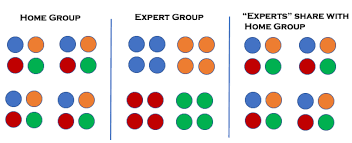
Some of the misunderstandings can be corrected if each group member meets with an” expert” group that reads the same section of text. With guiding questions, students are encouraged to work together to understand the text before returning to teach it to the rest of the group. If the teacher visits the “expert “groups while they are working, then correction can be caught early. This second step results in a much deeper understanding of the section of the text the expert learned about. The problem is that the “expert” does not necessarily understand how the section of text they learned about fits with the whole text. Fisher and Frey advocate for a third step when expert groups come back together a second time to discuss the question:
How does our part fit with what we have learned about the rest of the topic?
“The real learning power of this strategy lies in the critical third step, when students reconsider their assigned passage in light of the whole text…Students think about their thinking (metacognition) and synthesize and analyze ideas contained within the complete text. This process requires that students listen carefully to their peers and analyze the ways in which each part contributes to the entire text.”
Fisher and Frey
.
When students come back to their expert groups they must think about the connections, similarities and differences of their part to the newly learned content. As an example, each member of a home group receives a section of a data set about global temperature changes over time. Each member meets their expert group with the same data set for analysis and interpretation. When they return to their home group, each member shares their data set analysis with the group. The last step is for the group to determine the sequential order of all the data sets together through discussion with evidence and reasoning. Because of this last step, the student more deeply understands their own data set and whether their interpretation of a small set of data holds true when compared to the larger over-all picture.
Cooperative Learning Culture
The Jigsaw Method is a cooperative learning strategy created by Elliot Aronson in the early 1970’s as a way to break the racial tension in his classes after the desegregation of the schools in Texas. Aronson created a situation where the success of the group depended on the success of each student. Within a few weeks he saw a positive change in his class culture. The website Jigsaw Classroom.orghas more about the history and success of cooperative learning as well as tips for implementation.
Suggestions for Success
Discuss expectations for behaviors and outcomes with each transition from group to expert to group.
Create a template or organizer for students to fill out while in the expert group. This ensures the same information is taken back to the group.
For emergent bilinguals, annotateacademic and figurative language to make it more accessible.
Support discussions with guiding questions and sentence starters.
Assign specific jobs for each member during the small group work: Discussion leader, Timekeeper, Team Captain, Materials Manager
Add self-reflection time for students to monitor their contribution to the group and their understanding of the article content.
Tell students they will return to expert groups to think about what they have learned in relation to what they taught.
Resources
The Pedagogy in Action has tips for designing a successful Jigsaw at the high school
This is a guest post by Tara Butler, Mathematics teacher at Cascade Middle School and finalist for the Oregon Presidential Award for Excellence in Mathematics and Science Teaching in 2021.
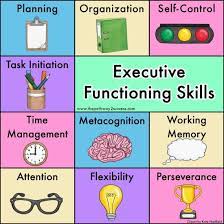
“Executive function is a set of mental skills that include working memory, flexible thinking, and self-control. We use these skills every day to learn, work, and manage daily life. Trouble with executive function can make it hard to focus, follow directions, and handle emotions, among other things.”
In addition to teaching middle school students math, I see my life’s work as the opportunity to develop problem solving, critical thinking, communication, creativity, and collaboration through the vehicle of mathematics. This charge also includes intentionally building Executive Function skills. We want to prepare students not just for our subject area but for every facet of their lives.
I’ve thought about the vitality to bring awareness to and to develop Executive Function skills in students, especially with the challenges the last year and a half has thrown their way. I came across this article in Edutopia by Sarah Kesty, “Supporting Executive Function Skills by Asking Questions.” I was inspired to deliver research based practices for my students to apply rather than my good faith efforts that weren’t giving each student what they deserve.
Following is a summary of what I uncovered:
Ask genuine questions rather than giving directives.
We don’t want students guessing what they are to be doing but if directions have been given and/or the expectations have been made clear, we can ask a question to jog their memory about their next best step. This relays high expectations and shows students we believe in their ability to solve problems and be self-sufficient.
Coach students to be their own coach.
For example, in solving a challenging math problem they can ask themselves:
It can seem easy or time saving in the moment to answer a student’s question or tell them how to do something rather than the long game of teaching them to turn to themselves first as a resource.
How is this structure similar to a simpler problem?
How can I draw this visually?
How can I look at this problem another way?
I will give myself time to think about this problem before asking for help.
Equip students with a set of general questions they can utilize in any situation*
What do you notice?
What parts do you understand?
What do you think you might need right now?
How can you tell?
Where could you look for that information?
How will you remember to use that strategy or take that action?
When we’re tired, overwhelmed, or stuck; what an honor for us to step back, put the content on the back burner for a moment, and remember that we play a critical role in shaping human lives.
Q: Steve, what are 1-2 practices you would like to see embedded in every Bend-La Pine classroom?
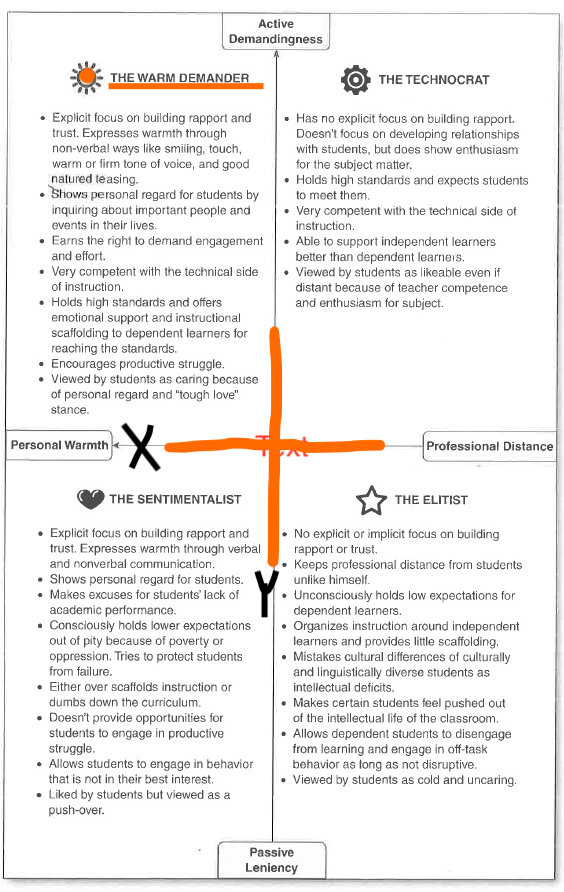
I would like to see a “Culture of Warm Demand” in every classroom – this is Zaretta Hammond’s work. Her approach is applicable in every classroom.
She has a graph that illustrates this concept: on the X-axis, is expectations; on the Y-axis, relationships (see below). And you want to have a classroom that has both high relationships and high expectations – those are the most effective classrooms.
When you’re holding kids to high expectations, you set a standard for them that you won’t accept anything less from them than their very best. But you also commit to pouring everything you have as an educator into that student as an individual person. It is because of that anchor in great relationship that you are able to ask for great things.
If you have that high expectations without that relationship, then you’re a drill sergeant. If you have the relationships without the high expectations, then you wind up creating a culture of low expectations that can wind up being bigoted. You lose kids in those scenarios.
Just loving kids is not enough. That’s the difference: we want to love them, but we also need to hold them to such high expectations, they activate their potential.
And if nothing more, you have to make the commitment: I’m going to get to know you and I’m going to care about you. If kids are struggling, that has something that may have to do with the state their world is in right now. Recognizing that for what it is and not taking it personally as an educator, is an important step. I have to decide that I am going to care about each student in all circumstances, and never give up on those expectations. That’s how you transform lives.
To me, that’s the starting place. You don’t have to know specific strategies, you don’t have to read tons of books – the starting place is the relationships. We’ve all had students triggers us emotionally, and we’ve all triggered students. We have to be able to go back to that situation and see it for what it is, and then figure out how we can talk about it, how we can get through it so our relationship can still be established and move on. When I hold a student to high expectations, it can not be oppressive, but must still be based in the care I have for you as a human being.
Q: Can you tell us a little more about the concept of bigotry? If both aspects of the Culture of Warm Demand are not in place, how does the relationship begin to possess the characteristics of bigotry?
If you have high expectations and no relationships, Hammond describes you as a technocrat. We’ve all had teachers who demand and demand and demand. But they don’t reach out or try to connect with me. I had a biology teacher during my sophomore year of high school that never ever – in 180 days of school – learned my name. The feeling you get when someone doesn’t even know who you are – your name, let alone any details about your life – is one that communicates both parties are not equally valued in this system. If we aren’t both equally valued, then the power imbalance is one of oppression.
Take it the other direction – if you have this culture that you’re just going to love kids and be emotionally available to them, and be supportive, then you’re only attending to the relationships and there are not high expectations. Those students are being oppressed similarly – they aren’t achieving the potential they could. And you’re creating an environment in which students may not know those opportunities exist for them. If you don’t push them towards opportunities, that is its own version of bigotry. It’s a balancing act on both ends of the spectrum.
How do I have high expectations AND strong relationships? That’s what we always have to ask ourselves with each individual student in our care.
Q: These concepts are obviously very important to you. How have they played out in your own life?
With my children, I had to take a very different disciplinary approach with one son versus the other. It was a delicate walk and, to nurture the relationship, I had to approach one on an adult level, with adult language. If I did that with my other son, he would have been confused and wondered what I was doing. That goes back to the platinum rule – I had to know and interact with my sons in different ways because they had different personalities; they were different people. I was more effective if I treated them how they wanted to be treated.
In another example, I know that bigotry can come from a lack of engagement opportunities, or during instruction. One of the most offensive things I ever said to a student was a glib, sexist remark that she had the courage to call me out on later. I had never thought about the moment through that lens, but for me to do anything but be respectful, and apologize, and own it would have meant I failed. She stepped up to her challenge – she came to me and told me I hurt her feelings and gave me the opportunity to grow from it. My challenge was to be respectful and accepting, and honor her courage.
Q: We’ve talked a lot about relationships and expectations. Let’s think about the larger educational systems in place that support or prevent those outcomes. What are the most important components of an educational system that is able to identify and act on inequities within?
Just this morning, I was in two elementary schools and we were talking about Covid and how it has exacerbated so many of the systemic moves that inhibit a student’s ability to succeed.
Think about this interview environment between me and you – I’m in a closed space with just my laptop; nobody is interrupting me, and we have the opportunity to fully engage with each other.
But then we think about some of the environments our students are learning in. When we quarantine kids and send them home, or we’re in remote learning, what about those kids that have a lot of noise and interruption? Or what about those kids that don’t have anybody at home able to engage with them? What happens to those kids and how do we as a system start to recognize how our system perpetuates those inequities. How do we set up our system so kids can be just as successful in their own environments as in ours?
I think about the research on reading scores, conducted when essentially the entire country was remote. Some of our most affluent students actually scored better than if they would have been in school. It was actually beneficial for them to be in lockdown because their growth rate was higher. Now compare that to some of our highest poverty students who lost so much ground during that time – their test scores regressed 1-2 grade levels. How are we going to look at our systems during and after Covid to address those disparities?
Covid has shown us there is no more important time in the history of education to start looking at the moves we make so that no student is left behind, regardless of any circumstances about who they are racially, culturally, socio-economically, or what gender they identify with – none of it should matter. We’re starting to peel back these layers and say, “We’ve got to do better.”
I think this is going to be a transformational time for us. We’ve got to start fixing some of these systems. It’s an exciting time for us and will continue to be so as long as we strive to take advantage of the opportunities here.
Q: We’re already seeing systemic responses that run counter to that thinking. There is so much energy around wanting a schedule that enables teachers to serve students better, but the schedule has already been built for next year and there’s a lot of reluctance to change that.
The system of public education is built within hundreds of years of inertia. A whole lot of people look at us and wonder why we want to change anything at all – they say, “Look at me. I turned out just fine.”
Within the last year, so many districts have had to change so many things so many times. But Covid forced our hand. We’ve proven that we can change quickly. Our biggest challenge is to elevate the reasons why we should change to the same sense of urgency as Covid gave us.
That’s the real question and that’s what we’re going to have to keep demanding of ourselves. I know how I should eat. I know exactly how l should eat. But I don’t always choose to do that. And I’ve only been trying to make consistently better choices for half as long as the public education system has existed.
We can’t let this opportunity get away. This is the biggest chance we’ve had in the recent history of public education to profoundly change the environments our kids experience every day.
FEW OF US TAKE ON A NEW TASK WITH NO IDEA WHAT IT WILL LOOK LIKE TO BE GOOD AT IT.
For our students, the use of exemplars (aka working examples or models), help them to know exactly what success will look like. Previous blog posts in this series have been on the importance of telling students what and why they are learning as well as providing a rubric that defines success.
This post is about showing students work that they can score against a rubric to deepen their understanding of what success looks like.
Any assignment that is given can have an exemplar. There are generally three phases to instruction with exemplars.
1.INTRODUCTION. Share with the students the exemplar. Tell the students that this example is from a previous year or period. You may or may not share the grade the exemplar received.
2. TRAINING. Have the students read or study the exemplar based on the rubric that has been provided. Point out the important aspects of the rubric or exemplar. It is very powerful for you show the students how you think as you analyze the exemplar or rubric. Using “I-statements” such as, “When I see this essay, the first thing that I notice is that there are clear subheadings that tell me how the text is organized” or “When I see this lab report, I notice that the vocabulary words from this week are included in the appropriate sections.” Through metacognition we train the students how they should be thinking when they analyze the exemplar and their own work before they turn it in.
3. APPLY LEARNING CRITERIA. Have the students engage with the exemplar by themselves or with a partner. As the students analyze the exemplar, they learn the success criteria, rubric.An especially useful extension activity can be to provide students with multiple exemplars and let them work together to determine what works and what doesn’t, which are stronger/weaker, etc.
You may provide an exemplar that is high-level or work or one that still needs work. By analyzing a less-than-perfect exemplar, they can use the rubric to see where improvements may need to be made or why.
Student after student will say, “The most helpful thing you did was show me examples when an assignment was really complicated.” Teacher after teacher might say, “That took time I didn’t have, and it didn’t teach them anything new. Was it worth it?” Yes. And yes. And yes.
Taking the time to show your students what the end product might look like is an equalizing and generous act because it understands that students want to succeed, and it recognizes their insecurity about how they might do it. Examples help them build a road from assignment to finished product.
Having very clear learning intentions for our students is hard work, but it may be one of the most important teacher moves in our classrooms. NO MATTER WHETHER YOU HAVE BEEN TEACHING FOR ONE YEAR OR TWENTY, STUDENT AWARENESS OF THE “WHY” IS CRITICAL.
Students must know why they are learning and how they will apply this learning in future contexts. We have all been that student who says, “When am I going to use this?” By getting ahead of the question, our learning intentions make future application transparent. Clear learning intentions is a critical part of a high-leverage classroom strategies: such teacher clarity done well can double the rate of student learning.
THE ‘WHY’ IS WHAT MAKES BACKWARD DESIGN ESSENTIAL. It is important to be clear about your learning intention before you plan the day’s/week’s/uniit’s activities. The academic tasks that a student engages in should serve to illuminate the learning intention. Students need to be able to see the clear link between where they are going and how you are getting them there.
It is critical to base our learning intentions on the standards, described skills, knowledge and habits of mind that student need to internalize. However, for many years there has been a push to “post the standards” in the classroom. While this is a great start, without explaining to students how to learn the standard or when to use the standard, it is just more adult writing on the board. This would be like your tax accountant posting the tax code you are supposed to follow without the explanation of how to use it in your return.
By being explicit about the learning intention student attention and engagement increases. If a student does not know the what and why of a lesson, they are far more likely to tune out. STUDENTS SHOULD HAVE THE SAME UNDERSTANDING OF WHERE THEY ARE HEADED IN A LESSON THAT THE TEACHER DOES.
Here are a few examples of clear learning objectives:
Today I am going to teach you how to identify and articulate important character traits in some major figures in the Battle of Gettysburg. This will help you understand how leaders in history motivate people to get their agenda done.
At the conclusion of this lesson, you will be able to explain to a partner a definition of covalent bonds. We will use the your knowledge in our experiment later in the week.
I want you to understand and apply scale factor at the end of today’s lesson. This is important because scale factor is an important concept in fractions, that you will use over and over again, in problem after problem, math class after math class.
Big or small, covering one lesson or one month of lessons, STUDENTS MUST KNOW THE WHY. They simply will not learn as much or as well without it.
ADDITIONAL RESOURCES:
Here is an extremely quirky video from a Scottish high school teacher arguing for the important of learning intention. No fancy production values here, but a sincere – if strangely humorous – delivery and some solid thinking.https://www.youtube.com/watch?v=YdDndXDABQw
Edutopia’s article sums it up and takes it one step further – arguing that the best teachers will spend a substantial portion of their planning time developing clear learning intentions and determining how best to embed them in the lesson. https://www.edutopia.org/article/framework-lesson-planning
Isn’t it great to see kids back in class? Everything else aside, isn’t it great to see them?
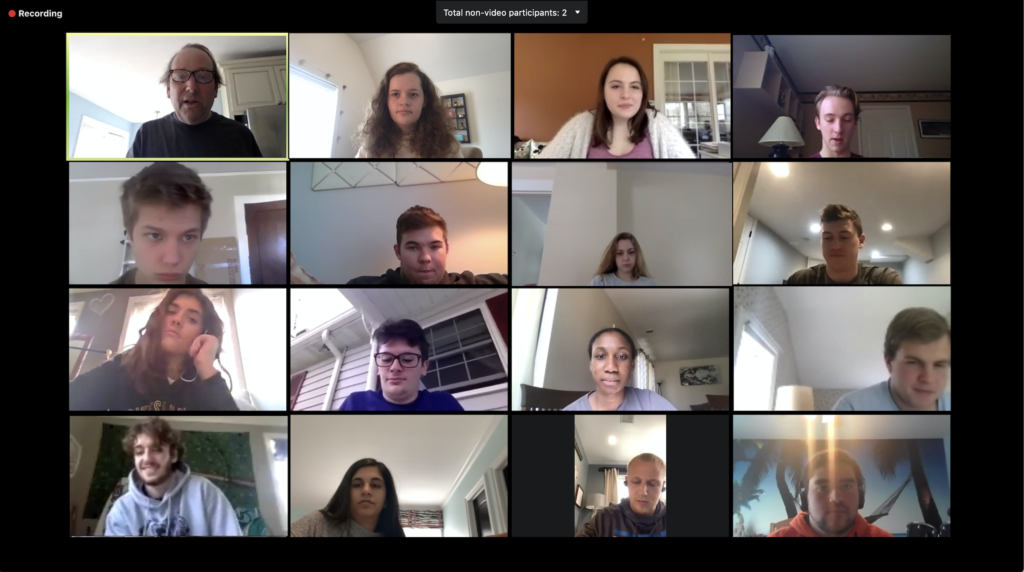
With Wednesdays being WebEx-only days, we wanted to take this week’s blog to think through ideas for breakout rooms.
It can be nerve-wracking to release students to work independently without supervision. However, with structure and an efficient plan, WebEx breakout rooms can be a great way for students from across both cohorts to connect with each other and share their thinking or practice what has been taught in person.
Here are a few ideas about how to make the most out of your WebEx breakout rooms:
1. Keep them short. Keep the break out rooms times between 2 and 3 minutes, no longer than 5 unless there is substantial work being completed.
It is better to use breakout rooms multiple times in a class session, rather than give them one breakout room for too long. NOT giving them enough time to have a complete conversation is best practice for virtual engagement. Too much time is unpleasant and awkward.
2. Give the students one task to complete rather than several. Give them one question to discuss, rather than several. Provide Sentence stems. If students are unlikely to know how to begin, a sentence stem or two can provide a clear first step in how to start.
This link provides some prompts for students to engage in academic conversations:
3. Provide a shared document. Create a Google document or a Jamboard (each group gets their own board) with a task or question that is to be completed during the time in the breakout room.
4. Assign jobs. In order to help students, stay on task when working together in a break out room a specific role will guide their next steps.
a. Leader. Makes sure that everyone is participating, that people are unmuted and that cameras are on when possible.
b. Time keeper. Makes sure that the task will be completed before the breakout room is over
c. Scribe. Write the answers in the shared document. Alternatively, all students could be a scribe and write their answers in a different color.
d. Technician. Share screen in the breakout room so all can see what is being worked on.
e. Presenter. Share the group work at the end of the breakout room.Jobs can be assigned by alphabet, next birthday, tallest or other random affiliation.
After the breakout room is done, it is great information to ask students how the process went in their group. A scale of 1-5 in a personal chat will give you feedback on how the breakout rooms went when you were not able to be there.
In a nutshell, less is more. Less time, fewer tasks, little open-endedness. Keep them focused. Keep them efficient. Your students will be breakout room rockstars.
There is no question: students and their families are feeling all of the same things we are about returning to the classrooms. Like us, they have been submerged in the stresses of home environments relentlessly; unlike us, they have not been protected by the same job stability, self-advocacy tools, or ability to go into the school building if that would work best.
Welcoming them back into our classrooms is offering them the chance to re-start their independent lives. But it’s been such a long time for them, there may well be some issues we would do well to consider.
Below, is a list of relevant readings you may find helpful.
1. The website We Are Teachers recognizes that, even when students are back on the classroom, they will likely still be engaging in remote sessions with us as a matter of routine. Therefore, it caters it’s suggestions to keep ourselves well-supported and moving forward despite the shifting locations and platforms: “2020’s New Rhythm: Moving from Virtual to In-Person (and Back Again)”
2. The National Association of School Psychologist put together this two-page article reflecting on student socio-emotional re-entry needs, and articulating what teacher practices will support their transition most effectively. “School Re-entry Consideration: Supporting Student Social and Emotional Learning and Mental and Behavioral Health Amidst Covid-19.” School-Reentry-Considerations-NASP.pdf
5. And, finally, I want to include an open letter that has lived on my desktop for months. Long-time community counselor, Kathy Ngel Hood, offers this advice for parents but I think we may also find its perspective helpful. There are no instructional tips here, but some excellent and compassionate thinking about the Covid lives of our students. “Observations from a Counselor”
Ready or not, you are FINALLY going to meet your students in-person! And you can provide some of the engaging in-person learning that you did before! Or can you?
Social distance requirements will make small groups difficult, but here are three digital tools to easily enable small group work, be it in-person, in WebEx, or in Canvas.
THIS SIX-MINUTE VIDEO IS A BRIEF ‘HOW-TO’ FOR INCREASING DIGITAL STUDENT ACCESS TO YOUR COURSE CONTENT. Individual students, small groups, and whole classes will engage EASILY and VIBRANTLY, using these tools that are just as quick to learn as they are for students to use.
WHAT TO LEARN MORE? Here are some resources that might be useful:
PADLET: For more information about any of the Padlet posting possibilities (audio, video, images, URL, drawing, articles), brief video tutorials abound on the internet!