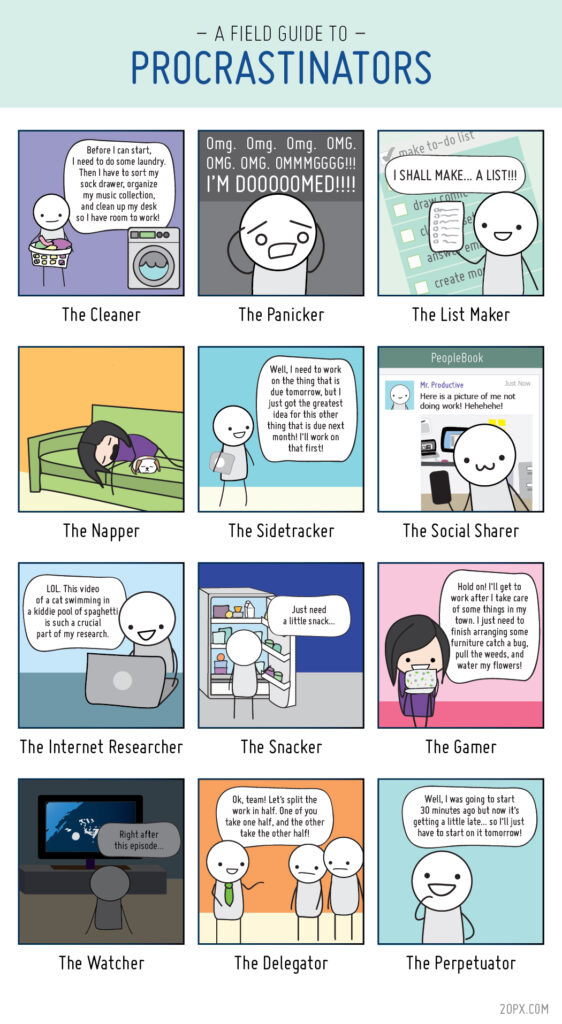

Procrastinating students are often misunderstood as being lazy or unmotivated. There’s more to it than that. Reflect on your own procrastination. Why do you do it? How does it make you feel? Does it lead to stress and guilt? Can you refocus and get the work done? Upon self-reflection you probably find that procrastination usually means you are stuck. Procrastination can lead to a myriad of emotions; regret, self-doubt, guilt, excitement, anxiety. Research suggest that students often are stuck for one of two reasons; fear of failure or confusion about the task.
It’s a common perception that students who procrastinate do so because they don’t care about the assignment – and that’s usually wrong.
Devon Price – Social Psychology Professor
Watch the video below about the types of procrastinators. Do you recognize yourself? Do you recognize some of your students? Think about the motivation behind each procrastinator and how that impacts their self-esteem and work production.
4 Types of Procrastinators by Michael Greschler
- The Perfectionist/Overdoer: Everything has to be just right. It’s impossible to prioritize and work effectively.
- The Defier: Resents authority and the loss of autonomy. Procrastinates to prove independence.
- The Dreamer: Loves the big picture, gets lost in the details. Procrastination is a way to stay in the beautiful details and not ruin them by doing the work.
- The Crisis Maker: Lives on the edge and does everything at the last second. Motivated by what’s immediate.
Watch this video on types of procrastination (5:54 minutes)
3 Reasons Students Procrastinate and How to Help them to Stop by Youki Terada. This article suggests 6 ways to help students NOT procrastinate:
- Have clear instructions and examples: Students that are confused don’t know how to start. Teacher clarity matters greatly (0.75 effect size). Give clear expectations and requirements in writing and provide exemplars.
- Spread out deadlines: Breaking down the assignments into mini-deadlines rather than one final deadline helps students prioritize.
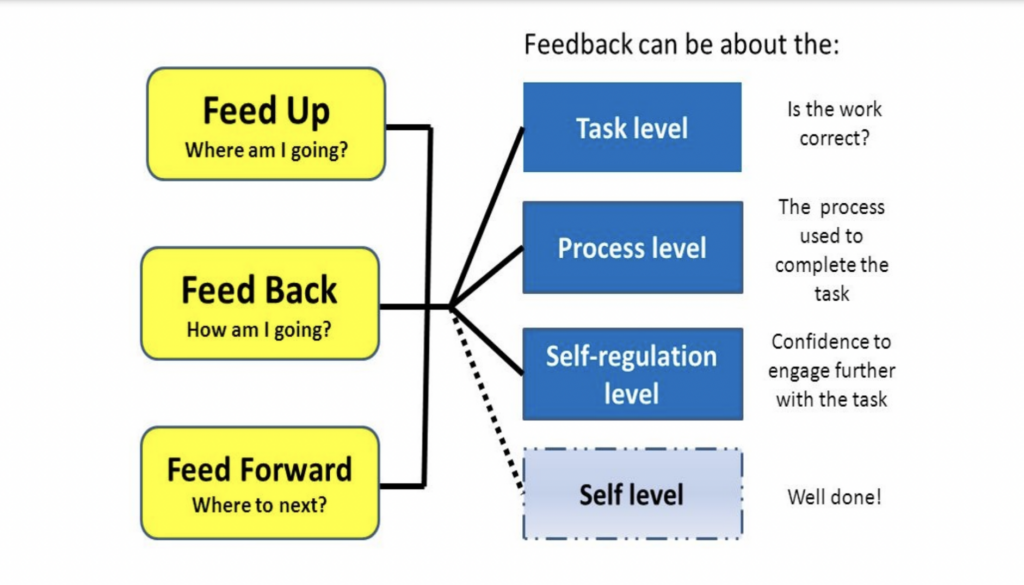
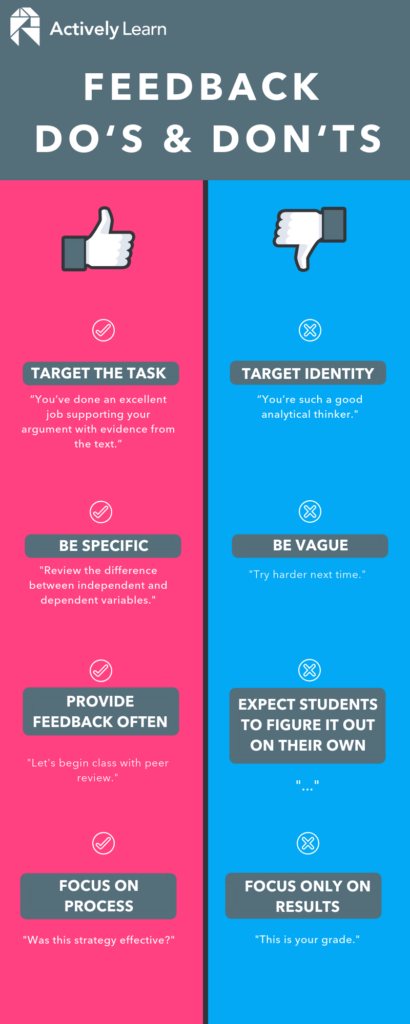
- Provide supportive feedback: Students with low-self esteem or are self-conscious shut down with criticism or fear of failing. Provide supportive feedback about their task and process. (See previous Blog post on Feedback)
- Model and practice study skills: Many student don’t know how to study and lack metacognitive skills. If they don’t recognize what they don’t know then they are lost. Don’t assume students learned study skills already or that they should know how to study. They need a variety of strategies in order to find the ones that work for them.
- Explicitly teach time management: Teach students how to plan backwards from a due date. Practice scheduling a day and a week and then self-reflect on how well they estimated the time allotted for each task.
- Be mindful of workload: There are predictable times when workloads are heavy (before breaks or the end of a grading period). Be mindful of the stress caused by the amount of work students are expected to juggle.
Just a little more…
- Understanding and Overcoming Procrastination
- Another Theory about Procrastination.
- 7 Strategies to Motivate Your Teenager
Worth the Watch! Inside the Mind of a Procrastinator (14 minutes)