
Gist Writing – A Quick Way to Have Students Write Summaries

We know that it is important for students to be able to write a summary of important information read in a text. Yet, some students struggle with this skill. Some students cannot find the main ideas and details, other students write so much that the summary turns into a retell with superfluous details included.

The strategy of “Gist Writing” is an evidence-based strategy that can help all students tackle this important skill.  It gets students into reading, writing, thinking, and communicating about summarizing text.

Step 1: Provide a text for students to read.  To begin, a shorter text is best and as the students gain expertise in the skill longer text can be provided.

Step 2: Students identify in a phrase who or what the text is about

Step 3: In 2 or 3 phrases that contain ideas from the text

Step 4: Combine the phrases from step 2 and 3 together into a sentence.

Step 5: Edit or “shrink”the sentence to be between 10 and 15 words.


Example:

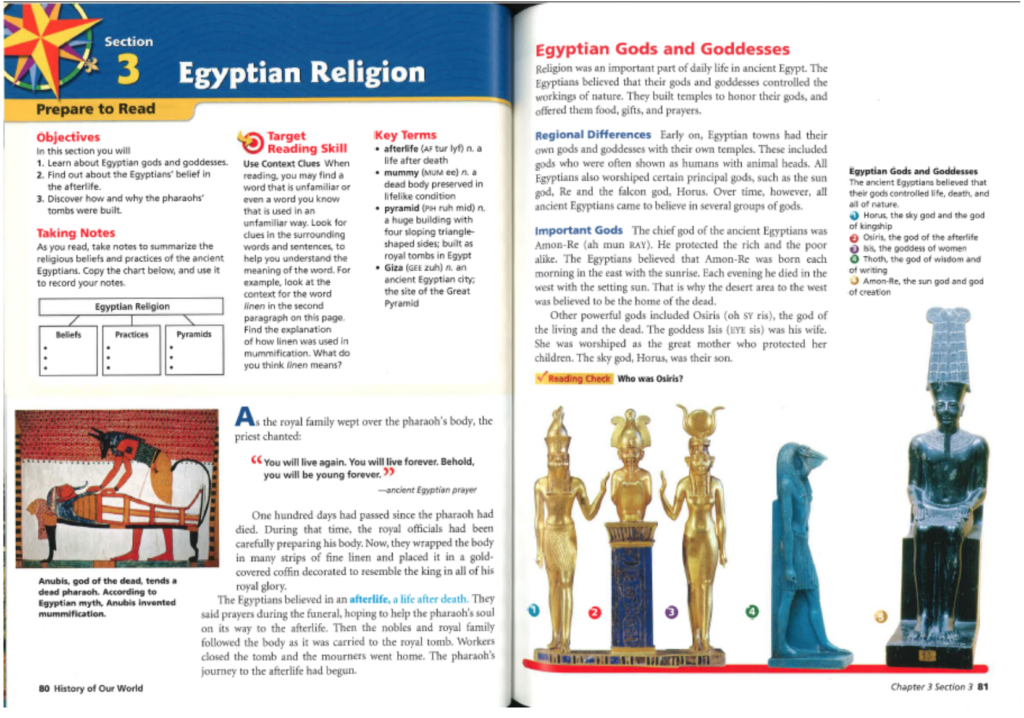
  1. Students read the follow text on Egyptian Gods and Goddesses
  1. Name the who or what the paragraph is about in a brief phrase

Ancient Egyptian Religion

  1. Identify two or three important details about the topic

They believed in an afterlife

People believed in several groups of gods

The main gods were Amon-Re, Osiris, Isis and Horus

  1. Combine the phrases for a create a sentence.

The Ancient Egyptian religion believed in several groups of gods including Amon-Re, Osiris, Isis and Horus that provided the afterlife. (20 words)

  1. “Shrink” the paragraph by stating the main idea

The Ancient Egyptian religion believed in several groups of gods including Amon-Re, Osiris, Isis and Horus that provided the afterlife.

The Ancient Egyptians believed in groups of gods that provided the afterlife. (12 words)

Ready for the next level? Have two students share their gist sentence and combine there to make a new sentence of 10-15 words.


If you would like to add a shout out to a colleague, please do so here.

What can we claim? Ideas for helping students with CERs in Science

Writing a well crafted Claim-Evidence-Reasoning(CER) is a struggle for students at many grade-levels. Often teachers find that students can write a claim and provide evidence but they struggle connecting the reasoning to their claim.   In science, it is not uncommon for a middle schooler to write a conclusion to an experiment citing evidence that seems disconnected and could not possibly support or refute the hypothesis (claim) they investigated.  No wonder the reasoning is difficult.

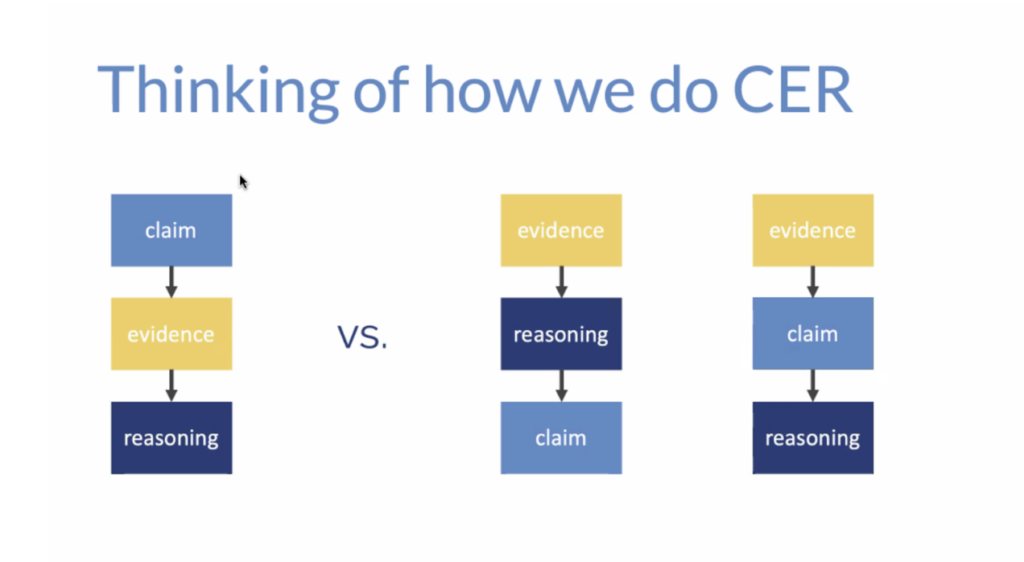
Many science teachers, me included, have asked for help from our language arts colleagues, when it comes to teaching students how to write a cohesive CER.  In Language Arts a CER is written in a format that starts with the claim, followed by evidence from a source and reasons why the evidence supports the claim.  In science, we need evidence before making a claim and explaining the scientific reasons for a phenomenon. Kristin Hunter-Thomson, a former middle school teacher and data literacy expert with Dataspire, suggests a few strategies for helping students write a meaningful CER in science.  

Start with small steps:  Expose students to visual representations often. Before they analyze and interpret their own data they need a lot of practice with a variety of visual representations.  Start with the basics as students analyze and discuss the different types of visualization in groups.  Start with simple questions and about structure and then look for patterns. Gradually the questions and thinking gets more complex.

What kind of visual is used? ( pie, bar, scatter plot, histogram,etc)

What are the parts of the visualization?

What is the overall shape of the visualization?

What is the context of the visualization?

Are there outliers? What does the data show? How does each variable change?

What is the pattern in the data?

What can you infer and why?

Flip it: Start with the evidence before making a claim. Describe the evidence and reason it connects to an important science concept and then make a claim that ties it all together.

What can’t the evidence say: Kristin Hunter-Thomson advocates for teaching students to make inference about what the data can and cannot say.   She points out that students often over-conclude from their data and miss the data limitation.  By teaching students to think about what the data can and cannot say, they begin to see boundaries and make meaning.

Which one doesn’t belong: Kristin Hunter-Thomson gives students evidence of a visual representation and then gives students two claims.  Students must decide which claim the data represents and write a CER for it.  For deeper thinking, explain why the other claim is not supported by the visual representations.

Build it backwards: Valerie Overley at PBMS has her sixth graders start with the reasoning then identify the evidence before making a claim.  Students read and highlight an article while answering questions about renewable and non-renewable energy.  Then students analyze a graph looking at the evidence.  From the evidence and reasoning they write a claim.

Resources


Structured Academic Conversation Protocol

Students getting stuck in classroom academic discussions? Off topic? Uncomfortable? No discussion at all?

If you are looking for ways to revitalize student conversations, stretch what you already do, affirm your practice, or remember an old strategy, this simple structured academic conversation provides supports for students who struggle and space for those who accel.

Large Group Debrief and/or exit ticket:

  • Tell me more…
  • What was one thing you heard that you agreed?
  • What was one thing you heard that you disagreed?
  • Why?

Additional conversation tool for the open discussion: sentence stems (agreeing, disagreeing, clarifying, building)

Prepared pro/con arguments across disciplines: procon.org

Want someone else to try this in your classroom? A second set of hands to navigate the scene. I’d love to give it a go with you and your students…any content area. Worse case scenario, we can laugh at the failures. I’ve had plenty. Email me: [email protected]

If you would like to add a shout out to a colleague, please do so here.