The Equitable Grading Think Tank: Updates and Perspectives

For many of us, one of the most startling parts of last year was the removal of the zero from our grading scales.  The move may have felt seismic but, as with everything else, we have managed to adapt and continue on.

Meanwhile, the conversations around equitable grading have never stopped.  In fact, this year, those conversations are continuing monthly among the 36 members of the Equitable Grading Think Tank.  Represented on the team are a wide variety of secondary teachers as well as site and district administrators (names appear below), all of whom are deeply committed to representing their sites and our district with integrity and fairness, all of whom welcome your questions if you want to reach out.

To prepare this post, I spoke with Stephen Duvall, the group’s facilitator, current principal of Cascade, and incoming Director of College and Career Readiness, and two members of the group’s leadership team: Katie Lyons, middle school science teacher currently Cascade, previously at Marshall; and Mary Wellington, 24-year middle school Spanish teacher currently at Pacific Crest as well as long-time BEA site rep.

How is the Equitable Grading Think Tank organized?

SD: We meet monthly, during teacher-directed SIW’s.  Based on applications, we’ve pulled together a group of teachers from middle and high schools across the district to have a voice in exploring equitable grading practices as a whole, and to look at making recommendations – including PD recommendations – by the end of the year.  We also have folks on the team from downtown and from Information Technology so that, whatever recommendations we make, we have had all the necessary voices at the table. We’ve tried to achieve representation from every site, but there were a couple unable to participate at this time.

MW:  So far, we’ve met twice.  We all read Grading for Equity by Joe Feldman this summer and then we met to discuss.  So far, we have focused on getting started by getting clear and unified about the ‘Why’ behind this work.

SD: We have all been tasked with keeping this work from living in isolation, with going back to our buildings and being conduits for our work.  We want to be 100% transparent.  Even if a teacher’s site did not have a representative apply to participate in the group, that teacher should not hesitate to reach out to us for more information and updates.

The team has also Partnered with Creative Leadership Solutions who has been very helpful in giving us a lot of resources to look at, and research to review.  That organization has been very helpful in giving us ideas for how to have these conversations, and what conversations to have.

KL: We’re not here to push a model.  We’re here to make recommendations after analyzing as many angles as we can.

What are the biggest learnings of the group so far?

KL: Learning why traditional grading practices are inequitable.  The district has done a lot of work highlighting its own inequities – it’s a very valuable, reflective moment we’re having right now.  This group pairs so nicely with those reflections, and the need for change can feel like it matters so much.

SD:  The overall recognition that there is a need for a change. In broad terms, there is a sense that this is necessary work.  We recently put out a survey to poll people on the ‘why’ behind the work – why is this important and why do we need to make some changes?  Team members responded on a 1-4 scale: 1 = “I have no idea.” And 4 = “I am fully on board and believe this work is essential”.  100% of the group scored themselves a 3 or a 4.  We are unified in this belief:  there is a need for a change.  Our group really is made up of a wide-range of perspectives from across the district, not unified in beliefs or in relationship to the work.  So to be unified in recognizing that what we’re doing for kids is not equitable is a really substantial belief to share.

KL:  Accepting the challenges we will face as a district trying to move forward.  First, we have to expand the mindset and beliefs of many of our colleagues.  Also, the logistics of making what feels like a drastic change in everything from classroom practices to the support systems in place to make it all work.  A lot of concern has been voiced about how are we going to do this in a way that makes sense for all.  

MW: There have been a couple of times during meetings where the perspective has been voiced: “This district already knows what it wants to do here.”  I’m pleased to say that is not the case. I find that the admin we’re working with are very much open to hearing all perspectives from the different schools. Nothing has been decided yet.  We are looking at everything.  The voice of teachers and the voices of the schools is important and is going to be listened to.  I don’t foresee an outcome where one decision is made for every site.
What are the big ideas the group is currently working on?

SD:  Grading is a big beast.  A thousand things go into it. As a group, we’ve identified four pillars for our decision-making process. We’ve looked at a number of folks out there, and everybody has some differences about their beliefs around what grading practices should be.  We looked at those, and then narrowed down to the four that would be most impactful for our decision-making and selected those four. All of our research and recommendation needs to go through these four.  As a group, we’ve decided that grading practices for our district need to be accurate, motivational, transparent, and bias-resistant.  

From there, we’ve identified the buckets we need to examine as a group:  homework, behavior’s role in the gradebook, retakes/redos; assessment methods and calculation methods; the process of identifying/using standards, scales, rubrics, and multiple methods of assessments; and systems – the structures and technologies in our buildings that will allow these changes to happen. 

What will the final product of the group be?

MW: At first, we were thinking our group would be a one-year process, but we’ve since realized that may not be realistic.  It may take two years – we don’t want to rush.  We want to do this well.  We may spend this year figuring our all the big ideas and then next year developing the PD plan.

SD:  We are exploring each one of these buckets on a monthly basis.  And then finding resources as well as people on our team that have been trying some of these practices.  And then our goal will be to come up with a few key recommendations around best practices for that bucket.  Our task is to make recommendations, not to make policy decisions.

Our second task is to make professional development recommendations around what training is needed to support a shift. No decisions have been made yet.  After we make our recommendations, Lora and Steve will evaluate which recommendations will remain recommendations, and which might shift towards policy.  However, no one is interested in making “thou shalt” changes as much as looking at what training and information can we provide to support staff members in moving towards more equitable grading practices.

If you were to look at neighboring large districts who have undertaken this work, it is a multi-year process.  The great thing about this work is that there are some things that are easy, small shifts that can happen via small shifts in classroom practices.  And then there are much bigger lifts that would require a lot more time and infrastructural investment.  District teachers can know this work is being done thoughtfully and methodically over a large span of time.  No one will be required to make huge changes quickly.
Can you give me an example of a topic and process you’re following to explore it?

SD: We are working with the topic of homework as a whole by looking at a wide variety of articles and videos; we also have some team members trying out a variety of strategies that will share their observations with us. 

MW: With homework, what do we see? What is it that’s equitable?  What is it that’s not?  How can we communicate all that in such a way that people are going to understand and acknowledge our own inequitable practice, but then tweak it and make it a better thing?  Instead of giving homework because we always have, how can we assign it in such a way that it benefits all students instead of hindering those without the home situations to support it?

SD:  After looking at our research and hearing about the experiences of our colleagues as they’ve been trying certain things, we’re going to make a few bullet points of best practice recommendations.  And then those will go to Lora and Steve who can take it from there.

Is there anything you especially want teachers to know, or to ask you about?

MW: Anything that people want to ask me about helps clarify for things for me too.  It’s helpful to have to talk through ideas or explain reasons behind certain thinking.  But we’re also early in the process – so my answers may still be evolving.

KL: Teachers are coming to their own reckoning.  I’m hearing a lot of conversations around teachers wanting to do this work.  My advice would be: absolutely!  Absolutely delve in the waters and do your own research; but also know there is a team going about this in the most evidence-based and methodical way to ensure there is consistency moving forward and to ensure – for anything we want to do – we do it in a supported way.  

We’re all so eager and I’m hearing lots of people wanting to hurry and make big changes.  Part of me wants to tell them to slow down because this is such hard work.  Good teachers that realize something is unfair want to fix it immediately, but we have to do it right.  The power of doing this work together is exactly why we can do this work successfully.
Who is in the group, in case I have follow-up questions or want to look at some of the resources?

Middle School:

  • CMS – Stephen Duval
  • CMS – Leticia Guest
  • CMS – Katie Lyons
  • CMS – Jake Slodki
  • HDMS – Libby Estenson
  • HDMS – Ingrid Hoban
  • HDMS – Lauren Houslet
  • HDMS – Dave McKae
  • HDMS – Nishka Morton
  • LPMS – Jessica Colburn
  • PCMS – Mary Wellington
  • SVMS – Christine Clark

High School:

  • BSH – Erin Hoffman
  • BSH – Amy Sabbadini
  • BSH – Jon Williams
  • BSH/CHS – Kolina Watt-Garcia
  • BTA – Alex Greenwood
  • CHS – Alex Baltodano
  • CHS – Jess Calbreath
  • CHS – Rayne Cedegreen
  • LPHS – Pam Price
  • MVHS – Michael Hicks
  • MVHS – Jason Gibbs
  • MVHS – Brandi Ross
  • MVHS – Sharon Sieveking
  • Realms – Roger White
  • SHS – Erin Carroll

Downtown:

  • BLPO – Amy Tarnow
  • IT – Patrick Elliot
  • IT – James Colestock
  • TLC – Juan Cuadros
  • TLC – Katie Legace
  • TLC – Lora Nordquist
  • TLC – Dean Richards
  • TLC – Dave Van Loo

Misc:

  • BEA – Sarah Barclay
  • Jewell – Adam Howell

The Math and Science Connection: Good for Kids, Good for Teachers

By Linda Adams and Colleen Behrens

For most of us, our middle school and high school math and science classes were taught in isolation.  Today not much has changed.  A student will go to a math class and then to a science class and – though the content and concepts might be related – they are taught in isolation.   In science, many of the Science and Engineering Processes (SEP) rely on mathematical computation to answer complex questions about phenomena.  As students progress, conceptual learning relies on more complex mathematical reasoning for sense-making.   In mathematics, students experience most learning of algorithms as deriving, manipulating, and memorizing  “naked numbers” without context, and then may have some “word problems” in the independent work where they must decide which algorithm to use and what numbers to plug in. 

 What if the student’s experience was more of a crossover between their math and science courses?   The CCSS-Mathematics and the NGSS have a lot in common. 

Figure 1 compares the eight Mathematical Practices (MP) to the eight Science and Engineering Practices (SEP).

The terminology might be different between the MP and the SEP but the conceptual understandings are similar.  Math and science teachers can explicitly teach the terminology of the MP and SEP in their classes to help students understand the interconnectedness of the two domains. Check out this video: here’s what one middle school did to help their students make those connections (6:49 minutes)

Similarly, the area of applied mathematics requires students to use mathematical modeling to describe scientific phenomena. UC Santa Cruz offers us a short video describing how their mathematicians, scientists and engineers use mathematics in their fields (3:41 minutes).

There are challenges to creating interdisciplinary experiences but how can we think differently about what we teach and how students learn?  How can we create more opportunities for students to make real-world connections between math and science/engineering practices? 

Below are some possible actions for math and science departments in the pursuit of more interconnection/overlap:

  • Compare terminology in math and science and explicitly teach in both subjects. For example, How is a conjecture in math similar to a hypothesis in science?
    • Coordinate SIW meetings to discuss the similarity and differences between the MP and SEP’s
    • Conduct learning walks where math teachers and science teachers observe each other in action.
    • Ask students to reflect on their experiences in both science and math.
    • Plan for opportunities to incorporate developing mathematical models, use computational thinking, and construct viable arguments, critique and debate the reasoning of others based on evidence across both disciplines. 
    • Revisit the overlapping skills with the CCSS and the NGSS and intentionally include elements into your lessons.

Common Math and Science Tools:

  1. CoDAP online data analysis tool
  2. Desmos online graphing calculator and activities
  3. TUVA LABS data analysis tool available as part of Stemscopes units for middle School science
  4. Gizmos Math and Science simulations. All BLSD high school science teachers have access. Curious math and middle school teachers can reach out to Colleen.
  5. JASP online data library
  6. MyNasaData data sets and lessons plans
  7. Our World Data data explorer for statistics
  8. What’s Going on with this Graph?  Weekly graph for classroom analysis done by the New York Times 
  9. Searchable Next Generation Science Standards
  10. Oregon Science Standards – NGSS
  11. Oregon -Common Core State Standards 

Works Consulted: Mayes, Robert, and Thomas Koballa. “Exploring the Science Framework: Making connections in math with Common Core State Standards.” NSTA, Dec. 2012, static.nsta.org/ngss/resources/201212_Framework-MayesKoballa.pdf.

Curious about Newsela? Here is a GREAT place to start!

A TIERED APPROACH TO NEWSELA

  • Start at the beginning if you’ve never heard of Newsela
  • Scroll down to #2 if you’re familiar but want to know what else it has to offer
  • CANVAS integration – use this document to sync Canvas & Newsela and read on if you want the most “bang for your buck” way to use Newsela!

IF YOU WOULD LIKE TO TAKE A ONE-HOUR PAID TRAINING AFTER SCHOOL HOURS, take this 30-second survey here!

#1: WHAT IS NEWSELA? Newsela is an instructional tool that allows teachers to find articles with appropriate reading levels for their students. Newsela articles feature questions and writing prompts that align with common core standards. Newsela allows teachers to bring real life events into the classroom with engaging content and analytics that all students can access: ELA, Foreign Language, Social Studies, Math, Science, ELL, Current Events, Social-Emotional learning and more. It truly is an amazing tool that allows us, teachers, to give our students specifically targeted articles on just about anything (read: ANY subject can benefit!)

WATCH THIS VIDEO to see how to explore content and use the unique search capabilities.

#2: NEWSELA IS MORE THAN PDF ARTICLES: Newsela as a stand-alone

You certainly don’t have to use Newsela and Canvas together. On its own, Newsela is packed with powerful tools to help you share current information on nearly any topic. It’s a great way to build literacy and allow your students to adjust the reading to their own specific needs. Start by enabling your district account by signing in through Clever. You’ll have access to all text sets and articles this way. You can also save content to use later. This is also where you’ll send your students to access digital news articles. WATCH THIS video to see all the Newsela features.

The PRO/CON text sets and Lesson Guides have everything you need to quickly plan a great lesson supported by age-appropriate reading levels for you students. (READ: Quick Sub Plans in a Pinch!)

#3: YOU LOVE NEWSELA, AND YOU WANT TO USE IT WITH CANVAS

START HERE: How to Sync Canvas & Newsela It’s a teeny bit lengthy process (10 minutes), but I think you’ll be pleased with how Canvas and Newsela work together to make your life easier.

WHY MERGE THE TWO?

  • Newsela is available in ALL Canvas courses via the left-hand Navigation menu (if it’s not visible go to the bottom, hit Settings > Navigation and then drag Newsela to the top visible > SAVE)
  • Enables users to log into Newsela from Canvas & Use Newsela within canvas
  • Imports Canvas classes and class rosters into Newsela
  • Streamlines assignment creation: Newsela assignments created in Canvas are automatically created in Newsela
  • Streamlines grading: Grades do not pass from Newsela to Canvas; however, Newsela assignments appear as submissions and can be viewed and graded in Speedgrader.
  • See your students’ analysis & synthesis right in Canvas, directly on the Newsela materials you assigned
  • Assign pre-made or self-made activities for students to complete directly in Newsela: Quizzes, Writing Prompts, & More

ADDITIONAL RESOURCES: How to Embed Newsela Content in Canvas Assignment

More on Newsela & Canvas FAQs

Subject Area Support Videos

Lucy Calkins Units of Study x Newsela Collaboration – If you teach ELA and use the Units of Study, this is actually a super cool training you can quickly do to see how you could integrate Newsela texts within your units.

The Newsela Support & Professional Learning section has just about everything here in super short, chewable videos. 

IF YOU WOULD LIKE TO TAKE A ONE-HOUR PAID TRAINING AFTER SCHOOL HOURS, take this 30-second survey here!

MANY OF YOU ARE TELLING US: THIS YEAR IS – somehow – bizarrely – WORSE THAN THE LAST. (How can it even be possible, you wonder? And is there anything you can do?)

(Navigation note: all blue text is linked to support documentation.)

As we attempt acclimation to a new school year, educators, students, and families continue to experience changes and conditions that are unexpected and unwanted – to hold the unknown as a chronic state instead of a “fun Friday” freedom. Equipped with nervous systems designed to operate briefly at crisis response (also known as “surge capacity”) levels, days can feel like weeks and each month, a year. Chronic exposure to unmanageable and unpredictable stress is at the heart of what makes the pandemic a slow-moving, traumatic experience for everyone involved with schools.

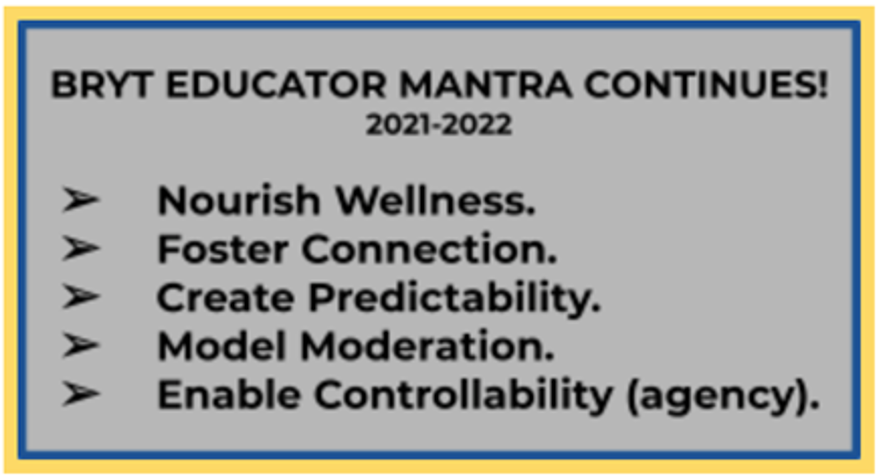
BRYT is honored to work with BLS coaches and leaders to support school-based Student Success teams in developing an intensive intervention for some of the district’s most seriously struggling students and families.  At the same time, we recognize that all students, families, and educators are experiencing significant challenges, and teachers are facing the realities of dysregulation every period of every day.  Dr. Bruce Perry’s core message is instructive in this regard: if we are to work with students in a way that fosters their ability to reason and reflect (critical for internalizing, retaining, and applying new knowledge), we first need to make sure that they are emotionally regulated and able to relate to their teachers and each other.  Here is our mantra for this work:

Nourishing Wellness & Modeling Moderation: Educators are dealing with more challenges and stressors than ever. While healthy levels of stress help us grow and become stronger, we cannot expect to work effectively and sustainably with students over the course of this school year if we are not afforded the time and resources to take care of ourselves and each other. Wellness doesn’t just happen—it depends on leaders and educators alike to set and sustain intention, making it not just okay, but an integral part of a systematic culture of care among school staff. As we work to support the students in front of us every day, we must also continue to increase our awareness of how systems either promote wellness or perpetuate disease and suffering, especially for those who are marginalized with less privilege and power—and as we increase our awareness, we can and must continue to engage in the kinds of uncomfortable reflections and conversations that address the inequitable distribution of wellness that too consistently characterizes our communities. When educators are cared for, a culture of care is then naturally extended to students and their families.

Fostering Connection: Consider integrating consistent, semi-structured non-academic check-ins with all students. These might happen in the context of advisory programs, or on a rotating basis during class. It is essential that all educators understand each school’s mental health infrastructure and referral process, in order to know exactly how to access support for students. Based on observations and information collected in check-ins, educators can provide basic support and care to students facing mild challenges. When there is heightened concern for wellbeing (perhaps due to a sudden change in behavior, appearance, or function) teachers can quickly notify administrators and support staff.

Create Predictability and Enable Agency: After so much inconsistency and time away from school, many students continue to be disoriented. Ongoing focus on orienting students to people, places, and routines/use of time is critical—even when it feels like they “should” be fully oriented and even if this means pushing back against pressure (whether real or internalized) about the need for academic catch-up. Providing achievable opportunities for students to choose how they engage with learning offers a sense of control. Additionally, this is the time for all educators to expand their tactics for helping themselves and students regulate emotionally through consistent rituals and routines, movement breaks, mindfulness, intentional transitions, and integrated SEL skills.  For those interested in broader understanding and tactics, Dr. Perry’s team provides many resources.

In building relationships and fostering powerful connections, entire communities benefit. When our interactions are full of compassion, grace, and hope, there is profound potential to heal, strengthen, regulate, and create belonging—whether it’s holding a door, negotiating an extension on an assignment, or reassuring an exhausted parent or colleague that they are not alone.