
Whose Voices are You Hearing in Your Classroom?

As educators we have all had interactions with students that impact us a great deal. One involving student voice was particularly impactful for me.

While working with a new high school math teacher I sat with a table of his algebra students as they discussed a challenging math task. Each student was asked to reflect on their ideas and connections to the problem. As the group I was sitting with did this, one student shared an idea that really connected to the problem but others in the group did not recognize it. I simply asked this student to repeat what he just said. When the student shared again the other students listened more attentively and realized the connection. As a result, the group had a great conversation and made sense of the problem. At the end of the class the teacher’s formative assessment was simply, “What did you learn today?” This student raised his hand and said, “I learned what it feels like to be smart in math class!” It hit me then how important it is for ALL our students to feel “smart”, heard and have their ideas valued in the classroom. This is what it means to belong in that space. 

If it’s true that those that are doing most of the talking are doing most of the learning, how can we amplify the student voices that don’t typically get heard in our classrooms? How will amplifying those voices change the dynamics of our classroom? 

The Matthew Effect describes what happens over time when some children enter into a positive feedback loop, whereby those who break the code with relative ease experience a positive effect and are able to learn what tasks they are given in schools with relative ease while those who don’t have the opportunity to get feedback do not experience this growth in learning.

Consider this analogy from a 2019 report in “Just Equations” on Race, Math and the Matthew Effect:

Two little girls join the soccer team. They have nearly identical athletic skills. Both are good runners, but Maria runs a half step faster than Gail. When the first soccer lesson begins, there’s one ball. They both run forward, and Maria gets to the ball first and kicks it. After they’ve done this 20 times, Maria has practiced kicking the ball 19 times, and Gail has had only one opportunity. A week later, Maria has learned a lot more about kicking the ball than Gail.                               

The slight difference in speed has widened into a much bigger difference in opportunity that, in turn, has widened the gap in kicking skills. After a while, Gail thinks she’s not good at soccer. She thinks Maria is good at soccer. Gail’s sense of soccer identity and belonging lead to diminished motivation and effort. Meanwhile, Maria’s excitement and motivation grow. There is no mystery as to why Maria will improve at a much faster rate than Gail. Her opportunities to learn in the moment, and over an increasing accumulation of moments, are greater—much greater.  

It does not have to be this way.                       

Across the field, another soccer team is practicing, and that team will wind up winning the championship. That team is well coached. They have 20 little girls and 20 balls. All the girls kick the ball often and get feedback from the trajectory of the kicked ball. The coaches systematically give feedback to each girl, not just the girls standing near them, or the girl who attracts their attention. 

In our classrooms, similar unnecessary differences in opportunity cause Matthew Effects. When the teacher poses a problem, some students raise their hands, saying “Ooh, ooh, ooh!” wanting to be called on. Time and again, they get the teachers’ attention, feedback, and encouragement. Meanwhile, many other students’ hands stay down as they build the mistaken identity that they cannot learn math. When teachers move too quickly, covering topic after topic, some students get left behind, not receiving feedback or instruction that makes sense to them. Day after day, the opportunity gap accumulates, and aspirations— especially STEM aspirations—erode, particularly for students of color and low-income students.

How can we make sure every student gets their “foot on the ball”? How can all of our students feel that they belong in our classrooms and “feel smart”?

If these questions have pique your interest, please check out these resources:

8 Ways to Empower Student Voice in Your Classroom Short article from ISTE

3 Strategies to Get Students Talking in Math Classrooms Short article from Edutopia

Simple Ways to Promote Student Voice in the Classroom Another brief article from Edutopia

Never Say Anything a Kid Can Say an article by Steve Reinhart. This is an oldie but goodie!


If you would like to add a shout out to a colleague, please do so here.

To Matt Faurot, Tara Termes, Katie Lyons (CMS):

“An amazing all school WEB assembly!”

“These three are doing an AMAZING job running the WEB program. The assembly they ran was fantastic and they made it happen. We have not had a school wide assembly since Covid began. Tara, Katie and Matt are really a fantastic team!” -Melissa Morris

To Chelsea Jennings (MVHS):

“Chelsea is doing so much. She has spearheaded the Bend LaPine Schools Newcomer program with such grace and professionalism. Her students know that she loves them and is always there. Her commitment to excellence challenges me to a be a better person. I also am so thankful for her steady, calm demeanor; she’s talked me off the ledge many times and I am so grateful to have her working with me as a partner in serving our ELL population!” -Nicole Contreras

To Lindsay Nickerson (CHS):

“Lindsay puts her creativity and joy into her classes and she gives them so many amazing experiences! Her classroom is warm, welcoming, fun and engaging.” -Bekki Tucker

To Jackie Greewood, Matt Johnson and The Summit Math Team (SHS):

“Jackie planned and facilitated a studio experience along with Matt Johnson for the Summit Math Team where the focus was on Ambitious Math Teaching, that is homing in on what keeps our students engaged, including anticipating teacher moves that will keep student on task and talking about the reasoning of their math ideas. A full day of learning and reflecting with each other!” -Linda Adams

To Amy Romero, Leigh Ann Medina, Sharon Sieveking and the entire Mountain View Math Team (MVHS):

“Leigh Ann and Sharon co-planned an amazing geometry lesson on writing proofs. EVERY SINGLE STUDENT WAS ENGAGED! They introduced the subject by comparing two column proofs to playing UNO. Using ideas from TDG’s Ambitious Math work Amy facilitated the full day PD with her team seamlessly. We did the math as teachers, anticipated student struggles and teacher moves that would keep the learning happening. Thank you Mountain View Math Team for a great day of PD!” -Linda Adams


SUPPORTING MULTILINGUAL LEARNERS: Part 1

Build Relationships

Learn how to pronounce and spell your students’ names correctlyWhen you learn how to pronounce your students’ names correctly you are doing two things; you are reaffirming their identities AND you are honoring and celebrating who they are. This is culturally responsive AND creates a sense of belonging. According to mynamemyidentity.org, by pronouncing names correctly you can build positive relationships in the classroom, which are crucial for healthy social, psychological and educational outcomes. 

Video: The importance of names and saying them correctly: ¡Colorín Colorado! (1:39 min.)

Greet Your Students at the Door

Greeting students at the door sets a positive tone and has been shown to increase engagement and reduce disruptive behaviors. In one study, when teachers started class by welcoming students at the door, academic engagement increased by 20 percentage points and disruptive behavior decreased by 9 percentage points.  Why? Research shows that greeting students at the door bolsters a feeling of belonging and a readiness to learn. It’s also a great way to get to know your students and for language learners to practice their social skills in a safe and supportive way.

Looking for more support? Reach out to . . .

Liza Digiglio Huet

Secondary Instructional Coach

Office of Diversity, Equity & Inclusion – Multilingual Services

[email protected]

541-355-1054


If you would like to add a shout out to a colleague, please do so here.

To Ron Crawford (BSHS)

“Ron is an excellent mentor. He goes above and beyond to help all colleagues and invest in this next generation of teachers. Thanks for always being there Ron and helping train up the next group of teachers. You inspire and you continue to grow yourself. Excellent example.” – Kathleen Glogau

To Amy Bruner (PBMS):

“Amy is our WEB leader, our Orchestra director, and is EXTREMELY good at organizing our student leaders in help our school community. She models patient and respectful behavior in ALL of her interactions.”

To Ben Jackson (LPMS):

“Way to remain calm, cool, and collected when talking with some of our most difficult students. You are very much appreciated!!”

To Spencer Wilson (LPMS):

“Way to be an outstanding 6th Grade Science teacher! You are a wonderful addition to our LPMS family and are doing a great job.”

To Summit High School English Teachers (SHS):

“I have twin boy/girl seniors this year! Together, they have taken many classes from Summit’s awesome English department. I want to thank that team for being amazing, and for meeting each student where they are. They took my son (“meh” reader/writer) and inspired him with books he loved, and he is arriving at being a college capable writer now, thanks to them. They also took my daughter (twin opposite!), a voracious reader and gifted writer, and helped her to hone those skills. One who didn’t say enough, now elaborates. One who said too much, can now trim down, and get to the point. This appreciation extends to the librarian, in the reading realm. Thank you all for helping my twins with lifelong learning.”

Teacher Shout Outs

We witness the fabulous work you do in the classroom.  Join us in recognition of your work and dedication. 

See something incredible happening in the classroom, in the hallways, online or outside of school that makes your school a better place for staff and students? Shout out to your colleague who is making it happen. You are the reason spectacular things are happening with students.  Bend La Pine is fortunate to have a dedicated team of professionals.  Let’s celebrate your hard work.

Every week we will highlight the work you do. Fill out the google form to recognize a colleague.


A couple of examples to get us started!

Shout out to Chris Kuka at Summit High School.  Chris has dedicated time researching and developing an Executive Function program at Summit.  In tandem with his colleagues, Chris connects with freshmen about their brains and how they work.  He uses a framework for each student to self-identify their EF strengths and weaknesses and then teaches the explicit EF strategies. Chris is paving the way to ensure all students have the tools they need to be successful in the classroom and beyond.


MVHS Freshman team (Joy Teson, Shauna Johnson and Trevor Tesow) met to collaborate on a hands-on urbanization activity for their students.  The Urban Game raises the roof! A great way to engage all their students.


Pilot Butte 6th grade Middle School Math Teacher Patty Brun is committed to creating an inclusive classroom where all student voices are heard. She is invested in developing relationships where her students feel safe to share their mathematical thinking. It was exciting to be in her classroom and I’m pretty sure that wasn’t just the anticipation of the fire drill that day!

Equitable Grading Strategies

Are you struggling to make the transition to a new way of grading?  In Rick Wormeli’s article, “The Grief of Accepting New Ideas” (LINK),  Wormeli suggests, “The way we teach is often a statement of who we are.”  Wormeli also suggests that the presentation of equitable grading practices implemented in our district may feel like a questioning of our values as we sort and navigate how to reinvent ourselves in an ever-changing world.  How do we hold tight to our confidence as educators, while also letting go of practices ingrained in our teaching so we may be open to accepting new ideas?  Wormeli suggests that with this change comes vulnerability and grief over the loss of this part of our identity. 

Depending on how you are wading your way through the start of the year with standards based grading now on your plate, hopefully you are on the side of hope.  Hopefully, you have turned to your collaborative teaching community to seek resources to make this transition a bit more bearable, more productive for you, and more valuable for students.  If you are looking for some teaching strategies to help support your transition to standards based grading, please see below for a collection of strategies presented at the Innovation Conference by three teachers from the Equitable Grading leadership team (Katie Lyons, Erin Hoffman, and Nishka Morton)

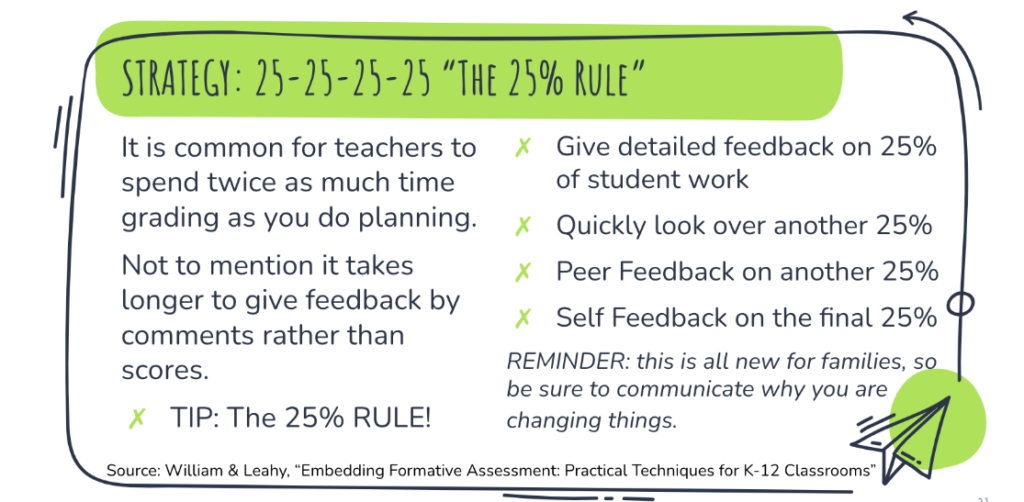
Disperse the Grading


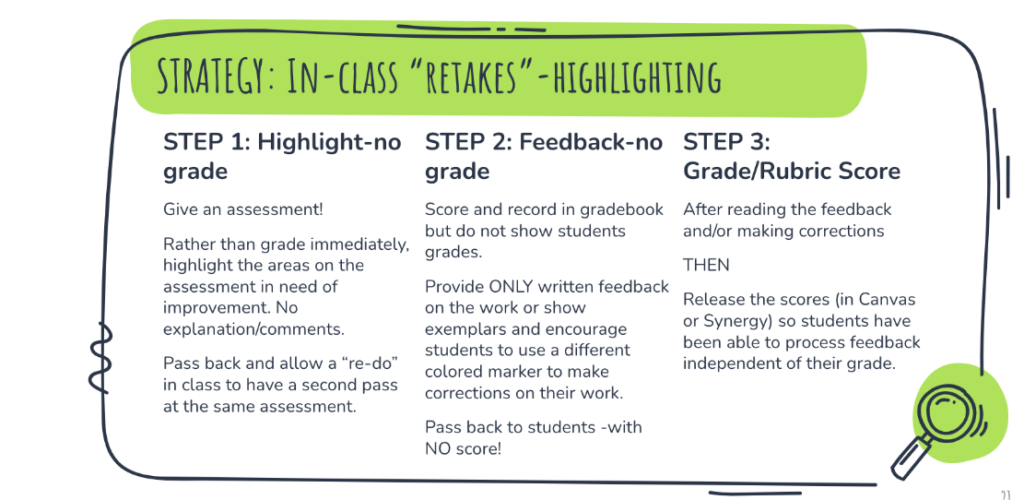
In-class Retakes

Are you struggling to find time for students can retake assessments?  Can you utilize class time to allow students multiple attempts on their assessments?  Try a highlighting technique for providing feedback on assessments.  Here is a video to show how this process works in one classroom:  LINK  A summary of this process is below


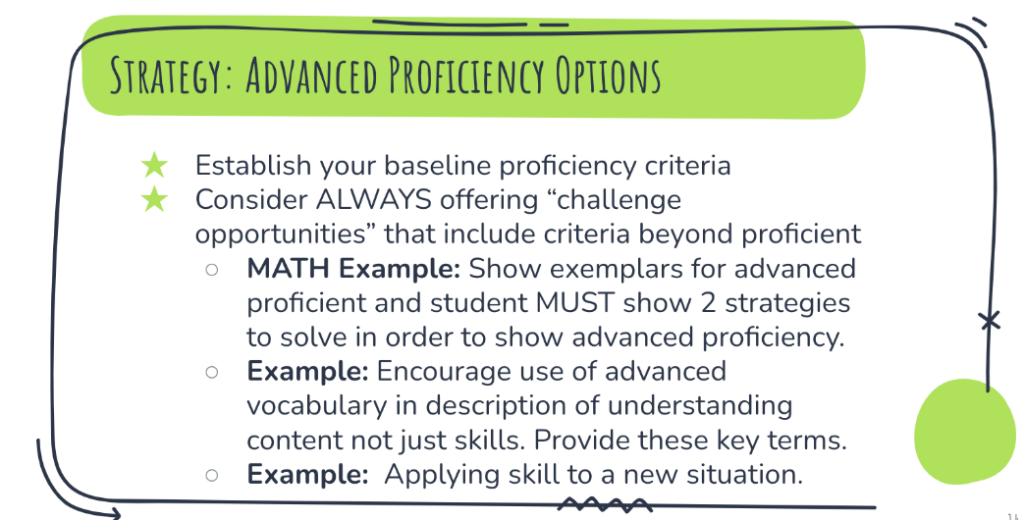
Advanced Proficiency Options

Often equity work is considered from a bottom-up perspective but don’t forget the opportunity to challenge your high achieving learners as you modify your assessments this year.  Consider building out extension opportunities on all assessments you create or assign this year. As you transition to rubric scoring, you will be better prepared to evaluate student work when you have developed the top-end of the rubric with your highest achieving students in mind.  By challenging them to pursue these extensions at every opportunity you are creating a bar in which they can rise to your clearly-stated expectations.  These are great opportunities to have students show true learning through content or development of their skills.  See below for a few ideas to consider:


More Tips!

Here are some of Rick Wormeli’s Practical Tips for Re-learning and Re-assessment:  LINK.  Re-learning may be the most important step in moving student learning forward.  Creating a thoughtful plan for re-learning the material and providing student choice for how this re-learning takes place, may in fact allow students to see their mistakes and failures as opportunities to learn.  

Last, don’t give up!  This work you are doing to transition your grading practice is challenging but important.  Student learning and mindsets have great potential to shift and grow.  If you need specific help or resources please reach out to your administrator or a member of the equitable grading team for support.