

Whose Voice am I Hearing? The Evolution and Revolution of Chatbots

The fodder of science fiction stories has finally arrived in our classrooms – students can use artificial intelligence programs such as ChatbotGPT to craft well-written and even sourced essays that you may find challenging to prove are not their own. Such writing programs will write essays according to any given prompt and length parameters, and are currently FREE for students to use.

At the outset, the three most helpful deterrents appear to be: 1) require students to hand-compose and keep process pieces (ideally, which you review and discuss for the purposes of feedback and goal-setting), so that there is a paper trail and they can easily demonstrate authentic ownership of the work, 2) require students to compose drafts and revisions in Google docs so that you will be able to access a version history that will show you their final draft evolution, and 3) consider providing as much or more grade credit for the process pieces than for the single, final product. All of the above de-incentivize using a ChatBot or – if a student was not deterred ENOUGH – make it more possible for you to trace the genesis of their work.

Also hopeful is Turnitin, which is developing code to detect Chatbot essays as non-human-composed. Equally hopeful (maybe) is an app developed by a college student, and currently free for you to check essays against. (Read more below.)

The days are early though, and this truly is “breaking news” in our classroom worlds. This story – and our best defenses against it – will be changing rapidly in the coming weeks. For now, we want to give you a few links so you can see a curated synthesis of some of the information currently out there about this topic.

The CNBC article “Why tech insiders are so excited about ChatGPT, a chatbot that answers questions and writes essays” takes a deeper dive into the development of chatbots, how they work, what companies have invested in developing their own text-based artificial intelligence tools, and even displays a written response developed by ChatGPT.

Curious how much companies are willing to invest in AI-writing technology? The article, “Microsoft escalates talks with the chatbot threatening Google’s dominance” is a quick read detailing the money and moguls involved in catapulting ChatGPT and other softwares into the limelight.   

Writer and Forbes contributor, Bruce Weinstein Ph.D, writes of the ethical questions raised by the use of artificial intelligence writing tools in: “Which Section Of This Article Was Written By An AI Chatbot?” He puts his own writing to the test when compared to an AI-produced response, and guides readers through some of the moral quandaries posed by the developing technology.

How can ChatGPT hold up in an AP Literature class? In this video, Wall Street Journal’s Joanna Stern, tried her hand at “Cheating with ChatGPT.” (7min)

The Journal discusses Turnitin’s commitment to handle AI detection for us: Is ChatGPT Writing Your Students’ Homework? A New Technology will be able to Detect it (Turnitin is currently available to all BLS high school students.)

NPR’s Monday report discusses the college-student created app, currently free for your use, that will help detect likelihood of AI origination: This 22-Year Old is Trying to Save us From ChatGPT Before it Changes Writing Forever

And, finally, on a lighter note: Summit High principal Michael McDonald requested a TGIF sonnet from Chatbot. Here’s what it generated: The weekend is here! School is done! / For two sweet days, we teachers can relax / For two nights, leaving all homework undone / By pool, book, or Netflix, we can Kick Back / Our afternoons spent with cherished friends / For camaraderie and to share a drink / While most of us just want the weekends’ ends / To muster the strength required, we need to think / And when it’s time to bid goodbye / The fact of school will be remembered fondly / Our opportunity to strive and try / And during the week our work will be seen soundly / The week may just bring challenges and dread / But still we teachers know the weekend is ahead!

Still curious? Here is an upcoming (free) webinar offered by The Write Center, discussing the issue: ChatGPT and the Future of Writing instruction.
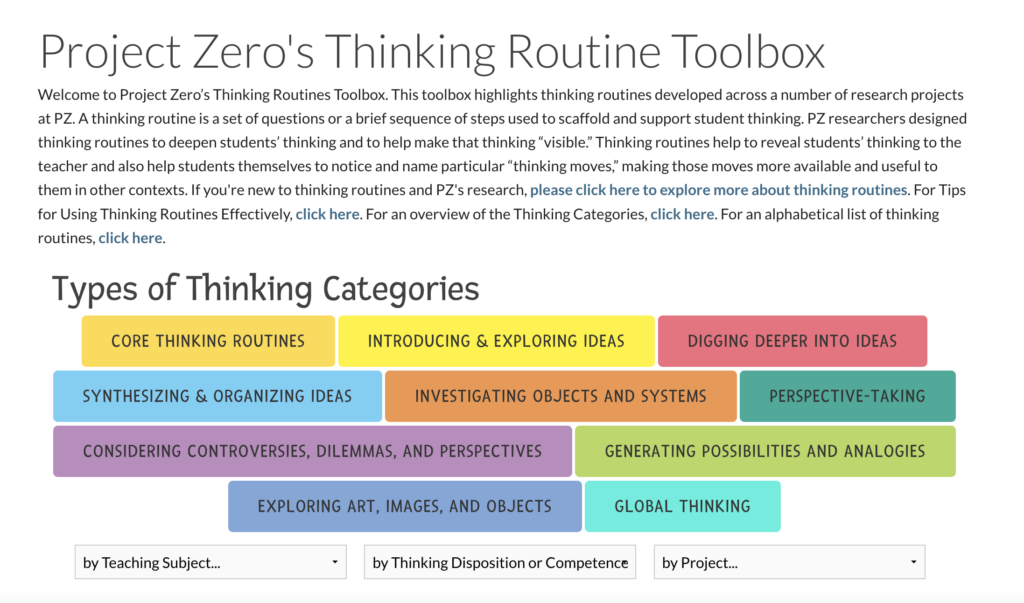

Student Thinking Toolbox

This website by Project Zero of the Harvard Graduate School of Education is full of routines for getting students to think critically about their learning and about the perspectives of others.

Search by subject area and grade level. Dig deeper and find that each routine has lesson strategies. For example, under the blue tab for Synthesizing and Organizing Idea is Portable Surprise with a Resource Link that summarized the routine and suggested ways to use it in an Ecology unit. Click on the image below to go to the website.

The following video talks about routines rather than strategies, meaning try one strategy with lots of practice to make it a routine. The video is 4:36 minutes.

Refection on 2022

As a Secondary Instructional Coaching team, we love working with you and your students. We know how hard each and everyone of you work and we appreciate your dedication to teaching This week’s blog post is a reflection on some of the ideas that have been shared in this post during this school year, many of the ideas that we have learned from you!


from Torie Withers: My favorite blog from 2022 is “Whose Voice are You Hearing in Your Classroom?” because of its timely, and also timeless, message: Every child deserves to be affirmed and acknowledged every day. As educators, our number-one goal is to support our students and create inclusive-learning environments where all children can thrive. This blog post highlights the fact that many of our students may not experience positive-feedback loops in their classrooms, and consequently are not accessing learning or experiencing growth. For me, this post is an essential reminder of the “why” behind how children learn as well as why we as teachers do this work.

from Colleen Behrens: My favorite blog(s) from 2022 is the three part series from Liza Huet; Supporting Multilingual Learners, Stages of Language Acquisition, Strategies that Work – We are often searching for strategies to help our multilingual learners succeed.  Liza’s provides a few gems that reminds us of the importance of creating a sense of belonging with simple acts such as learning students’ names or greeting each student at the door. The blogs also revisit strategies from SIOP and Envoy that many of us already know but may have forgotten during the past few years such as: making learning visual, “I Do,We Do,You Do”, and mixing up the Think-Pair-Share.

from Michele Clements:  My 2022 favorite is “Feedback vs. Feed Forward” – As language arts teachers, exploring ways to best prepare our students for a 21st century context we can not yet imagine, one of our most diligent efforts comes in the effort to teach process over product.  Feedback is an integral part of that because our traditional feedback methods – especially those tied to grades – tend to be product-focused ones.  This is a great blog for nudging our thinking forward, suggesting other feedback options for us, and challenging us to accept the possibility of more effective timing and methodologies.

from Linda Adams: My absolute favorite is the Shout Outs!!! One of Monica’s most fabulous ideas. In addition, I really appreciate what Liza has shared about sporting bilingual students on October 21.

from Monica Freeman:  Teachers are the Best of Bend La Pine.  You make the art of teaching successful for our students. Everyday.

If you would like to add a shout out to a colleague, please do so here.

To Aaron Groenewold (CMS):

Aaron provides a fun, safe classroom where ALL kids feel included and seen. He works magic with some of our hardest-to-reach students, and we’re so lucky to have him at our school Way to go, AAron!

To Madeline Ranstrom (CMS):

Madeline is a fantastic Spanish teacher, but also needs to be recognized for her quick thinking and response in her classroom for a student that was choking and couldn’t breathe. Madeline kept her class calm while administering first aid to the student, and averted what could have been a very awful situation. Way to go, Madeline!

To Deanna Anguilla (TRS):

Deanna helped plan a great assembly recognizing local Veterans on Veterans Day. The entire K-8 student body and many parents showed up and thanked them for their service. Afterwards they had biscuits and gravy, eggs and coffee for breakfast.

To Chris Ruff and Jenny Brown (CHS):

Chris and Jenny collaborate every single day as they work to develop relevant and engaging World Studies curriculum. They support each other through a curricular lens, and they support each other through the challenges of teaching and building a cohesive social studies department. Chris and Jenny set the standard for collaboration. -Chris Boyd