The fodder of science fiction stories has finally arrived in our classrooms – students can use artificial intelligence programs such as ChatbotGPT to craft well-written and even sourced essays that you may find challenging to prove are not their own. Such writing programs will write essays according to any given prompt and length parameters, and are currently FREE for students to use.
At the outset, the three most helpful deterrents appear to be: 1) require students to hand-compose and keep process pieces (ideally, which you review and discuss for the purposes of feedback and goal-setting), so that there is a paper trail and they can easily demonstrate authentic ownership of the work, 2) require students to compose drafts and revisions in Google docs so that you will be able to access a version history that will show you their final draft evolution, and 3) consider providing as much or more grade credit for the process pieces than for the single, final product. All of the above de-incentivize using a ChatBot or – if a student was not deterred ENOUGH – make it more possible for you to trace the genesis of their work.
Also hopeful is Turnitin, which is developing code to detect Chatbot essays as non-human-composed. Equally hopeful (maybe) is an app developed by a college student, and currently free for you to check essays against. (Read more below.)
The days are early though, and this truly is “breaking news” in our classroom worlds. This story – and our best defenses against it – will be changing rapidly in the coming weeks. For now, we want to give you a few links so you can see a curated synthesis of some of the information currently out there about this topic.
Writer and Forbes contributor, Bruce Weinstein Ph.D, writes of the ethical questions raised by the use of artificial intelligence writing tools in: “Which Section Of This Article Was Written By An AI Chatbot?” He puts his own writing to the test when compared to an AI-produced response, and guides readers through some of the moral quandaries posed by the developing technology.
How can ChatGPT hold up in an AP Literature class? In this video, Wall Street Journal’s Joanna Stern, tried her hand at “Cheating with ChatGPT.” (7min)
And, finally, on a lighter note: Summit High principal Michael McDonald requested a TGIF sonnet from Chatbot. Here’s what it generated: The weekend is here! School is done! / For two sweet days, we teachers can relax / For two nights, leaving all homework undone / By pool, book, or Netflix, we can Kick Back / Our afternoons spent with cherished friends / For camaraderie and to share a drink / While most of us just want the weekends’ ends / To muster the strength required, we need to think / And when it’s time to bid goodbye / The fact of school will be remembered fondly / Our opportunity to strive and try / And during the week our work will be seen soundly / The week may just bring challenges and dread / But still we teachers know the weekend is ahead!
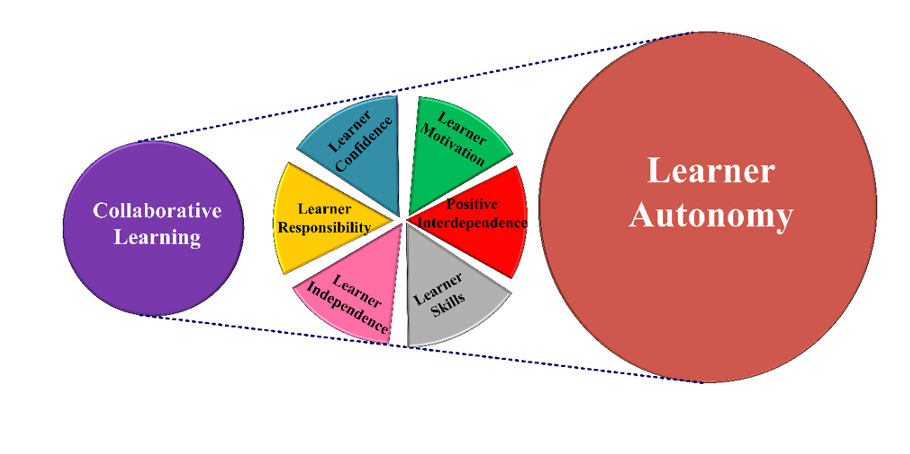
I don’t know about you, but for me, the hardest part of teaching virtually during the pandemic was the inability to create the same level of connection with my students. It became painfully clear to me that this lack of connection had a devastating impact on my ability to teach and for students to learn. This was multifaceted, no doubt. One contributing factor to my change in teaching was the “over-accountability” of small, micro-managed assignments for students in Canvas and the gradebook. I used small assignments and turn-ins just to see if my students were out there somewhere, logging in to their class. This was the antithesis of my typical pedagogy which encouraged and scaffolded increased autonomy in language learning. I felt that I was devolving. Ugh!
Now that we are back in the classroom, I am back to the drawing board to increase motivation specifically through student autonomy. Autonomy is identified as one of three basic psychological needs for learning, along with competence and relatedness. “The need for autonomy refers to learners need to be the initiator of their actions and to a sense of psychological freedom when engaging in a learning activity,” reports Leen Haerens, PhD for the Center for Self Determination Theory. To read more about the research behind these key factors, clickhere.
Tip #1: HOW AUTONOMY TRANSLATES TO MOTIVATION
Case: The Dreaded Class Presentation.
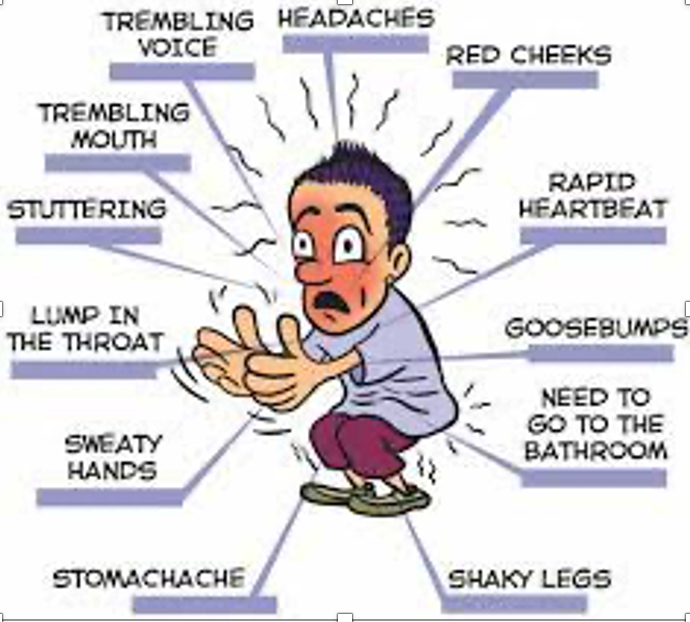
Even prior to the pandemic, I was seeing more students become increasingly stressed when needing to give presentations in class. Knowing that students are experiencing more anxiety in their learning environment due to the external stressors caused by the global pandemic, addressing this fear is key. When students have agency over an experience, their stress will decrease. We want to encourage students to gain presentational skills, but how can we still allow learner autonomy at the same time?
I developed an accommodations menu for presentations for my Spanish classes. I offer some accommodations to all students and save some of the scaffolded steps for students who are expressing considerable anxiety or have a 504 for anxiety.
For students working at the ‘Most Support’ level, we create a plan to move to down the menu to ‘Less Support’ throughout the year. I have found that students who would normally avoid a presentation, skip class, take a zero, or be perpetually absent will instead look at my menu, speak with me about what they feel they can manage, and create a plan for presenting. When a student knows that their teacher can offer choice, they see their autonomy respected and acknowledges. This builds confidence, trust, and motivation within the educational community.
Tip #2: ALLOWING FOR AUTONOMY WHEN DEMONSTRATING LEARNING
Case: Assessment Self-reflection
One way that I increase metacognition, which in turn increases autonomy and independence, is to ask students to do self-reflection on unit reviews prior to an assessment, and/or self-reflection after an assessment. Rather than prescribing a required review of materials, I ask students to identify what aspects of the assessment are challenging and what they plan to do to learn and meet the objective of the unit of study. If a student knows what is still challenging, they may not know how to study or fill in the gaps. This is where the teacher can suggest strategies, resources, or peer help. Curating collections of resources that are available to all students takes time for the teacher up front, but it allows students to practice autonomy when deciding what, when, and where to review, study or practice knowledge and skills. When students are engaged in reflecting on their learning and contributing to the study plan, they learn valuable self-assessment skills and see themselves as the key decision-maker in their learning journey.
The skills for learning a language are not always intrinsic. I can see students’ maturity and growth in autonomous learning as they move from novice level to advanced proficiency through our language programs. I can see this growth at my AP Spanish students analyze rubrics, look for and highlight evidence in their argumentative essays and ask me for specific help or tools. These are the skills we want our students to carry beyond the classroom into their jobs, advanced studies and into the greater community.
If you are curious about more ways to increase student autonomy in the classroom, enjoy a deep-dive here.
This morning I was curious. Where does “curiosity killed the cat” come from and what does it mean? Was it related to the naughty little monkey, Curious George?
I consulted my pocket computer…an idiom used to warn of the dangers of unnecessary investigation or experimentation? REALLY, what dangers?
For many, there is the belief that curiosity provides intrinsic motivation for learning. Sometimes that means Googling your question, and other times it involves digging deeper, letting yourself fall down “rabbit holes” and learning other new and related ideas.
In essence, we are ALL wired to be curious. Curiosity prepares our brains for learning and makes learning rewarding. Curiosity = Engagement!
Modelling curiosity is the first step to recognising and valuing it in your classroom. Teachers do this instinctively, asking questions to elicit thinking in our lessons, and showing enthusiasm and joy when we discover new things with our students.
One of my favorite ways to engage a lesson with curiosity is to start with a picture, graph, cartoon or quote and add 2 questions; “What do you notice?” and “What do you wonder?“
9:53 – Kathy explain the instructional routine in her classroom. Kathy’s math routine is applicable across content areas.
The beautiful thing about Kathy’s routine is that, while students notice and wonder you are validating all student responses and giving all students a voice, whether it is a content-specific wondering or whether it is purely an observation about what they are seeing.
Here is a second, holiday example:
What do you notice? What do you wonder? A New Zealand couple has dug up a monster-sized potato. It weighs 17.4 lbs and has been nicknamed Doug. Here’s my curiosity-driven math question for students: potatoes typically have a density of 1.08g/ml. About how many cups of mashed potatoes would Doug provide for a holiday dinner?
By the way, in case you were still wondering…
The earliest reference of the proverb “Curiosity killed the cat” came from William Shakespeare in his play Much Ado About Nothing. In the original form it meant “care or worry or sorry killed the cat,” not curiosity. I agree! For teachers, curiosity is too powerful an instructional tool to kill anything. Let’s celebrate what makes us curious!
The weight of the past two years feels heavy on our shoulders. Teachers are reporting that students are lacking skills in social-emotional areas and academic skills. Many teachers are asking, “How do we support our students and the gaps in learning we are seeing with them right now?”
Taking a “we are all in this together” approach, it seems imperative that we, as a school community of educators, tackle what we’re seeing in our students head on, and collaboratively.
In the 2019 book Disciplinary Literacy Inquiry & Instruction by Jacy Ippolito, Christina L. Dobbs, and Megin Charner-Laird, the case for teaching literacy across disciplines is strongly made. All teachers should view themselves as playing significant roles in developing a student’s literacy.
One way teachers can support students is by pointing out ways in which texts look very different in each class. The text that students engage with in Language Arts looks very different from text in a Career and Technical Education course. The lens that a reader must take for a Social Studies text, which is filled with bias, is different from many texts in a Science course.
AdLit: All About Student Literacy has a website has a slew of amazing, simple, & ready-to-implement-today reading strategies that all teachers can use in their next lessons. The strategies emphasized are: Comprehension, Vocabulary, and Writing. What I like most about the way the website organizes these are in when you would implement these strategies in the reading process: BEFORE reading, DURING reading, and AFTER reading. I want to highlight a favorite from each stage of the reading process. If you’re intrigued, the website is easy to navigate and will offer many more!
Before Reading – Concept Sorts
One of my favorite reading strategies is Concept Sorts — using this technique, you can develop some prior knowledge and connections you want kids to make on their own. As an added bonus, the format is simple and will reach all students.
(Concept Sorting is a way of engaging students in Hexagonal Thinking, which has become a new rage in education – If you’d like to learn more about it, I’ll link an interesting blog post from The Cult of Pedagogy.)
During Reading – Concept Maps & Highlighting
The first one you might want to consider trying while students are reading is a Concept Map (I like to call them Brain Webs) — it’s low-stake writing and thinking, perfect for students with skills that are limited. The limited amount of writing and focus on single words and phrases helps students organize their thoughts quickly.
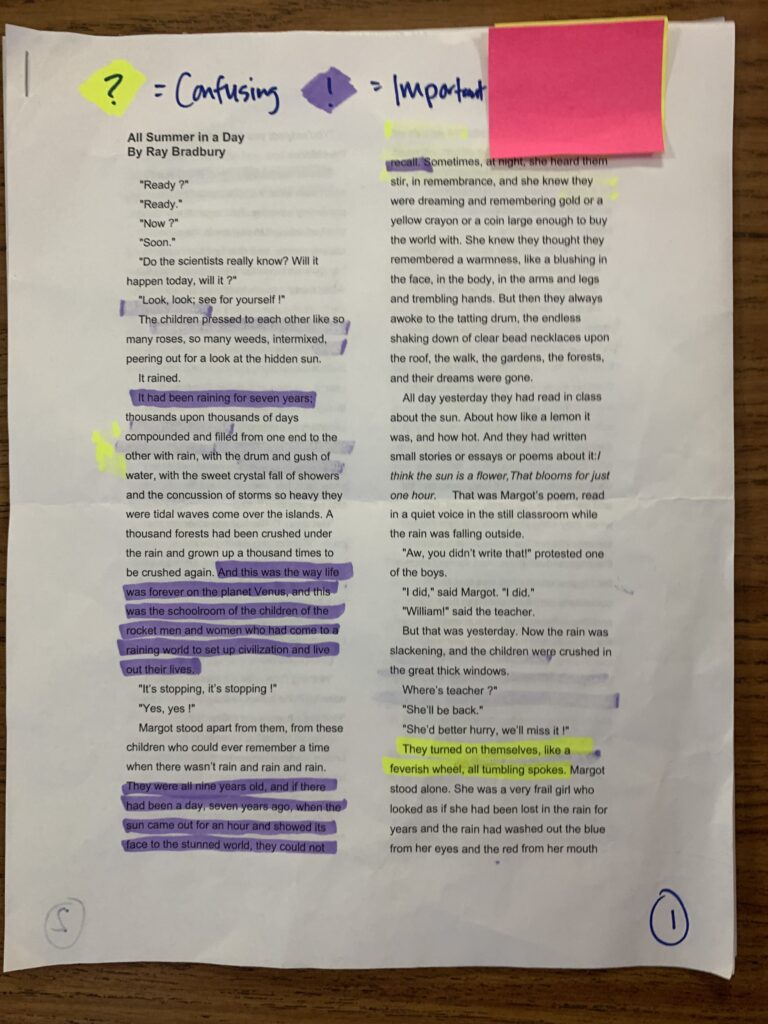
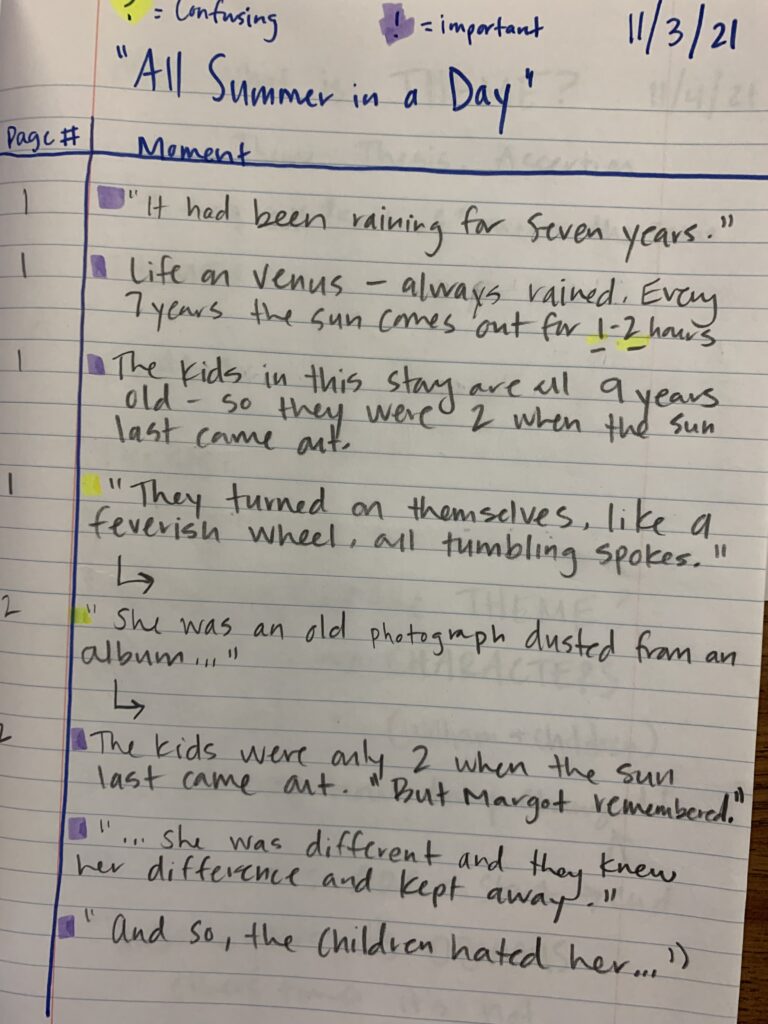
Another strategy I love and slightly adapted from the website version is Two Highlighters: Important and Confusing – I love telling my students, “It’s a sign of intelligence to be able to admit what you don’t know or understand.” The idea is in one color, they highlight words and moments that they don’t understand. The other color is for those moments that make us think, “Wow, this seems really important. I may not know why exactly yet, but I want to remember to look back at this later.” When I model this in front of them, chart it on a simple table in my reader’s notebook, and show them how to resolve simple issues that may be tripping them up, it increases reading comprehension by so much. It forces students to go back and re-read, to think deeply, and shows them a strategy they can use in any class, with any text. Once students have these moments organized, teachers can help strategize ways to resolve the difficult moments. If it’s vocabulary, would defining it help? Finding a synonym to replace the difficult vocabulary term? Is it a context issue?
After Reading – Summarizing
Summarizing is a tough skill for students, but we know it helps build comprehension. Generally, we see students write too much or pull out less-important information. Using this strategy, teachers can hone in prior knowledge and help build vocabulary. One way you could guide students into a more-targeted approach is the
How to implement this right away: Begin by reading OR have students listen to the text selection.
Ask students to write a summary of the target text based on the following framework questions:
What are the main ideas?
What are the crucial details necessary for supporting the ideas?
What information is irrelevant or unnecessary?
Guide students throughout the summary writing process. Have them use keywords or phrases to identify the main points from the text.
Encourage students to write successively shorter summaries, constantly refining their written piece until only the most essential and relevant information remains. I like the “Summarizing 5-3-1” method. Give students a task to summarize a passage or text in five sentences. Then practice with three sentences. And finally, challenge students to write a one-sentence summary. They will improve on identifying the most important details quickly with this strategy.
Many teachers use some version of points in their grading system. Points may be given for assignments and assessments, extra credit, behavior, participation, and/or motivation. Most of us probably had teachers who used points in the classrooms we grew up in.
The downside to using points is that they can turn into a commodity that students use to get a grade, rather than an accurate representation of a student’s knowledge. Students may ask how to earn a few more points to get from an 87% to a 90%, but none would ask for those three points to move from an 84% to 87%. However, as long as the point increase is accompanied by an increase in learning, shouldn’t all increases be considered valuable?
Redos and Retakes
All of us have taught a lesson that did not go the way we’d hoped, only to get to try again the next period or the next day. What if our students stopped us and said, “Sorry, you can’t teach that to us again, you taught it yesterday!”
It is true that the world has timelines, but it also gives grace for learning. The ability to redo something happens all the time in our students’ lives. (Retaking a driving test is perhaps the most important retake our students will have in their adolescence! When our children don’t do a good enough job cleaning their room we don’t say “You got one chance to clean it!” We say, “Go back and do it until it is done correctly.” They – and us – get redos every day, when the first effort wasn’t successful.
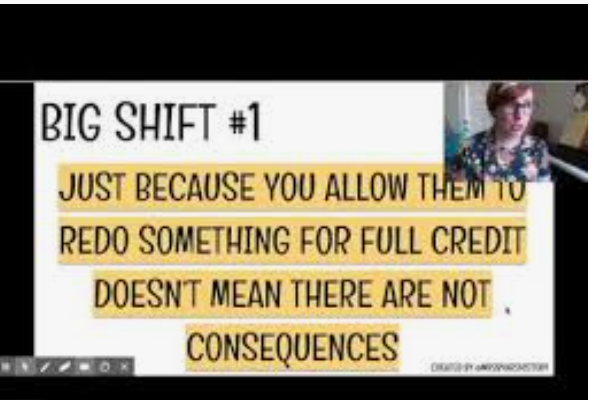
If the goal of a class is to impart knowledge to a student, then when the student demonstrates that knowledge must be flexible. The ability for students to try again to show their understanding of the content taught shows we value their learning, more than our timeline. Furthermore, if the students can represent full knowledge of course standards, they should earn 100% of the points available. Removing an artificial celling (i.e., student can only earn 80% of the original total may reward a student for persisting, but it also punishes them for not learning as fast as others. Why do we want to do that?
Retakes and redos as mandatory practices in classrooms provide an equal opportunity to all students to show what they have come to understand as a result of our instruction and purposeful tasks in the classroom. If a student has a history of low success in school, providing multiple opportunities to be successful breaks a cycle of low achievement. It tells the student the game is not won at halftime, but at the end – and that adjustments can be made along the way. We also send the message to the students “I will not let you fail!” We continue to push the students to learn the critical information that we have determined is worthy of their time and effort.
8:33
Extra Credit Points
By definition, extra credit points are not required. This means that is some extreme cases, the points may not even be related to the standards being taught in the course (extra points for bringing in supplies or cleaning the board.) Extra credit exacerbates school as a game. If the purpose is for your students to know and understand a set of standards and content, then providing extra credit does not move a student toward more knowledge, it makes a grade currency that some students look to collect.
Extra credit can also undermine the desired outcomes of student learning. Students who play the point chasing game can give less effort to important key learning only to “make up” points with less critical knowledge. If the extra credit points are tied tightly to the learning of the course, then shouldn’t they be available to all students, not just those who have the knowledge of how to navigate the educational system. If the work is important, require it; if it is not, don’t include it in the grade.
While much of the conversation around equitable grading can be about what ends up on a report card, we all know there is a lot that goes into the creation of that final grade. The Equitable Grading Think Tank is also looking at the processes that guide the formation of that grade. Today’s post is about one area of their exploration: Homework.
There is no doubt that homework is an important part of a student’s school experience. Homework is the application of the skills and content taught in class. When homework is assigned, it is best when there is a high probability of success on the work; otherwise, students will be practicing incorrectly and will not have the ability to receive corrective feedback. We want to know if the student understands the content taught and to give them an opportunity to show that understanding. What we don’t want to do is have a student make mistakes. The old saying “Practice makes perfect” is not actually true. “Practice makes permanent” is true. This is why we want the practice to have a high level of success.
The practice that will have the most benefit for students is assigning things that a student is revisiting, is called spaced practice (6:23 minutes – works great at 1.5 speed!). This means that a homework assignment could have a few questions from a couple of weeks ago, a few questions from last week, and a couple of questions from the most recent learning that connect to the earlier parts of the homework.
In some classrooms, the homework assigned is the work of that day, (i.e., “Please finish any of today’s classwork you ran out of time to complete.”) For students with a weaker understanding of the content, the issue is now they must complete the work with fewer academic scaffolds. Students will do the work without the supports of the classroom, which includes other students who have received the same instruction and the teacher who delivered the instruction. While some students may have supports at home to produce accurate work, almost none of them will have the supports that were tied to the initial instruction. The most inequitable part of homework comes between those students who do not have the space, adult support, or ability to dedicate time (due to family and work responsibilities) to do homework and those who have all of these.
Since homework is practice, having homework play a smaller percentage of the overall grade makes sense. Grades on homework are typically given for 2 reasons: 1) correctness of work and/or 2) reasonable attempts made. If homework is given a heavy weight in an overall grade, we can have an inaccurate understanding of the students’ knowledge because the student for a variety of reasons, including correcting misunderstandings after the grade was assigned.
It is important that homework, if tabulated into a student’s grade, plays an accurate and supportive role – one that is motivating to both students and teacher. Curious to hear more? Rick Wormeli is one of the first Nationally Board Certified teachers in America, working full-time as an author, researcher, and trainer of teachers. Here, he discusses homework and grading policy.
Here’s the good news: If you did nothing more than alter your homework assignments to have more “spaced practice” characteristics, you would have taken a enormous step forward in utilizing a more equitable system that may well work better for you AND your students. It’s a possibility worth considering.
For many of us, one of the most startling parts of last year was the removal of the zero from our grading scales. The move may have felt seismic but, as with everything else, we have managed to adapt and continue on.
Meanwhile, the conversations around equitable grading have never stopped.In fact, this year, those conversations are continuing monthly among the 36 members of the Equitable Grading Think Tank. Represented on the team are a wide variety of secondary teachers as well as site and district administrators (names appear below), all of whom are deeply committed to representing their sites and our district with integrity and fairness, all of whom welcome your questions if you want to reach out.
To prepare this post, I spoke with Stephen Duvall, the group’s facilitator, current principal of Cascade, and incoming Director of College and Career Readiness, and two members of the group’s leadership team: Katie Lyons, middle school science teacher currently Cascade, previously at Marshall; and Mary Wellington, 24-year middle school Spanish teacher currently at Pacific Crest as well as long-time BEA site rep.
How is the Equitable Grading Think Tank organized?
SD: We meet monthly, during teacher-directed SIW’s. Based on applications, we’ve pulled together a group of teachers from middle and high schools across the district to have a voice in exploring equitable grading practices as a whole, and to look at making recommendations – including PD recommendations – by the end of the year. We also have folks on the team from downtown and from Information Technology so that, whatever recommendations we make, we have had all the necessary voices at the table. We’ve tried to achieve representation from every site, but there were a couple unable to participate at this time.
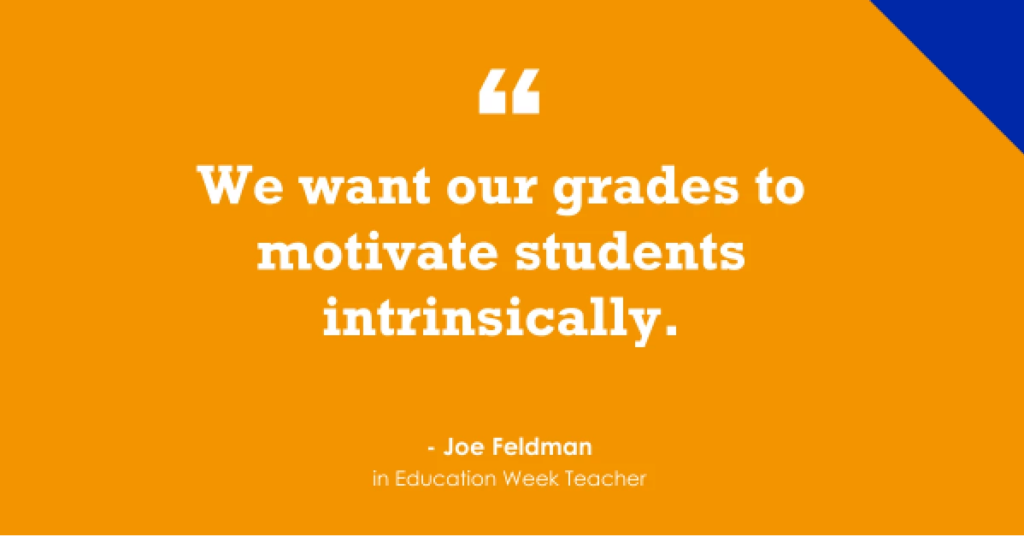
MW: So far, we’ve met twice. We all read Grading for Equity by Joe Feldman this summer and then we met to discuss. So far, we have focused on getting started by getting clear and unified about the ‘Why’ behind this work.
SD: We have all been tasked with keeping this work from living in isolation, with going back to our buildings and being conduits for our work. We want to be 100% transparent. Even if a teacher’s site did not have a representative apply to participate in the group, that teacher should not hesitate to reach out to us for more information and updates.
The team has also Partnered with Creative Leadership Solutions who has been very helpful in giving us a lot of resources to look at, and research to review. That organization has been very helpful in giving us ideas for how to have these conversations, and what conversations to have.
KL: We’re not here to push a model. We’re here to make recommendations after analyzing as many angles as we can.
What are the biggest learnings of the group so far?
KL: Learning why traditional grading practices are inequitable. The district has done a lot of work highlighting its own inequities – it’s a very valuable, reflective moment we’re having right now. This group pairs so nicely with those reflections, and the need for change can feel like it matters so much.
SD: The overall recognition that there is a need for a change. In broad terms, there is a sense that this is necessary work. We recently put out a survey to poll people on the ‘why’ behind the work – why is this important and why do we need to make some changes? Team members responded on a 1-4 scale: 1 = “I have no idea.” And 4 = “I am fully on board and believe this work is essential”. 100% of the group scored themselves a 3 or a 4. We are unified in this belief: there is a need for a change. Our group really is made up of a wide-range of perspectives from across the district, not unified in beliefs or in relationship to the work. So to be unified in recognizing that what we’re doing for kids is not equitable is a really substantial belief to share.
KL: Accepting the challenges we will face as a district trying to move forward. First, we have to expand the mindset and beliefs of many of our colleagues. Also, the logistics of making what feels like a drastic change in everything from classroom practices to the support systems in place to make it all work. A lot of concern has been voiced about how are we going to do this in a way that makes sense for all.
MW: There have been a couple of times during meetings where the perspective has been voiced: “This district already knows what it wants to do here.” I’m pleased to say that is not the case. I find that the admin we’re working with are very much open to hearing all perspectives from the different schools. Nothing has been decided yet. We are looking at everything. The voice of teachers and the voices of the schools is important and is going to be listened to. I don’t foresee an outcome where one decision is made for every site.
What are the big ideas the group is currently working on?
SD: Grading is a big beast. A thousand things go into it. As a group, we’ve identified four pillars for our decision-making process. We’ve looked at a number of folks out there, and everybody has some differences about their beliefs around what grading practices should be. We looked at those, and then narrowed down to the four that would be most impactful for our decision-making and selected those four. All of our research and recommendation needs to go through these four. As a group, we’ve decided that grading practices for our district need to be accurate, motivational, transparent, and bias-resistant.
From there, we’ve identified the buckets we need to examine as a group: homework, behavior’s role in the gradebook, retakes/redos; assessment methods and calculation methods; the process of identifying/using standards, scales, rubrics, and multiple methods of assessments; and systems – the structures and technologies in our buildings that will allow these changes to happen.
What will the final product of the group be?
MW: At first, we were thinking our group would be a one-year process, but we’ve since realized that may not be realistic. It may take two years – we don’t want to rush. We want to do this well. We may spend this year figuring our all the big ideas and then next year developing the PD plan.
SD: We are exploring each one of these buckets on a monthly basis. And then finding resources as well as people on our team that have been trying some of these practices. And then our goal will be to come up with a few key recommendations around best practices for that bucket. Our task is to make recommendations, not to make policy decisions.
Our second task is to make professional development recommendations around what training is needed to support a shift. No decisions have been made yet. After we make our recommendations, Lora and Steve will evaluate which recommendations will remain recommendations, and which might shift towards policy. However, no one is interested in making “thou shalt” changes as much as looking at what training and information can we provide to support staff members in moving towards more equitable grading practices.
If you were to look at neighboring large districts who have undertaken this work, it is a multi-year process. The great thing about this work is that there are some things that are easy, small shifts that can happen via small shifts in classroom practices. And then there are much bigger lifts that would require a lot more time and infrastructural investment. District teachers can know this work is being done thoughtfully and methodically over a large span of time. No one will be required to make huge changes quickly.
Can you give me an example of a topic and process you’re following to explore it?
SD: We are working with the topic of homework as a whole by looking at a wide variety of articles and videos; we also have some team members trying out a variety of strategies that will share their observations with us.
MW: With homework, what do we see? What is it that’s equitable? What is it that’s not? How can we communicate all that in such a way that people are going to understand and acknowledge our own inequitable practice, but then tweak it and make it a better thing? Instead of giving homework because we always have, how can we assign it in such a way that it benefits all students instead of hindering those without the home situations to support it?
SD: After looking at our research and hearing about the experiences of our colleagues as they’ve been trying certain things, we’re going to make a few bullet points of best practice recommendations. And then those will go to Lora and Steve who can take it from there.
Is there anything you especially want teachers to know, or to ask you about?
MW: Anything that people want to ask me about helps clarify for things for me too. It’s helpful to have to talk through ideas or explain reasons behind certain thinking. But we’re also early in the process – so my answers may still be evolving.
KL: Teachers are coming to their own reckoning. I’m hearing a lot of conversations around teachers wanting to do this work. My advice would be: absolutely! Absolutely delve in the waters and do your own research; but also know there is a team going about this in the most evidence-based and methodical way to ensure there is consistency moving forward and to ensure – for anything we want to do – we do it in a supported way.
We’re all so eager and I’m hearing lots of people wanting to hurry and make big changes. Part of me wants to tell them to slow down because this is such hard work. Good teachers that realize something is unfair want to fix it immediately, but we have to do it right. The power of doing this work together is exactly why we can do this work successfully.
Who is in the group, in case I have follow-up questions or want to look at some of the resources?
For most of us, our middle school and high school math and science classes were taught in isolation. Today not much has changed. A student will go to a math class and then to a science class and – though the content and concepts might be related – they are taught in isolation. In science, many of the Science and Engineering Processes (SEP) rely on mathematical computation to answer complex questions about phenomena. As students progress, conceptual learning relies on more complex mathematical reasoning for sense-making. In mathematics, students experience most learning of algorithms as deriving, manipulating, and memorizing “naked numbers” without context, and then may have some “word problems” in the independent work where they must decide which algorithm to use and what numbers to plug in.
What if the student’s experience was more of a crossover between their math and science courses? The CCSS-Mathematics and the NGSS have a lot in common.
Figure 1 compares the eight Mathematical Practices (MP) to the eight Science and Engineering Practices (SEP).
The terminology might be different between the MP and the SEP but the conceptual understandings are similar. Math and science teachers can explicitly teach the terminology of the MP and SEP in their classes to help students understand the interconnectedness of the two domains. Check out this video: here’s what one middle school did to help their students make those connections (6:49 minutes).
Similarly, the area of applied mathematics requires students to use mathematical modeling to describe scientific phenomena. UC Santa Cruz offers us a short video describing how their mathematicians, scientists and engineers use mathematics in their fields (3:41 minutes).
There are challenges to creating interdisciplinary experiences but how can we think differently about what we teach and how students learn? How can we create more opportunities for students to make real-world connections between math and science/engineering practices?
Below are some possible actions for math and science departments in the pursuit of more interconnection/overlap:
Compare terminology in math and science and explicitly teach in both subjects. For example, How is a conjecture in math similar to a hypothesis in science?
Coordinate SIW meetings to discuss the similarity and differences between the MP and SEP’s
Conduct learning walks where math teachers and science teachers observe each other in action.
Ask students to reflect on their experiences in both science and math.
Plan for opportunities to incorporate developing mathematical models, use computational thinking, and construct viable arguments, critique and debate the reasoning of others based on evidence across both disciplines.
Revisit the overlapping skills with the CCSS and the NGSS and intentionally include elements into your lessons.
TUVA LABS data analysis tool available as part of Stemscopes units for middle School science
Gizmos Math and Science simulations. All BLSD high school science teachers have access. Curious math and middle school teachers can reach out to Colleen.
Works Consulted: Mayes, Robert, and Thomas Koballa. “Exploring the Science Framework: Making connections in math with Common Core State Standards.” NSTA, Dec. 2012, static.nsta.org/ngss/resources/201212_Framework-MayesKoballa.pdf.
#1: WHAT IS NEWSELA? Newsela is an instructional tool that allows teachers to find articles with appropriate reading levels for their students. Newsela articles feature questions and writing prompts that align with common core standards. Newsela allows teachers to bring real life events into the classroom with engaging content and analytics that all students can access: ELA, Foreign Language, Social Studies, Math, Science, ELL, Current Events, Social-Emotional learning and more. It truly is an amazing tool that allows us, teachers, to give our students specifically targeted articles on just about anything (read: ANY subject can benefit!)
WATCH THIS VIDEO to see how to explore content and use the unique search capabilities.
#2: NEWSELA IS MORE THAN PDF ARTICLES: Newsela as a stand-alone…
You certainly don’t have to use Newsela and Canvas together. On its own, Newsela is packed with powerful tools to help you share current information on nearly any topic. It’s a great way to build literacy and allow your students to adjust the reading to their own specific needs. Start by enabling your district account by signing in through Clever. You’ll have access to all text sets and articles this way. You can also save content to use later. This is also where you’ll send your students to access digital news articles. WATCH THIS video to see all the Newsela features.
The PRO/CON text sets and Lesson Guides have everything you need to quickly plan a great lesson supported by age-appropriate reading levels for you students. (READ: Quick Sub Plans in a Pinch!)
#3: YOU LOVE NEWSELA, AND YOU WANT TO USE IT WITH CANVAS
START HERE: How to Sync Canvas & NewselaIt’s a teeny bit lengthy process (10 minutes), but I think you’ll be pleased with how Canvas and Newsela work together to make your life easier.
WHY MERGE THE TWO?
Newsela is available in ALL Canvas courses via the left-hand Navigation menu (if it’s not visible go to the bottom, hit Settings > Navigation and then drag Newsela to the top visible > SAVE)
Enables users to log into Newsela from Canvas & Use Newsela within canvas
Imports Canvas classes and class rosters into Newsela
Streamlines assignment creation: Newsela assignments created in Canvas are automatically created in Newsela
Streamlines grading: Grades do not pass from Newsela to Canvas; however, Newsela assignments appear as submissions and can be viewed and graded in Speedgrader.
See your students’ analysis & synthesis right in Canvas, directly on the Newsela materials you assigned
Assign pre-made or self-made activities for students to complete directly in Newsela: Quizzes, Writing Prompts, & More
ADDITIONAL RESOURCES: How to Embed Newsela Content in Canvas Assignment
Lucy Calkins Units of Study x Newsela Collaboration– If you teach ELA and use the Units of Study, this is actually a super cool training you can quickly do to see how you could integrate Newsela texts within your units.
CURIOUS ABOUT PEAR DECK? – This article provides a pro/con comparison and training video recorded by former BLPS teacher Gabe Schepergerdes. Teachers spanning the K-12 spectrum swear by it as an engaging instructional organizational tool. And because it’s basically a PowerPoint of your classroom day, it is easy to upload to Canvas for anyone who is absent. https://blogs.bend.k12.or.us/dean.richards/2021/03/15/curious-about-pear-deck/
AN ‘F’ IS AN ‘F’ IS AN ‘F’…OR IS IT? We know the conversation and controversy about removing 0% F’s from our grading scale is a difficult issue for many. Here are a collection of brief resources, helping to frame the conversation that has taken place in many districts around the country:https://blogs.bend.k12.or.us/dean.richards/2020/11/24/an-f-is-an-f-is-an-f-or-is-it/