Canvas Professional Learning Options for August 30th

In the afternoon (1:00-4:00), teachers will have a choice of several options to learn more about next steps in the use of Canvas. These trainings meet the contract requirements for District Directed Professional Learning.

These trainings are best experienced in person, as the Bend La Pine teachers/instructors will be able to guide you the steps to engage with Canvas in new ways. However, we realize that, for a variety of reasons, a synchronous, remote option via WebEx will meet some teachers needs; therefore, many courses will have that option.

During each of the courses (except for the invitational Grade Guardian course) you will receive information about Canvas-Synergy grade book set-up for this year. You will also receive the guidance for Canvas course expectations.

You do not need to register for the professional learning, you will only need to check in via Google form during the Canvas sessions.

Canvas for New Hires and Beginners

Facilitator: Dan Curfew

Location: Pacific Crest Middle School and La Pine High School Library

Description: This training is for teachers who are new to Canvas.  Canvas includes a variety of built-in course construction and management tools that can be customized to create unique and accessible teaching and learning experiences.  You will learn the basics of Canvas and have time to start building your courses

Canvas 201 – Leveraging Canvas to Increase Engagement

Facilitators: Leah Boon and Melissa Morris

Location: Cascade Middle School Library & WebEx (https://bls.webex.com/meet/leah.boon

Description: You’ve mastered the basics of Canvas — now you want to step up your game. This course will review the basics but go deeper with each so you can see how using the same tool in different ways can help scaffold learning and also build up to higher-order thinking skills and promote more engagement with your students.

Student Centered Voice and Choice

Facilitators: Lisa Meredith and Bekki Tucker

Location: Caldera High School  and WebEx (https://bls.webex.com/meet/bekki.tucker

Description: Learn how to make the shift of instruction to a student-centered approach where the role of the learner moves from receiver of learning to active participant.  You will learn about a variety of digital learning tools to enhance learning in Canvas. All of these tools promote the 4Cs for students: communication, collaboration, critical thinking, and creativity. 

Equity and Canvas

Facilitator: Christie McCormick

Location: WebEx (http://bls.webex.com/meet/christie.mccormick

Description: Easy, readily applicable Canvas features you can use right now to make your classes more engaging and equitable, your grading easier and more accurate, and your life more fulfilling! (OK, at least a little less stressful?)

Creating Dynamic Canvas pages (HTML and Canvas)

Facilitator: Kathie Quick

Location: Summit High School (B22)

Description: There is so much more that can be done to design your Canvas pages! We will use the HTML editor to add more style and flexibility to the Rich Content Editor. Learn things like using custom colors and design features, adding buttons, and using tables to organize and style content.

Overview of Grade Guardian (for Counselors, Graduation Coaches, Student Success teams, Tier 2 Support Staff, administrators, and Special Education) 

This training is by invitation only. 

Facilitator:   Tanya Johnson of AspirEDU

Location:  Zoom 

Meeting ID: 883 7325 3588

See Principals for Passcode

Description:  The Canvas LMS contains a great deal of information that we may use to improve retention and graduation rates. Grade Guardian retrieves data on a daily basis to help identify at-risk students at your school. This training, for non-teaching staff,  provides a brief overview of Grade Guardian. Participants will learn how to navigate this tool to quickly identify students in need of additional supports. What’s more, Grade Guardian can be used to identify students in Canvas without parent “Observers” and to determine athletic eligibility.
Innovative Teaching and Learning Conference 8/24 and 8/25

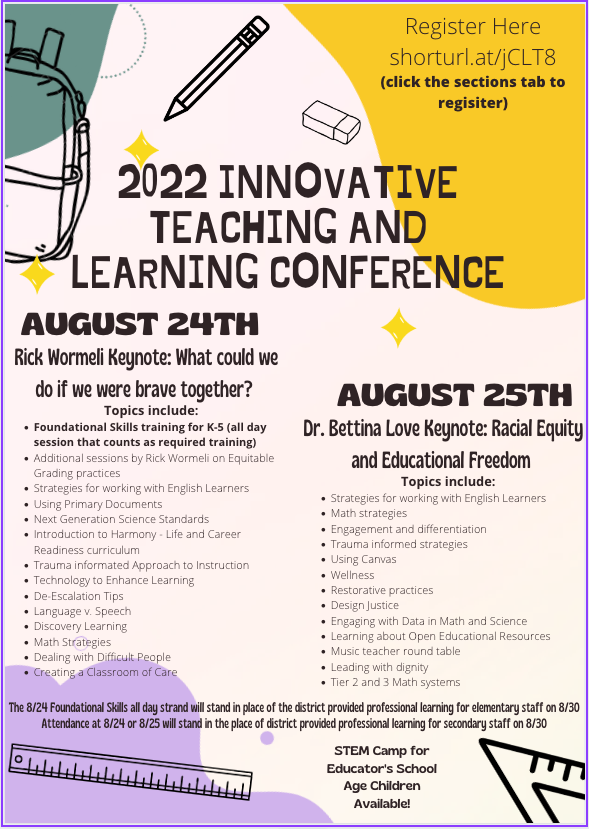
For the last several years (minus the lost year to CoVid) Bend-La Pine has put on an amazing conference. The incredible teachers of Bend-La Pine share with their peers the beautiful work that they have been doing. Along with national level speakers, BLP teachers share the innovative work that happens in our schools every day.

We are excited to bring the Innovative Teaching and Learning Conference back again this year with over 30 educators sharing what they are doing in their classrooms every day.

You can register at this link. Click on the Sections tab part way down the screen to see the registration.


Interested in learning more about our keynote speakers? Here is a sample of their work.

Rick Wormeli on late work

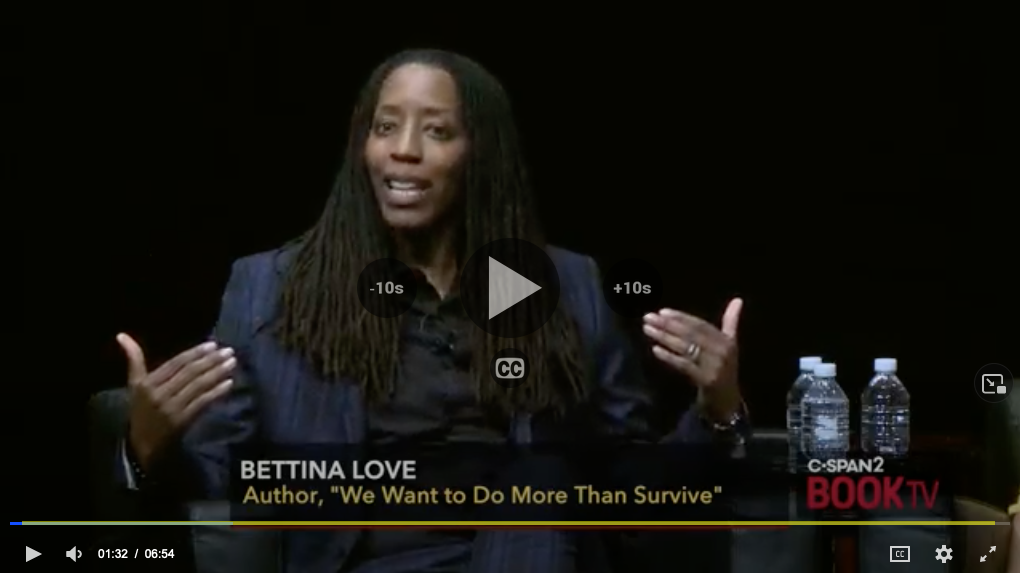
Dr. Bettina Love on “co-conspiratorship” for equity

Student Agency: Students as Leaders of Their Own Learning

As learners, we have all had that feeling of cramming something into our head for the purpose of regurgitation on an exam. We had to learn it because the know-it-all teacher says that we do.  Our only option for how to show our knowledge is on the test on that one day, that one time.  This is the opposite of student agency. Student agency is the way that students feel that their learning is something that they own. Student Agency provides connection, relevancy, control and self awareness of what is being taught.

Like all pedagogy, student agency comes down to specific moves that teachers make to increase the engagement and ownership that students have with their content.


Strategies That Can Increase Student Agency

Knowing Strengths as a Learner

The old adage of “Know thyself” is the first step of agency. Do they know when they are confused? Do they know what help can look like? Do they know how to best get help when they don’t know what they know they need to know? When a student engages in self assessment and metacognition, there is an awareness of how learning occurs and next steps to be taken. Once the awareness of their “stuckness” is in place they can find ways to move through it.


Posing “Ungoogleable” Questions

Many of you begin a class, lesson or unit with an essential question.  This strategy can increase engagement and purpose in the lessons in which students engage. These invitations to learning bring students in by bringing their voice to the solutions. 


Flexibility in Showing What You Know

There are times and standards that fit well with giving students flexibility in displaying knowledge. With options in the artifacts of learning, students must make choices in showing how they demonstrate what they know. Allowing students to have a strength based approach to their own learning makes school more meaningful.


Self Assessment

When students engage in a self assessment prior to teacher assessment they must engage in reflection. Holding assignments, projects and assessments up to a mirror before handing them over to the teacher makes them reflect on the criteria for success one last time (we hope that they are also thinking about the criteria as they work!)  Focusing students back to the criteria also leads to better peer assessment. 


Exit Ticket on Process

One of my favorite generic exit tickets was 3 questions (ungraded)

  1. What did we learn today?
  2. What was easy?
  3. What can I do differently to help you with the things that were difficult?

These three questions gave me a lot of information about how students were digesting the lessons and gave me insights into their thinking.  I would begin the next day by sharing a few of the “what we learned” to anchor us in the new learning. I also acknowledged the new moves that I would take to bring everyone to the same place. It gave the students control over how I provided instruction that led to learning.  This is the definition of agency!

Additional Resources on Agency

https://www.youtube.com/watch?v=bXS5FnaWyDk

‘Student Agency Is Ownership’ by Larry Ferlazzo This article is from EdWeek. While EdWeek is subscription based, you have a few free articles a month.

Educator Network Day Opportunities

Next Wednesday, April 20th, marks the final Educator Network Day. This optional professional development and collaboration day gives you an opportunity to connect with teachers in a learning community to engage in issues important to your content.

You will be paid for your prep time. Content ICCLs will share timesheets at the training. Please return timesheets to Dean Richards in TLC or via email at [email protected].

Times 

(unless otherwise noted)

Middle School 3:15-4:30

High School 2:30-3:45

Secondary (MS & HS) 3:15-4:00

Content/LevelMajor Agenda ItemsFacilitator(s)Meeting SpaceWebEx Option
BandCheck-ins
Advocacy update
Questions for the advocacy team
Good of the order
Keith ChaietWebex – 3:00-4:00https://bls.webex.com/meet/keith.chaiet
ChoirDebrief festival
Add items to comea agenda
Advocacy letter
Luke MacSweenWebex opens at 315 till 4https://bls.webex.com/meet/luke.macsween
CTEIndustry certificates 9-12
Horizontal alignment 6-12
Work related learning experiences 6-12
HSS funds 6-8
Bekki TuckerCaldera High School- Business Room and/or Webex 3-4:15https://bls.webex.com/meet/bekki.tucker
DeansTransition time for grade 8
Discipline as the year comes to an end
Looking ahead to next  year, evaluate data, start conversations
Jake SlodkiWebexWebExhttps://bls.webex.com/meet/jake.slodki 
Fine Arts8th grade to HS transitions Recap of Youth Take Over Month/ScholasticJulia ReynoldsReynolds Webex
https://bls.webex.com/meet/julia.reynolds
Health/PE(Secondary)Health:Introduction to “Catch My Breath” pilot program for vaping prevention. How to access this FREE curriculum and lesson demonstration
PE:Give One, Get OneBring your favorite/best instant activity, warm up, game, lead up game, grading tool, whatever to share with your colleagues. And tour Caldera’s PE facilities. 
Aimee Snyder(DCHD)
Denise Horton
Caldera High School
Room 226 (Health)
Gym (PE)

Language Arts (MS)Team Time
Assessment Discussion
Reading Intervention Discussion Build up Our Collective Resources
Sarah Huddarthttps://bls.webex.com/meet/sarah.huddart 
Language Arts (HS)Writing PLC members meet to plan future planningMichele ClementsMichele’s WebExhtps://
Math (MS)Using Delta Math to support students. Linda Adams
Tara Butler-Kruger
Jeannie Wenndorf
Brian Miller
Caldera H.S. Media Center
Math (HS)Reviewing and discussing HS CORE scope and sequence. Linda Adams
Amy Romero
Jackie Greenwood
Caldera H.S.Media Center
OrchestraCheck-ins
Advocacy update
Questions for the advocacy team
Debrief Festival
Eddy RobinsonWebExhttps://bls.webex.com/meet/eddy.robinson
School Counselors (MS and HS)
2:30 pm to 4 pm.
We will be reviewing school specific Youth Truth data in the social-emotional and engagement categories. The goal is to support counselors in using this information to take the next steps in building a data informed, comprehensive school counseling program.Jess Calbreath
Lynne Tat
Jennifer Hauth
Caldera High School, Room 210
Science (HS)
PLS’s work together to complete the site Science Safety checklist
Colleen Behrens

Laura Gemignani
Meet in Laura’s Webex to start 
Work at your school site
Laura Gemignani Webex
Ron Crawford Webex
Science (MS)PLS’s work together to complete the site Science Safety checklistColleen Behrens
Sarah Durfee
Meet in Colleen’s Webex to startWork at your school siteColleen Behrens Webex
Social Studies (MS)Share lessons, tools, and supplementary materials with your colleagues as we create a district-wide shared Google Drive. Melissa Morris
Jessica Colburn 
https://bls.webex.com/meet/jessica.colburn
Social Studies (HS)Share lessons, tools, and supplementary materials with your colleagues as we create a district-wide shared Google DriveAllie Chiavetta Webex – https://bls.webex.com/meet/allie.chiavettaochoa
Student Success Coordinator/Instructor/Education AssistantsNME # 4 Jen Goodman and Darlene BeckerMS/HShttps://bls.webex.com/meet/jen.goodman
World LanguageShare materials previews and pilotsJulie MontoyaWebex:3:00-4:00https://bls.webex.com/meet/julie.montoya 

Tribal History/Shared History

Tribal history shared history

In 2017 SB13, Tribal History, Shared History was adopted into law.  This act brings the Native Oregonian history and experience, through the lens of the nine federally recognized tribes, into the forefront of Oregon Schools.  

The Department of Education has created a website that has lesson plans across several disciplines including Language Arts, Math, Social Studies, Science and Health in 8th grade and 10th grade

ODE has also created a series of Essential Understandings of Native Americans In Oregon  for Teachers to understand the experiences of Native People.  Much of this history was not taught in our schools prior to SB13.

The following are several resources that can be used to learn and teach more about those who have lived here since time immemorial.


Abby Hall, former student teacher at Bend High, created these videos about the Klamath Tribes, of which she is a member

Truth, Reconning, and Healing, the Klamath Tribes

This is an 8-minute video on the boarding school experience.  There will also be corresponding curriculum written for 11th grade students that can be found at the Klamath Tribes website as well as Oregon Department of Education website. 

We’re Still Here, The Termination and Restoration of the Klamath Tribes 

This is a 5-minute video on the Termination and Restoration of the Klamath Tribes.  There will also be corresponding curriculum written for 6th grade students that can be found at the Klamath Tribes website as well as Oregon Department of Education website.

Heal the Land, Heal the People 

This is a 5-minute video on the importance and cultural connections to the land. 


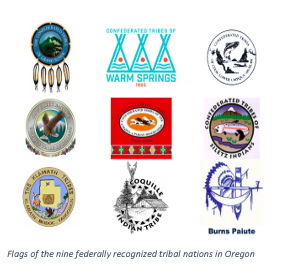
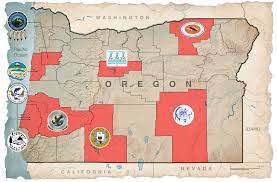
Learn more about specific tribes by visiting the websites of the 9 federally recognized tribes in Oregon

Tribal Websites


OPB did a great show on the native people of Oregon on the show Oregon Experience, Broken Treaties, An Oregon Experience.  It is an almost an hour long and rated G. Here is the summary:

Hundreds of books exist about the Lewis and Clark expedition and the decades of pioneers who followed them West.  But even today, most Oregonians don’t know much about the people who had settled here centuries before “the settlers” came.  “Broken Treaties” introduces viewers to the tribes of our state and explores a thread of the Oregon story that hasn’t been told very well over the years.   


Teaching about Tribal History is not just a Social Studies thing! Here is a link about teaching STEM with Indigenous People in mind.

Teaching STEM In Ways that Respect and Build Upon Indigenous Peoples’ Rights


When thinking about the important pieces of our shared history, Leilani Sabzalian (Assistant Professor, Indigenous Studies in Education, University of Oregon) shares about the 6 P’s to keep in mind here.

Black History Month Resources

This week’s blog is written by Christie Boen, District Librarian. She has curated a list of resources and text that may be helpful.

When you Google Black History Month, you’ll most likely see the name, Carter G. Woodson, known as the “Father of Black History”. In 1915, he created the Association for the Study of Negro Life and History. Then in 1926, he started the first “Negro History Week” on February 7th. It wasn’t until 1976 when Black History Month was officially recognized. It was then that President Gerald Ford urged Americans to “honor the too-often neglected accomplishments of Black Americans in every area of endeavor throughout our history.”

The theme for Black History Month 2022 is Black Health and Wellness. Some ways you can celebrate Black History Month:

  • Support Black-Owned Businesses
  • Learn About Noteworthy Black Figures and Their Contributions
  • Donate to Charities That Support Anti-Racism Equity and Equality
  • Purchase, Read, and Share Books by Black Authors
  • Support and Learn About Black Women

History

There are a plethora of Black History resources out there, but you may not have time to curate them for yourself or your students. This is where I come in.  Below are some fantastic resources to get you started.

Best Books of 2021 by Black Authors

Trailer for Instructions for Dancing

Trailer for Beasts of Prey

Trailer for Concrete Rose

Classroom Guide and Trailer for Born on the Water

Trailer for My Day with Panye

Trailer for Your Mama

Depending on your own identity and experiences, and those of your students, these topics can be sensitive to navigate.  Use this checklist from the LEAD Cohort to prepare appropriately, and/or reach out to a LEAD representative for collaboration. 

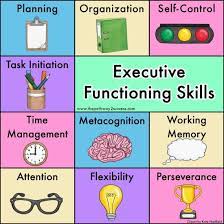
Fostering Executive Function Skills

picture source: Pathway 2 Success

This is a guest post by Tara Butler, Mathematics teacher at Cascade Middle School and finalist for the Oregon Presidential Award for Excellence in Mathematics and Science Teaching in 2021.

“Executive function is a set of mental skills that include working memory, flexible thinking, and self-control. We use these skills every day to learn, work, and manage daily life. Trouble with executive function can make it hard to focus, follow directions, and handle emotions, among other things.” 

Understood.org

In addition to teaching middle school students math, I see my life’s work as the opportunity to develop problem solving, critical thinking, communication, creativity, and collaboration through the vehicle of mathematics.  This charge also includes intentionally building Executive Function skills.  We want to prepare students not just for our subject area but for every facet of their lives.  

I’ve thought about the vitality to bring awareness to and to develop Executive Function skills in students, especially with the challenges the last year and a half has thrown their way.  I came across this article in Edutopia by Sarah Kesty, “Supporting Executive Function Skills by Asking Questions.”  I was inspired to deliver research based practices for my students to apply rather than my good faith efforts that weren’t giving each student what they deserve.

Following is a summary of what I uncovered:

  1.  Ask genuine questions rather than giving directives.  

We don’t want students guessing what they are to be doing but if directions have been given and/or the expectations have been made clear, we can ask a question to jog their memory about their next best step.  This relays high expectations and shows students we believe in their ability to solve problems and be self-sufficient.  

  1. Coach students to be their own coach.  

For example, in solving a challenging math problem they can ask themselves:

It can seem easy or time saving in the moment to answer a student’s question or tell them how to do something rather than the long game of teaching them to turn to themselves first as a resource. 

  • How is this structure similar to a simpler problem?
  • How can I draw this visually?
  • How can I look at this problem another way?
  • I will give myself time to think about this problem before asking for help.  
  1. Equip students with a set of general questions they can utilize in any situation*
  1. What do you notice?
  2. What parts do you understand?
  3. What do you think you might need right now?
  4. How can you tell?
  5. Where could you look for that information?
  6. How will you remember to use that strategy or take that action?

When we’re tired, overwhelmed, or stuck; what an honor for us to step back, put the content on the back burner for a moment, and remember that we play a critical role in shaping human lives.  

Educator Network Day Information

Happy New Year!


Next Wednesday is the second Educator Network Day. As you have likely heard from your administrators, this required training will be similar to October’s date. Teachers will be meeting in content area groups to discuss issues important to your discipline. While the agendas vary based on content, all will give some time to the upcoming Canvas syllabus requirement for second semester.
You can find a brief agenda and the location (all will have a virtual option) in the link below.

Agenda and location here

MANY OF YOU ARE TELLING US: THIS YEAR IS – somehow – bizarrely – WORSE THAN THE LAST. (How can it even be possible, you wonder? And is there anything you can do?)

(Navigation note: all blue text is linked to support documentation.)

As we attempt acclimation to a new school year, educators, students, and families continue to experience changes and conditions that are unexpected and unwanted – to hold the unknown as a chronic state instead of a “fun Friday” freedom. Equipped with nervous systems designed to operate briefly at crisis response (also known as “surge capacity”) levels, days can feel like weeks and each month, a year. Chronic exposure to unmanageable and unpredictable stress is at the heart of what makes the pandemic a slow-moving, traumatic experience for everyone involved with schools.

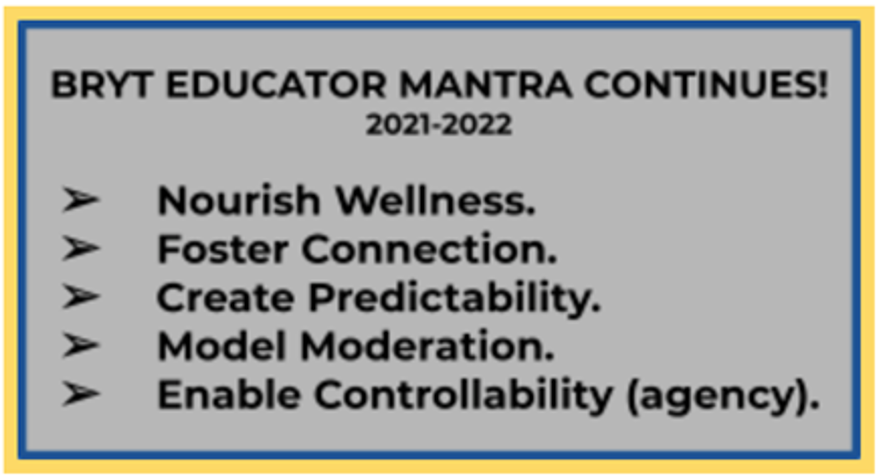
BRYT is honored to work with BLS coaches and leaders to support school-based Student Success teams in developing an intensive intervention for some of the district’s most seriously struggling students and families.  At the same time, we recognize that all students, families, and educators are experiencing significant challenges, and teachers are facing the realities of dysregulation every period of every day.  Dr. Bruce Perry’s core message is instructive in this regard: if we are to work with students in a way that fosters their ability to reason and reflect (critical for internalizing, retaining, and applying new knowledge), we first need to make sure that they are emotionally regulated and able to relate to their teachers and each other.  Here is our mantra for this work:

Nourishing Wellness & Modeling Moderation: Educators are dealing with more challenges and stressors than ever. While healthy levels of stress help us grow and become stronger, we cannot expect to work effectively and sustainably with students over the course of this school year if we are not afforded the time and resources to take care of ourselves and each other. Wellness doesn’t just happen—it depends on leaders and educators alike to set and sustain intention, making it not just okay, but an integral part of a systematic culture of care among school staff. As we work to support the students in front of us every day, we must also continue to increase our awareness of how systems either promote wellness or perpetuate disease and suffering, especially for those who are marginalized with less privilege and power—and as we increase our awareness, we can and must continue to engage in the kinds of uncomfortable reflections and conversations that address the inequitable distribution of wellness that too consistently characterizes our communities. When educators are cared for, a culture of care is then naturally extended to students and their families.

Fostering Connection: Consider integrating consistent, semi-structured non-academic check-ins with all students. These might happen in the context of advisory programs, or on a rotating basis during class. It is essential that all educators understand each school’s mental health infrastructure and referral process, in order to know exactly how to access support for students. Based on observations and information collected in check-ins, educators can provide basic support and care to students facing mild challenges. When there is heightened concern for wellbeing (perhaps due to a sudden change in behavior, appearance, or function) teachers can quickly notify administrators and support staff.

Create Predictability and Enable Agency: After so much inconsistency and time away from school, many students continue to be disoriented. Ongoing focus on orienting students to people, places, and routines/use of time is critical—even when it feels like they “should” be fully oriented and even if this means pushing back against pressure (whether real or internalized) about the need for academic catch-up. Providing achievable opportunities for students to choose how they engage with learning offers a sense of control. Additionally, this is the time for all educators to expand their tactics for helping themselves and students regulate emotionally through consistent rituals and routines, movement breaks, mindfulness, intentional transitions, and integrated SEL skills.  For those interested in broader understanding and tactics, Dr. Perry’s team provides many resources.

In building relationships and fostering powerful connections, entire communities benefit. When our interactions are full of compassion, grace, and hope, there is profound potential to heal, strengthen, regulate, and create belonging—whether it’s holding a door, negotiating an extension on an assignment, or reassuring an exhausted parent or colleague that they are not alone.

WELCOME BACK TO YOU & YOUR COMPUTER! Quick Synergy and Canvas Comments that May Help

Welcome to the first Secondary Instruction Blog of the 21-22 school year!

The best thing about this year is that we get to start the year with student’s faces (at least the top half of them!) We all are working hard to stay safe, maintain our distance, wash hands and teach at the same time. It is quite a task – and one many of us never, ever expected.

Technology is continuing to play a crucial role in the education of our students. Two daily platforms that you are interfacing with are Synergy and Canvas. We wanted to start out this year with a quick blog post to remind you of the supports the Instructional Technology team has put together.

Synergy

Many of you have been using Synergy for years and feel really comfortable with it. New teachers just getting started in our district should know about “Synergy for Teachers”.  This website is your one-stop-shop for gaining knowledge about the grade book tools available within Synergy.  At the top of the site, you will see links to specific resources for grade book, Teacher Vue, report cards, and commonly used reports.  Synergy For Teachers is just one of the many resources that can be found in the  Tech101 resource found in our staff portal.  Or, better yet, bookmark this link right now!

Canvas

Canvas continues to be the required student learning platform. Resources for students, including all assignments should be posted here. This is especially important right now as students are quarantining and need access to relevant resources and to know what assignments are due. As most of us know from last year, the best way to understand Canvas is to use it. To support you, the Instructional Technology Team has created a one-stop shop for Canvas Training and Resources. Your schools also have Canvas First Responders who can provide you with additional support and answer questions.