WHICH WAY TO EQUITY? A Conversation with Dr. Doug Reeves

Q: Doug, when and how did you become interested in exploring inequities in grading practices?

During my teaching career, I was aware that different teachers had had wildly different grading policies.  It was unfair that students – for the same performance – could get different grades. 

Even though I had read the research, when I started doing the research, it became deeply alarming.  The seminal piece of research was when I would take the same set of student scores, and I’d ask teachers what’s the difference between who gets A’s and B’s and who gets D’s and F’s:  they would tell me work ethic, or work completion, or parental support, or intelligence – but it wasn’t any of those things.  The distinguishing element was the grading scale the teacher used, which is the very definition of inequitable and unfair practices.

Q:  Can you tell us about one of your biggest ah-ha equity moments?

When I was teaching, a lot of my students were new arrivals to the country.  When a child entered the class halfway through the semester, and they didn’t have a cumulative folder under their arm, we would accept them as they were and proceed from there.  But if another child with the same achievement profile had been with me the entire semester, that child would get systematically punished whereas the new arrival would get rewarded with a clean grade slate.  

Q:  Equity in education is such a frequent topic these days. What was the watershed moment for turning our attention towards equity?

I don’t think we’ve had it yet – we still have a deeply inequitable system.  I’m from Topeka, Kansas, the home of Brown vs. Board of Education.  People think everything must have gotten better after the case when, actually, things got worse.  My father knew people involved on both sides and a number of schools serving African American students were not only shut down – some staying that way for an entire year – but, as many as 40% of African American teachers and administrators lost their jobs.  Consequently, we know their descendents are under-represented in the teacher leadership pool.  It’s not unusual for people who look like me to have two or three generations of teachers in the family, but when your memory is that your grandmother or grandfather, or maybe even a parent, was laid off in 1954 after Brown v. Board of Education, that doesn’t leave a very good taste in your mouth.  I don’t think we’ve had a watershed moment yet – we’re still working towards equity, not very wisely in some cases.

Q:  What do you think prevents us from having the watershed moment?

Deeply entrenched attachment to the bell curve of blue birds, robins, and blackbirds, specifically the people who are served very, very well by the present system.  The people who most fight grading reform are not teachers – I think that’s an unfair reputation – but are privileged parents of privileged kids who see more kids qualifying for scholarships and more kids qualifying for college admission, and they don’t like that competition.  I see that all over the United States.  

Q:  What are two key teaching moves you would love to see happen in every classroom in America?

#1:  calling on students rather than asking students to raise their hands. The rule should be you raise your hand to ask a question, not to answer a question. Relying on raised hands to answer questions is a mark of grave inequity. Some people call this move ‘cold calling,’ but I would just call  it good and fair engagement.  You can do it with a smile, you don’t have to humiliate or embarrass anybody – there’s always time to phone a friend, give a student a minute of think time, or ask for a partial answer.  What’s not okay is to have kids who are checked out, and kids check out when they know you’re not going to call on them.  So #1 is calling on students fairly. #2 is evaluating students based on how they finish the semester, not the average.

If I could just pick two, those two things would be solid moves towards classroom equity.

Q:  Let’s talk a little more about getting rid of the average. What are the steps a teacher would take?

The first topic I want to be clear about:  I’m not saying to leave the gradebook blank – have all that practice in there, have the evidence in there.  It’s all worth knowing and communicating.  Oregon was an early adopter state, and has had standards for twenty year, and the essence of standards is that they are evaluated and then the grade gets rewarded.  

You don’t assign a grade for the average achievement between the beginning and end of the standard.  It’s just a fundamental principle of accuracy: if I am going to grade someone accurately, I grade them based on how they perform against the standard. 

Think of it like this: we’re coming up on track season. If at the state track championship, a kid is wins and the race, but we take away his medal because he had some bad times back in February, that’s ludicrous. 

If that student is proficient in May, yet we continue to grade them down for the mistakes they made earlier in the year, that’s inequitable.

The typical journey of a student is to struggle and struggle and then have a breakthrough.  The breakthrough is that learning typically happens because of content or feedback delivered by the teacher. If we really believe in resilience and perseverance, if we really believe in social-emotional learning, then we ought to be rewarding the breakthrough. When we use the average, we say breakthrough doesn’t matter and resilience doesn’t matter, because I’m still going to punish you for what you did 2-3 months ago.

Q: We have been coached that can not evaluate according to standards unless we set it up appropriately in the system, and we can’t set it up in the system until we are trained how to do that.  How do you respond to that?

In every grading system I know, teachers have the ability to override the algorithm that generates the automatic grade and enter their own evaluation on the final grade.  In most systems, we’re talking about nothing more than disabling the average function.  I think it’s good if teachers have a fundamental understanding of why the average is bad, and why the hundred-point scale is bad, but that doesn’t really require extensive training.  

Q:  So, you are arguing that teachers should have the gradebook as a piece of information but then, at grading time, enter their own evaluations? 

That is exactly what I’m saying.  It’s how you finish the race that counts.  

Q: And then, for concerned parents, how do they defend those choices?

When you encounter those privileged parents that want to talk about someone else’s grade:  how could that child earn the same grade as mine?  Or when those same parents reach out to your administrator, the two of you have to be unified in your response: “Mrs. Jones, I’m not going to talk to you about anyone else’s grade besides your own.  Number one: that’s unethical.  And number two:  we’re a standards-based district in a standards-based state.”  

So you don’t need to defend how you grade someone else’s kid, you only need to defend how you grade that parent’s kid.  And to the extent there is a hint of imperfection, those parents almost always find it to their advantage that you take into account how your child finished instead of letting the grade be held back by some of the challenges along the way.

Q: What are some of the pedagogical lessons you have learned from Covid-based education you hope to see brought forward to in-person classrooms?

The biggest lesson is relationships, relationships, relationships. Some of the best practices I saw during remote learning were teachers leaving their houses and going to find their students. Of course, they couldn’t do home visits, but they could do sidewalk visits or window visits. Some teachers used the telephone. The teachers that did that had the greatest impact. I saw schools that had 50% attendance rates in the fall of 2020, get up over 90% attendance with the same kids and the same parents. It was all about the human connection.

We also learned there is no way that technology can teach a six-year-old how to read. The promises of technology have always been overblown. All you have to do is look in the faces of students and teachers who came back in March and April for the first time in a year, and you saw what human connection can do. And not just in the classroom. In extracurricular activities, in play, in all of these other things that are the reason kids come to school…those are the social connections, and those are the things that really matter.

Finally, the lesson we should have learned, but I don’t think we really have is that not every standard is equal. This nonsense that says we’ll make up for lost time, by talking really fast and trying to frantically cover every standard. All you have time for is content exposure and there is zero evidence that says exposure leads to learning. 

At the secondary level, schools are following one of two paths: path #1: in the fall of 2021, they are going to have the same schedule, the same time allocation they had in the fall of 2019. They are essentially saying: We learned nothing. I can not push strongly enough against someone who thinks we can have the same schedule in the future as we’ve had in the past. 

Path #2: some schools are building interventions into their daily schedules. They are not afraid to identify the issues and recognize what we already know: if you don’t build interventions into the day – if you hold them after school, on Saturdays, or during the summer, the kids that need those interventions most, won’t come. There are schools who are building an hour, or two, or whatever is necessary, of content-area support into the daily schedule. 

Let’s face it.  We have students who are behind.  But we had students who were behind before Covid – now they’re even more behind.  Obviously, there was a large learning loss experienced by all but the most privileged students. The one question is: what are we going to do about it?
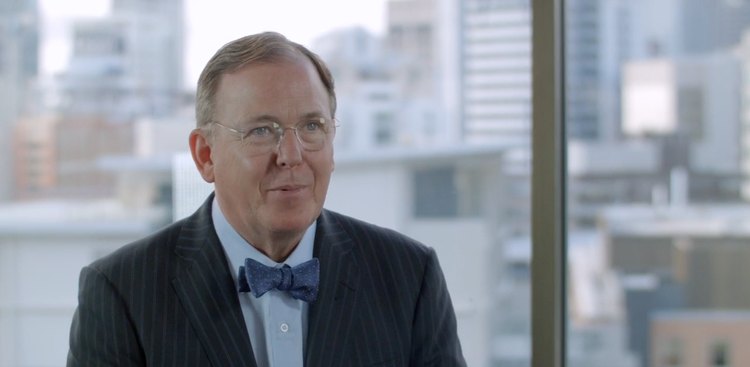
Dr. Douglas Reeves is the author of more than 40 books and 100 articles on education and leadership.  Twice named to the Harvard University Distinguished Authors Series, Doug has shared his research in 50 states and more than 40 countries.  He can be reached @DouglasReeves or at [email protected].

Would you like to learn more about these important topics? Here are some resources Doug recommends.

  1. Here is the professional organization led by Dr. Reeves. In it you will find articles, research, videos and more. https://www.creativeleadership.net.
  2. Karin Chenoweth‘s work includes a seminal collection of research entitled It’s Being Done: Urgent Lessons from Unexpected Schools, which studies 15 disparate schools from around the country and identifies the characters they share. https://www.goodreads.com/book/show/677223._It_s_Being_Done_?from_search=true&from_srp=true&qid=NEqJ6fIIYB&rank=1
  3. Caitlin Flanagan wrote this article for last month’s issue of The Atlantic. In it, she discusses an unsettling adversary in the equity fight: parents. https://www.theatlantic.com/ideas/archive/2019/04/what-college-admissions-scandal-reveals/586468/

A Conversation with Dr. Steve Cook, part 2

Q: Steve, what are 1-2 practices you would like to see embedded in every Bend-La Pine classroom?

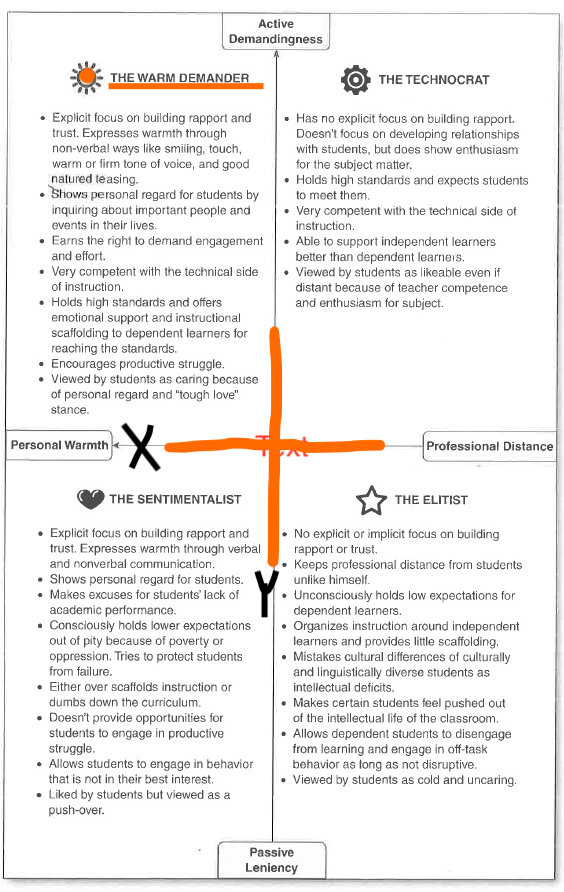
I would like to see a “Culture of Warm Demand” in every classroom – this is Zaretta Hammond’s work.  Her approach is applicable in every classroom.  

She has a graph that illustrates this concept:  on the X-axis, is expectations; on the Y-axis, relationships (see below).  And you want to have a classroom that has both high relationships and high expectations – those are the most effective classrooms.  

When you’re holding kids to high expectations, you set a standard for them that you won’t accept anything less from them than their very best. But you also commit to pouring everything you have as an educator into that student as an individual person. It is because of that anchor in great relationship that you are able to ask for great things.  

If you have that high expectations without that relationship, then you’re a drill sergeant.  If you have the relationships without the high expectations, then you wind up creating a culture of low expectations that can wind up being bigoted. You lose kids in those scenarios. 

Just loving kids is not enough.  That’s the difference: we want to love them, but we also need to hold them to such high expectations, they activate their potential. 

And if nothing more, you have to make the commitment: I’m going to get to know you and I’m going to care about you.  If kids are struggling, that has something that may have to do with the state their world is in right now.  Recognizing that for what it is and not taking it personally as an educator, is an important step.  I have to decide that I am going to care about each student in all circumstances, and never give up on those expectations.  That’s how you transform lives.  

To me, that’s the starting place.  You don’t have to know specific strategies, you don’t have to read tons of books – the starting place is the relationships.  We’ve all had students triggers us emotionally, and we’ve all triggered students.  We have to be able to go back to that situation and see it for what it is, and then figure out how we can talk about it, how we can get through it so our relationship can still be established and move on. When I hold a student to high expectations, it can not be oppressive, but must still be based in the care I have for you as a human being.

Q: Can you tell us a little more about the concept of bigotry?  If both aspects of the Culture of Warm Demand are not in place, how does the relationship begin to possess the characteristics of bigotry?

If you have high expectations and no relationships, Hammond describes you as a technocrat.  We’ve all had teachers who demand and demand and demand.  But they don’t reach out or try to connect with me.  I had a biology teacher during my sophomore year of high school that never ever – in 180 days of school – learned my name.   The feeling you get when someone doesn’t even know who you are – your name, let alone any details about your life – is one that communicates both parties are not equally valued in this system.  If we aren’t both equally valued, then the power imbalance is one of oppression.

Take it the other direction – if you have this culture that you’re just going to love kids and be emotionally available to them, and be supportive, then you’re only attending to the relationships and there are not high expectations.   Those students are being oppressed similarly – they aren’t achieving the potential they could.  And you’re creating an environment in which students may not know those opportunities exist for them.  If you don’t push them towards opportunities, that is its own version of bigotry.  It’s a balancing act on both ends of the spectrum.

How do I have high expectations AND strong relationships?  That’s what we always have to ask ourselves with each individual student in our care.

Q: These concepts are obviously very important to you. How have they played out in your own life?

With my children, I had to take a very different disciplinary approach with one son versus the other.  It was a delicate walk and, to nurture the relationship, I had to approach one on an adult level, with adult language.  If I did that with my other son, he would have been confused and wondered what I was doing.  That goes back to the platinum rule – I had to know and interact with my sons in different ways because they had different personalities; they were different people.  I was more effective if I treated them how they wanted to be treated.

In another example, I know that bigotry can come from a lack of engagement opportunities, or during instruction. One of the most offensive things I ever said to a student was a glib, sexist remark that she had the courage to call me out on later.  I had never thought about the moment through that lens,  but for me to do anything but be respectful, and apologize, and own it would have meant I failed.  She stepped up to her challenge – she came to me and told me I hurt her feelings and gave me the opportunity to grow from it.  My challenge was to be respectful and accepting, and honor her courage.

Q:  We’ve talked a lot about relationships and expectations.  Let’s think about the larger educational systems in place that support or prevent those outcomes. What are the most important components of an educational system that is able to identify and act on inequities within?

Just this morning, I was in two elementary schools and we were talking about Covid and how it has exacerbated so many of the systemic moves that inhibit a student’s ability to succeed.  

Think about this interview environment between me and you – I’m in a closed space with just my laptop; nobody is interrupting me, and we have the opportunity to fully engage with each other.  

But then we think about some of the environments our students are learning in.  When we quarantine kids and send them home, or we’re in remote learning, what about those kids that have a lot of noise and interruption?  Or what about those kids that don’t have anybody at home able to engage with them?  What happens to those kids and how do we as a system  start to recognize how our system perpetuates those inequities.  How do we set up our system so kids can be just as successful in their own environments as in ours?

I think about the research on reading scores, conducted when essentially the entire country was remote.  Some of our most affluent students actually scored better than if they would have been in school.  It was actually beneficial for them to be in lockdown because their growth rate was higher.  Now compare that to some of our highest poverty students who lost so much ground during that time – their test scores regressed 1-2 grade levels.  How are we going to look at our systems during and after Covid to address those disparities?

Covid has shown us there is no more important time in the history of education to start looking at the moves we make so that no student is left behind, regardless of any circumstances about who they are racially, culturally, socio-economically, or what gender they identify with – none of it should matter.  We’re starting to peel back these layers and say, “We’ve got to do better.”  

I think this is going to be a transformational time for us.  We’ve got to start fixing some of these systems.  It’s an exciting time for us and will continue to be so as long as we strive to take advantage of the opportunities here.

Q:  We’re already seeing systemic responses that run counter to that thinking.  There is so much energy around wanting a schedule that enables teachers to serve students better, but the schedule has already been built for next year and there’s a lot of reluctance to change that.  

The system of public education is built within hundreds of years of inertia.  A whole lot of people look at us and wonder why we want to change anything at all – they say, “Look at me.  I turned out just fine.”  

Within the last year, so many districts have had to change so many things so many times.  But Covid forced our hand.  We’ve proven that we can change quickly. Our biggest challenge is to elevate the reasons why we should change to the same sense of urgency as Covid gave us.

That’s the real question and that’s what we’re going to have to keep demanding of ourselves.  I know how I should eat.  I know exactly how l should eat.  But I don’t always choose to do that.  And I’ve only been trying to make consistently better choices for half as long as the public education system has existed.

We can’t let this opportunity get away.  This is the biggest chance we’ve had in the recent history of public education to profoundly change the environments our kids experience every day.

Zaretta Hammond’s Graph

A Conversation with our New Superintendent, Dr. Steve Cook

Steve and Stephanie Cook

Q:  Tell us  a little bit about yourself and your family.  Why are you looking forward to moving to Bend?

A couple of things about me:  I have three grown kids.  I have been a teacher, a building administrator. I have never taught my kids, but I have been a building administrator for all three of my children in some way, shape, or form.  My wife, Stephanie, is a former critical care nurse, and also a retired school nurse.  We have both worked in education, myself my entire adult life.  I’m just finishing up my 32nd year in education.  I spent 13 years as a teacher, 12 years as a building administrator, and getting ready to start year 8 as a district administrator. 

My wife and I have been fortunate enough to find a house here.  I’m going to finish out my contract in Coeur d’Alene and be here sometime in mid-June. We are also bringing a puppy with us – a rescue dog named Alfreda.  She was a stray and my wife fell in love with her the moment she saw her.  

I am also extremely excited to join the Bend community.  I feel so grateful for the opportunity to work with you all and others – to get to be eyeball deep in making the best learning experiences we can for kids and to help teachers and administrators and staff facilitate and grow that kind of collaborative learning experience for kids.  

Q:  Tell us about your biggest life moments around the topic of equity.

The biggest one for me was by far the largest learning experience I’ve had around equity – and it happened as an adult.  I’ve grown up in pretty diverse areas.  I grew up in Topeka, Kansas until I was 10, and then we moved to Dodge City so my parents could take over the family farm.  And then my second teaching position, where I spent for the majority of my teaching career, was in Bonner Springs.  All three of those areas were quite diverse.  

As a teacher in Bonner Springs, I was telling a story about growing up in Topeka.  Both my parents were teachers and we lived in a fairy frugal house, in a very diverse and poor neighborhood.  The middle school was right next to the elementary school and sometimes the older kids would pick on the younger ones.   

So there I was in the Bonner Springs staff lounge, remembering all of this, and telling a story about how one day some African American boys were chasing us, trying to beat us up: they thought we had theme park tickets and they wanted them.  To make it all worse, I was taking band and needed to take home my practice drums each day.  So there I was: a scrawny little 4th grader, trying to get to a block mother’s house without dropping my drums.  But I couldn’t run as fast, and the boys caught me and beat me up pretty bad. 

Now, the secretary of the high school was Mary Kimbrough. She was African American and had worked at the high school forever, and was one of those names that was known throughout the town and commanded respect.  And there I was in the staff lounge, telling this story for the laughs and the jokes. My audience was in stitches over this story of how the African American kids beat me up. Mary came up to me and she was furious. She wagged her finger in my face and she said, “Steven Cook! Those kids are just kids!”  

I was stunned.  I felt so small.  It was the first time I’ve ever recognized that I was delineating around race – there was no reason to specify the race of those boys.  Never in my life did I even consider race to be a thing.  It was the first time in my life I was made to recognize my own whiteness.  After that, Mary Kimbrough was so graceful and so kind to me, and helped me to grow through my own ignorance.  

It impacted me deeply and personally.  

Q:  And the second most impactful moment?

The second one was later on, after I became a principal and was embedded in the expeditionary learning network, when I was really gaining experience and starting to feel comfortable in the shoes of an instructional leader.  The training I got, and the professional development I received, as an Expeditionary Learning principal is the most transformative I have received in my career.  

Q:  Can you tell us a little bit more about Expeditionary Learning?

Expeditionary Learning (EL) is a style of learning that came out of Outward Bound, a project-based learning experience.  And these projects are very complex and many times they involve giving back to the community in some way.  One of the biggest differences between EL and the mainstream model is that we don’t compete with one another; the competition is my own to be better than I was yesterday, to engage with my own self-growth and self-efficacy.  EL was absorbed by many of the inner-city charter schools and challenged the dominant culture of low expectations and helped transform it into a culture of high expectations.  We have two EL schools in the Bend-La Pine district  – the middle and high schools of Realms.  

Q:  And it was EL that was so transformative to you as an instructional leader?

Yes.  It’s because of the explicit intentionality and importance they place on not just the moves you make as a teacher, and not just the moves you make as an instructional leader, but also on the moves you make that are empathetically connected to that student that is sitting right in front of you.  EL asks us:  are you truly doing what you can to maximize that learning experience for that student?  When you think about teaching in that way, you become much more attuned, and much more connected.

Q:  So when we’re talking about providing equitable instruction, what does that mean beyond providing an accessible learning experience to every student in the room?

The first thing is:  can we start by agreeing that there are two moves every instructor can make right away?  1) Aspire to the best quality, Tier 1 instruction you can.  That you are always looking and evaluating and making new decisions about the moves you are making.  2) Creating a community and a socio-emotional experience for every student in the room that gives them a felt comfort and a safe environment, so that they feel like they’re a part of that community.

And on the basis of both of those things are strategic moves that we can train upon.  Those strategic moves are things you do as an adult that are going to create that feeling of felt safety and create that empathetic kind of relationship so I know, recognize, and understand who my learners are as individual people, and what value they are bringing into my classroom.

I came to know the Platinum Rule: don’t treat others the way you want to be treated; treat others the way they want to be treated.  And if you can start to build and connect with kids on that level, you can start to recognize what their needs are.  

Q:  Is it those relationships and that self-reflection as a teacher that make learning accessible?

Accessibility is such a broad term…It’s almost too vague in some regards.  But it starts with knowing and understanding who that kid is and what they’re bringing in the door – who had breakfast, who had a rough morning (as adults, we even struggle with rough mornings; they’re tough!).  We bring whatever we have into our world.

We can talk about specific ways to do that, but creating an environment in which every kid feels welcome starts with simple things like creating an environment in which every kid gets eye contact, in which every kid gets a smile, every kid hears his or her name in a positive way.  You don’t let kids off the hook, you don’t give them an opportunity to bail out of the learning experience, but you also treat them with respect and dignity when they say, “I’m struggling with this.” 

As adults, we’ve all had a moment – whether it’s something you remember from your childhood, or something you’ve experienced as an adult – where someone has done something that makes you feel less than safe, or less than comfortable. Recognizing when we do that as adults, stepping back and apologizing in front of kids, might be some of the most powerful things we ever do.  When we do that, we show kids that we still have a lot to learn.  And if I’m aspiring to do that better than I did the day before, it means I’m taking some risks and I’m doing some things I’m not perfect at yet and I’m going to fail sometimes.  

It is important to create an environment where we do that together, and embrace those mistakes and own them.  And if we can do that in a way that empowers how we engage with each other, those are the kind of relationships I want to be in.  If we’re afraid to make mistakes, that’s not a safe environment.

Part 1 of 2. The rest of this interview will be published next week.

Curious about EL? Here’s a great link to get you started: https://eleducation.org/

Curious about Pear Deck?

OUR ELEMENTARY COLLEAGUES LOVE IT FOR A REASON! IT CAN BE JUST AS GREAT FOR SECONDARY STUDENTS.

Skyline and CDL’s math teacher Gabe Schepergerdes loves it and uses it on a daily basis. At Skyline, it is used so commonly that a subscription is provided for the staff. The CDL team was converted immediately upon seeing a demonstration about how he uses it. Throughout K-12 education, the teachers that know it, love it. No matter what grade or subject you teach, if you use slideshows, PearDeck is a fabulous engagement tool that is as easy for you as for them. Are you curious?

Gabe sells it better than I can. He provides a demonstration about how he uses it on a daily basis with his class. Because his demonstration was provided for an audience, you will be able to see both the teacher view and the student view of the experience. If you are someone who struggles to keep students engaged, or if you are also looking for new engagement tools, Gabe’s video explores this fantastic option.

GABE’S TRAINING SESSION (16min): https://bls.webex.com/bls/ldr.php?RCID=5d0c5c95db134b91adf591b635a3aa68 PASSWORD: YcqQSNP2The Pros of Pear Deck:

  • The Pro’s of Pear Deck:
    • Screen-sharing take A LOT of bandwidth and students don’t always have enough as it is. Pear Deck allows students to open your slide show, thus allowing you to remain in a regular WebEx session which is much more manageable for the bandwidth capabilities of many families.
    • Pear Deck works with either of our slideshow platforms: PowerPoint or Google Slides.
    • You get a real-time typing view of student work, meaning that you don’t have to wait until they press ‘Send’ to begin to prepare your responses. This also allows you to message students directly based on the direction you are seeing them heading in, rather than having to wait until they are finished to offer guidance.
    • Students do not see each other’s responses unless you share screen so that they can. You see everybody’s, but they do not. This allows you to ask more challenging questions, or for students to complete more challenging tasks without needing to send work to you through a different platform.
    • Pear Deck is free as a Google Add-on. This means that if you click on the 3 x 3 buttons on the top right of your screen, Pear Deck will be one the of the options.
  • The Con’s of Pear Deck
    • The platform improves significantly with $150/teacher. (To see the comparison list: https://www.peardeck.com/pricing) I know we are not there yet, but hopefully, in the future, we can begin to consider site or department tech subscriptions as part of a site’s curriculum or tech budget, rather than only available if provided by the district or if a department is willing to pay the entire bill (which would take most of a department budget).
    • One of the improvements in a Pear Deck subscription is a student-paced option, which would allow you to use Pear Deck for asynchronous presentation as well. Free Pear Deck is live delivery/teacher-paced.
    • Also with a subscription comes the options for students to use a drawing feature to show their work in more ways than typing words.

On balance, Pear Deck is a superior application that dramatically enhances the engagement potential of our slideshows. Whether in a live or virtual classroom, this is an app you can use. If you agree that Spring Break is an excellent time to pick up a new tech skill, we encourage you to consider this one.

Can you Give me an Example?

FEW OF US TAKE ON A NEW TASK WITH NO IDEA WHAT IT WILL LOOK LIKE TO BE GOOD AT IT.

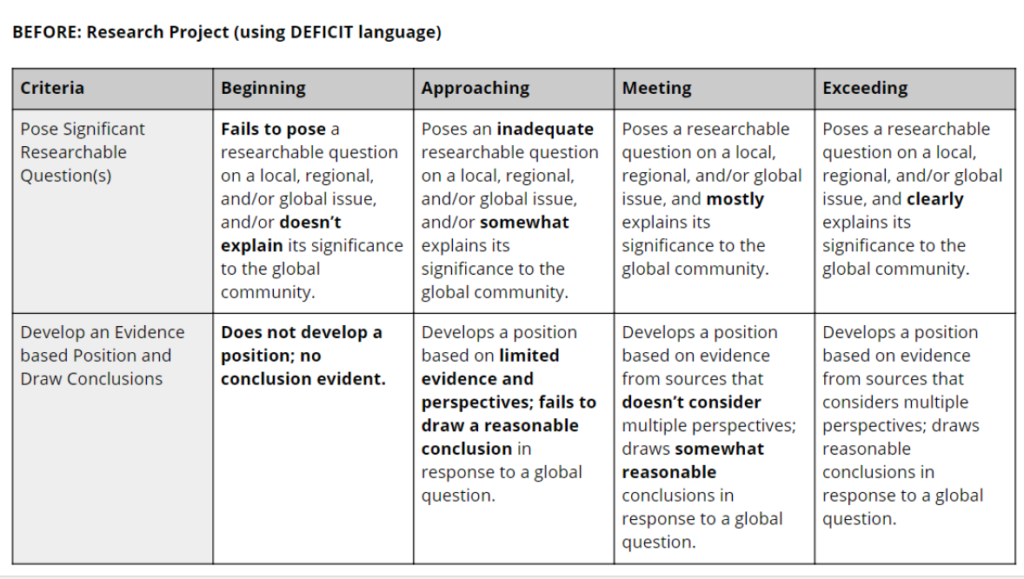
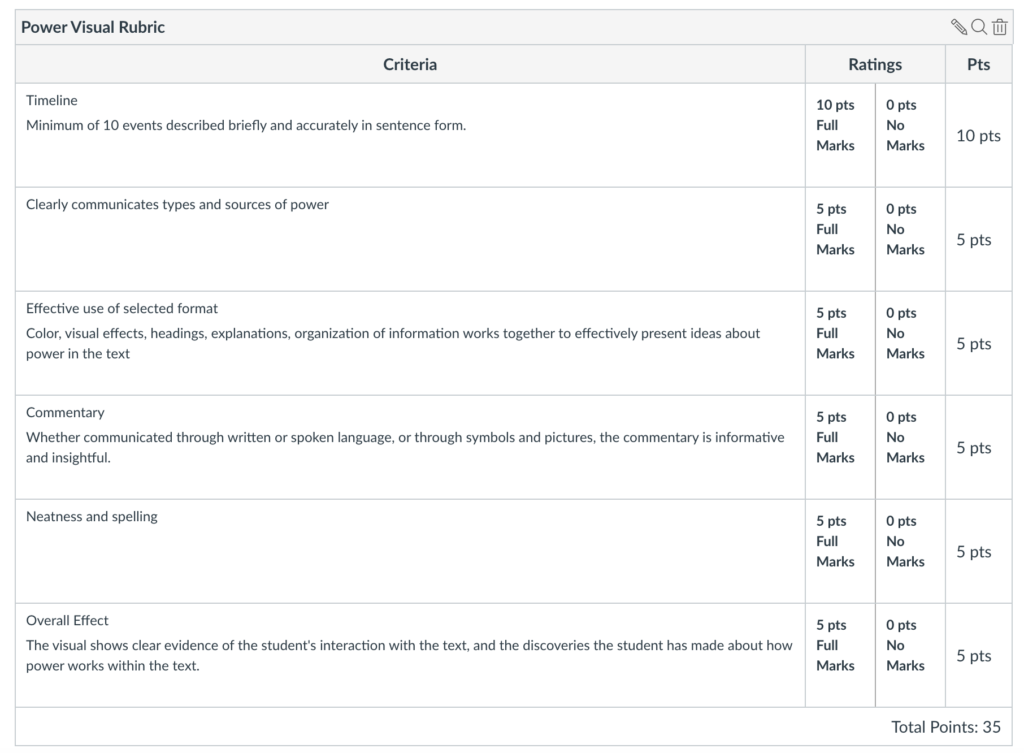
For our students, the use of exemplars (aka working examples or models), help them to know exactly what success will look like. Previous blog posts in this series have been on the importance of telling students what and why they are learning as well as providing a rubric that defines success.

This post is about showing students work that they can score against a rubric to deepen their understanding of what success looks like.

Any assignment that is given can have an exemplar. There are generally three phases to instruction with exemplars.

1.INTRODUCTION. Share with the students the exemplar. Tell the students that this example is from a previous year or period. You may or may not share the grade the exemplar received.

2. TRAINING. Have the students read or study the exemplar based on the rubric that has been provided. Point out the important aspects of the rubric or exemplar. It is very powerful for you show the students how you think as you analyze the exemplar or rubric. Using “I-statements” such as, “When I see this essay, the first thing that I notice is that there are clear subheadings that tell me how the text is organized” or “When I see this lab report, I notice that the vocabulary words from this week are included in the appropriate sections.” Through metacognition we train the students how they should be thinking when they analyze the exemplar and their own work before they turn it in.

3. APPLY LEARNING CRITERIA. Have the students engage with the exemplar by themselves or with a partner. As the students analyze the exemplar, they learn the success criteria, rubric. An especially useful extension activity can be to provide students with multiple exemplars and let them work together to determine what works and what doesn’t, which are stronger/weaker, etc.

You may provide an exemplar that is high-level or work or one that still needs work. By analyzing a less-than-perfect exemplar, they can use the rubric to see where improvements may need to be made or why.

Student after student will say, “The most helpful thing you did was show me examples when an assignment was really complicated.” Teacher after teacher might say, “That took time I didn’t have, and it didn’t teach them anything new. Was it worth it?” Yes. And yes. And yes.

Taking the time to show your students what the end product might look like is an equalizing and generous act because it understands that students want to succeed, and it recognizes their insecurity about how they might do it. Examples help them build a road from assignment to finished product.

“How do I Get There?” Students as Participants in their own Learning

Last week’s blog focused on the importance of communicating clear learning intentions: the WHY of our lessons. This week, we focus on student success: WHAT does success look like?

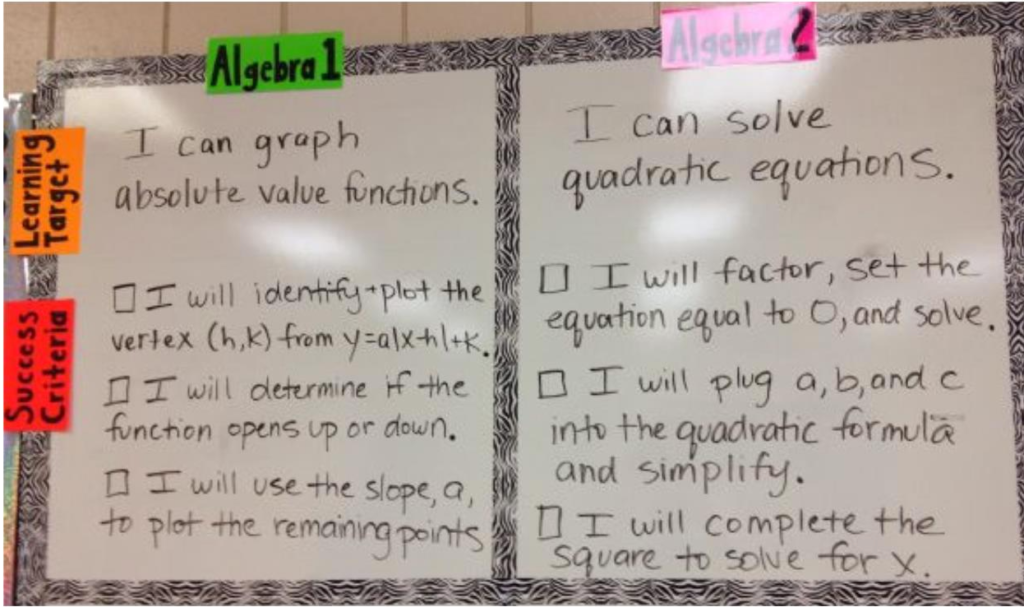
LEARNING INTENTIONS tell students where I am going; SUCCESS CRITERIA help students know how they are going to get there, and what choices they will make along the way. Students must have a clear expectations about what it looks like to be successful in the learning endeavor they are about to engage in. Success criteria provide a framework, a set of rules that students will use to understand their success in learning.

Success criteria tells students how far they will swim before they dive into their learning.

Well-written criteria give students feedback about learning. Feedback does not always have to come from the teacher. Because they know their success criteria, students can engage in more meaningful conversations with their peers about their work. Such peer assessment is they type of assessment that we get in real life. (I assure you that I shared this blog post with my peers, received feedback and made adjustments before posting it!)

Well-written criteria also enables students to engage in more effective self-assessment. Rather than asking them “How do you think you did,” we can ask them, “Where do you believe you scored and what justification do you have for your reasoning?”

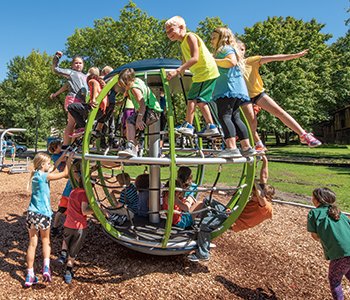
Not providing success criteria is similar to coach telling their team to play a game, but not telling them how to win or, even, very many of the rules. We’ve all been there at one time or another: think of that time on the playground when nothing was clear and we had to figure out the game as we went, hoping we got it right. Sure, some of us kept playing. Many of us walked away, accepting lesser playground status, feeling like outsiders because we didn’t seem to know what the other kids understood innately.

Clear learning intentions and success criteria have been shown to increase levels of engagement and motivation because the rules of the game are clear, and students no longer feel unsure of what to do next or what they are trying to accomplish.

When kids know their success criteria, the playground works. When students know their success criteria, the classroom works.

The Why of “WHY?”

Having very clear learning intentions for our students is hard work, but it may be one of the most important teacher moves in our classrooms. NO MATTER WHETHER YOU HAVE BEEN TEACHING FOR ONE YEAR OR TWENTY, STUDENT AWARENESS OF THE “WHY” IS CRITICAL.

Students must know why they are learning and how they will apply this learning in future contexts. We have all been that student who says, “When am I going to use this?” By getting ahead of the question, our learning intentions make future application transparent. Clear learning intentions is a critical part of a high-leverage classroom strategies: such teacher clarity done well can double the rate of student learning.

THE ‘WHY’ IS WHAT MAKES BACKWARD DESIGN ESSENTIAL. It is important to be clear about your learning intention before you plan the day’s/week’s/uniit’s activities. The academic tasks that a student engages in should serve to illuminate the learning intention. Students need to be able to see the clear link between where they are going and how you are getting them there.

It is critical to base our learning intentions on the standards, described skills, knowledge and habits of mind that student need to internalize. However, for many years there has been a push to “post the standards” in the classroom. While this is a great start, without explaining to students how to learn the standard or when to use the standard, it is just more adult writing on the board. This would be like your tax accountant posting the tax code you are supposed to follow without the explanation of how to use it in your return.

By being explicit about the learning intention student attention and engagement increases. If a student does not know the what and why of a lesson, they are far more likely to tune out. STUDENTS SHOULD HAVE THE SAME UNDERSTANDING OF WHERE THEY ARE HEADED IN A LESSON THAT THE TEACHER DOES.

Here are a few examples of clear learning objectives:

  • Today I am going to teach you how to identify and articulate important character traits in some major figures in the Battle of Gettysburg. This will help you understand how leaders in history motivate people to get their agenda done.
  • At the conclusion of this lesson, you will be able to explain to a partner a definition of covalent bonds. We will use the your knowledge in our experiment later in the week.
  • I want you to understand and apply scale factor at the end of today’s lesson. This is important because scale factor is an important concept in fractions, that you will use over and over again, in problem after problem, math class after math class.

Big or small, covering one lesson or one month of lessons, STUDENTS MUST KNOW THE WHY. They simply will not learn as much or as well without it.

ADDITIONAL RESOURCES:

  1. Here is an extremely quirky video from a Scottish high school teacher arguing for the important of learning intention. No fancy production values here, but a sincere – if strangely humorous – delivery and some solid thinking. https://www.youtube.com/watch?v=YdDndXDABQw
  2. Edutopia’s article sums it up and takes it one step further – arguing that the best teachers will spend a substantial portion of their planning time developing clear learning intentions and determining how best to embed them in the lesson. https://www.edutopia.org/article/framework-lesson-planning

WebEx Wednesday: A Model for Efficiency and Effectiveness

Isn’t it great to see kids back in class? Everything else aside, isn’t it great to see them?

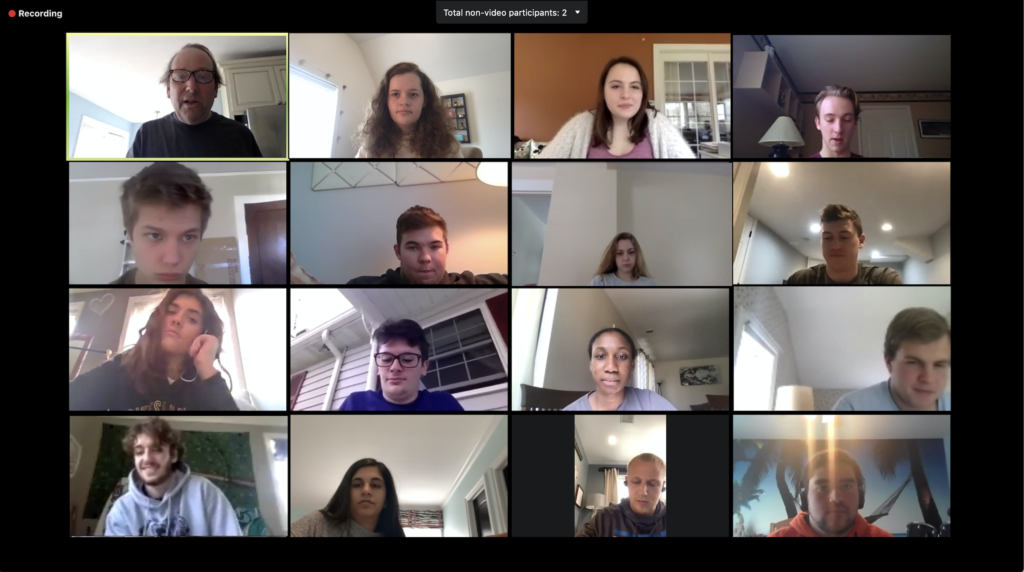
With Wednesdays being WebEx-only days, we wanted to take this week’s blog to think through ideas for breakout rooms.

It can be nerve-wracking to release students to work independently without supervision. However, with structure and an efficient plan, WebEx breakout rooms can be a great way for students from across both cohorts to connect with each other and share their thinking or practice what has been taught in person.

Here are a few ideas about how to make the most out of your WebEx breakout rooms:

  • 1. Keep them short. Keep the break out rooms times between 2 and 3 minutes, no longer than 5 unless there is substantial work being completed.
    • It is better to use breakout rooms multiple times in a class session, rather than give them one breakout room for too long. NOT giving them enough time to have a complete conversation is best practice for virtual engagement. Too much time is unpleasant and awkward.
  • 2. Give the students one task to complete rather than several. Give them one question to discuss, rather than several. Provide Sentence stems. If students are unlikely to know how to begin, a sentence stem or two can provide a clear first step in how to start.
    • This link provides some prompts for students to engage in academic conversations:
  • 3. Provide a shared document. Create a Google document or a Jamboard (each group gets their own board) with a task or question that is to be completed during the time in the breakout room.
  • 4. Assign jobs. In order to help students, stay on task when working together in a break out room a specific role will guide their next steps.
    • a. Leader. Makes sure that everyone is participating, that people are unmuted and that cameras are on when possible.
    • b. Time keeper. Makes sure that the task will be completed before the breakout room is over
    • c. Scribe. Write the answers in the shared document. Alternatively, all students could be a scribe and write their answers in a different color.
    • d. Technician. Share screen in the breakout room so all can see what is being worked on.
    • e. Presenter. Share the group work at the end of the breakout room.Jobs can be assigned by alphabet, next birthday, tallest or other random affiliation.

After the breakout room is done, it is great information to ask students how the process went in their group. A scale of 1-5 in a personal chat will give you feedback on how the breakout rooms went when you were not able to be there.

In a nutshell, less is more. Less time, fewer tasks, little open-endedness. Keep them focused. Keep them efficient. Your students will be breakout room rockstars.

First Thing’s First: We Need you to Take Good Care of Yourself.

In our professional lives, Covid is a difficult and unwieldy gift that won’t stop giving. We’ve lost track of how many problems it has caused, how many challenges we’ve cleared, just to have five more populate our horizons.

It’s just really, REALLY hard.

However, we are starting to feel some hope: there is reason to believe we may be approaching one of the final landmark obstacle courses for this school year: the one of successfully welcoming students back into our classrooms. And we all know that, despite the simplicity of the stated task, what we encounter will be anything but simple.

To manage this challenge successfully, it is imperative that we take good care of ourselves by acknowledging our own fears and stressors, and put ourselves in the best place possible to acknowledge and support out students. None of us want to add to the trauma our students have already encountered, but we best avoid that by allowing our own histories to be valid. We MUST recognize and allow our own needs.

In different ways, we are all suffering from Covid Fatigue. UC Davis recommends the following four strategies as the ones that can make the biggest difference in our daily work lives:

  • Exercise: “It’s the No. 1 best thing we can do for coping,” she said. “Any exercise – even a simple walk – helps. It releases endorphins, gets some of the adrenaline out when the frustration builds up. Just getting out and moving can be really helpful for people.”
  • Talking: “This really helps, too. Just saying it out loud is important,” Hermanson said. “Find the right places and times, but do it. Ignoring feelings doesn’t make them go away. It’s like trying to hold a beachball underwater – eventually you lose control and it pops out. You can’t control where it goes or who it hits.”
  • Constructive thinking: “We may think it is the situation that causes our feelings, but actually, our feelings come from our thoughts about the situation,” she said. “We can’t change the situation, but we can adjust our thinking. Be compassionate with yourself and others. Remind yourself, ‘I’m doing the best I can.’”
  • Mindfulness and gratitude: “The more you do this, the easier it gets,” she said. “Try being in the moment. You’re right here, in this chair, breathing and looking around. We put ourselves through a lot of unnecessary misery projecting into the future or ruminating about the past. For now, just take life day by day.”

The strategies are simple, it’s true. But in situations as complicated as ours, the small differences made by simple actions are helpful. Think of standing up and taking a walk around your building as throwing yourself a lifeline. Think of checking in on a colleague as a worthy support for them and you.

As we move into this new phase of education during Covid, let the simple and the easy routines of basic self-care have a place in our days.

Here are some additional articles you may find interesting:

Forbes provides a brief, well-stated overview of teacher feelings, needs, and impossible choices. It does not so much provide solutions, rather a helpful statement of situation. You have to close three aggravating pop-up ads (which are bad for mental health!), but I was glad I stuck with it: Forbes – “The Mental Health Resources Teachers Need”

In a similar vein, science writer Tara Haelles authors this blog post: “Your Surge Capacity is Depleted – It’s Why You Feel Awful” Halles uses her own work/life situation to frame research about what is happening to us physiologically. It’s helpful to understand the bigger picture of our bodies during these events, and what it all means for the minds living in them.

You may find this one most helpful of all: Association of Supervision, Curriculum, and Development published Educational Leadership. January’s issue was on the emotional and mental health needs of school personnel that are arising so significantly during Covid. Here is the editorial, which contains some strong perspective and a variety of links to the other articles in the issues: “There’s Always More to the Story” – December 2020/January 2021

And, finally, Mental Health America gives us this blog post of suggestions and reminders to maintain healthy perspectives and habits as we continue to navigate during Covid: “Teachers: Protecting your Mental Health”

Students Have Been Learning from Home for a Year. How Do We Bring Them Back?

There is no question: students and their families are feeling all of the same things we are about returning to the classrooms. Like us, they have been submerged in the stresses of home environments relentlessly; unlike us, they have not been protected by the same job stability, self-advocacy tools, or ability to go into the school building if that would work best.

Welcoming them back into our classrooms is offering them the chance to re-start their independent lives. But it’s been such a long time for them, there may well be some issues we would do well to consider.

Below, is a list of relevant readings you may find helpful.

1. The website We Are Teachers recognizes that, even when students are back on the classroom, they will likely still be engaging in remote sessions with us as a matter of routine. Therefore, it caters it’s suggestions to keep ourselves well-supported and moving forward despite the shifting locations and platforms: “2020’s New Rhythm: Moving from Virtual to In-Person (and Back Again)”

2. The National Association of School Psychologist put together this two-page article reflecting on student socio-emotional re-entry needs, and articulating what teacher practices will support their transition most effectively. “School Re-entry Consideration: Supporting Student Social and Emotional Learning and Mental and Behavioral Health Amidst Covid-19.” School-Reentry-Considerations-NASP.pdf

3. Edutopia’s brief blog post is action-oriented and to the point: “5 Tips for a More Efficient Transition from Virtual to In-Person Teaching”

4. Lexia Learning authored this blog post coaching teachers and administrators on what to prepare for and what to expect. A quick read with some helpful tips you may want to consider. “Returning to the Classroom after Covid-19 Shutdowns: What to Expect and How to Be Prepared.”

5. And, finally, I want to include an open letter that has lived on my desktop for months. Long-time community counselor, Kathy Ngel Hood, offers this advice for parents but I think we may also find its perspective helpful. There are no instructional tips here, but some excellent and compassionate thinking about the Covid lives of our students. “Observations from a Counselor”

============================================================