Educator Network Day Opportunities

Next Wednesday, April 20th, marks the final Educator Network Day. This optional professional development and collaboration day gives you an opportunity to connect with teachers in a learning community to engage in issues important to your content.

You will be paid for your prep time. Content ICCLs will share timesheets at the training. Please return timesheets to Dean Richards in TLC or via email at [email protected].

Times 

(unless otherwise noted)

Middle School 3:15-4:30

High School 2:30-3:45

Secondary (MS & HS) 3:15-4:00

Content/LevelMajor Agenda ItemsFacilitator(s)Meeting SpaceWebEx Option
BandCheck-ins
Advocacy update
Questions for the advocacy team
Good of the order
Keith ChaietWebex – 3:00-4:00https://bls.webex.com/meet/keith.chaiet
ChoirDebrief festival
Add items to comea agenda
Advocacy letter
Luke MacSweenWebex opens at 315 till 4https://bls.webex.com/meet/luke.macsween
CTEIndustry certificates 9-12
Horizontal alignment 6-12
Work related learning experiences 6-12
HSS funds 6-8
Bekki TuckerCaldera High School- Business Room and/or Webex 3-4:15https://bls.webex.com/meet/bekki.tucker
DeansTransition time for grade 8
Discipline as the year comes to an end
Looking ahead to next  year, evaluate data, start conversations
Jake SlodkiWebexWebExhttps://bls.webex.com/meet/jake.slodki 
Fine Arts8th grade to HS transitions Recap of Youth Take Over Month/ScholasticJulia ReynoldsReynolds Webex
https://bls.webex.com/meet/julia.reynolds
Health/PE(Secondary)Health:Introduction to “Catch My Breath” pilot program for vaping prevention. How to access this FREE curriculum and lesson demonstration
PE:Give One, Get OneBring your favorite/best instant activity, warm up, game, lead up game, grading tool, whatever to share with your colleagues. And tour Caldera’s PE facilities. 
Aimee Snyder(DCHD)
Denise Horton
Caldera High School
Room 226 (Health)
Gym (PE)

Language Arts (MS)Team Time
Assessment Discussion
Reading Intervention Discussion Build up Our Collective Resources
Sarah Huddarthttps://bls.webex.com/meet/sarah.huddart 
Language Arts (HS)Writing PLC members meet to plan future planningMichele ClementsMichele’s WebExhtps://
Math (MS)Using Delta Math to support students. Linda Adams
Tara Butler-Kruger
Jeannie Wenndorf
Brian Miller
Caldera H.S. Media Center
Math (HS)Reviewing and discussing HS CORE scope and sequence. Linda Adams
Amy Romero
Jackie Greenwood
Caldera H.S.Media Center
OrchestraCheck-ins
Advocacy update
Questions for the advocacy team
Debrief Festival
Eddy RobinsonWebExhttps://bls.webex.com/meet/eddy.robinson
School Counselors (MS and HS)
2:30 pm to 4 pm.
We will be reviewing school specific Youth Truth data in the social-emotional and engagement categories. The goal is to support counselors in using this information to take the next steps in building a data informed, comprehensive school counseling program.Jess Calbreath
Lynne Tat
Jennifer Hauth
Caldera High School, Room 210
Science (HS)
PLS’s work together to complete the site Science Safety checklist
Colleen Behrens

Laura Gemignani
Meet in Laura’s Webex to start 
Work at your school site
Laura Gemignani Webex
Ron Crawford Webex
Science (MS)PLS’s work together to complete the site Science Safety checklistColleen Behrens
Sarah Durfee
Meet in Colleen’s Webex to startWork at your school siteColleen Behrens Webex
Social Studies (MS)Share lessons, tools, and supplementary materials with your colleagues as we create a district-wide shared Google Drive. Melissa Morris
Jessica Colburn 
https://bls.webex.com/meet/jessica.colburn
Social Studies (HS)Share lessons, tools, and supplementary materials with your colleagues as we create a district-wide shared Google DriveAllie Chiavetta Webex – https://bls.webex.com/meet/allie.chiavettaochoa
Student Success Coordinator/Instructor/Education AssistantsNME # 4 Jen Goodman and Darlene BeckerMS/HShttps://bls.webex.com/meet/jen.goodman
World LanguageShare materials previews and pilotsJulie MontoyaWebex:3:00-4:00https://bls.webex.com/meet/julie.montoya 

Supporting Students During High Stakes Testing

by Linda Adams

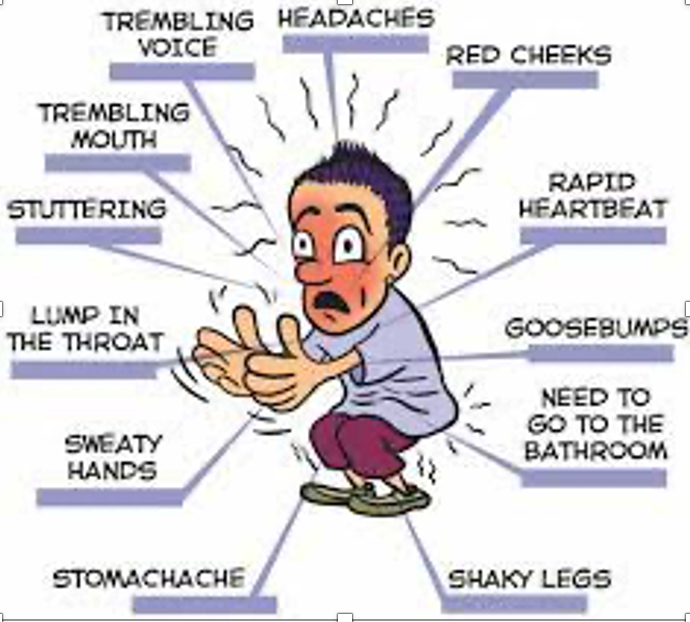
A few years ago toward the end of a year of teaching 6th grade math and science abroad I had a very big Aha moment. My students were about to take the NWEA MAPS test and were very stressed out about it. As I dug into why students were feeling so stressed I heard them say they were worried about having to concentrate for longer periods than they thought they were capable of, they were worried about not knowing or understanding the material and as a result, failing. In some cases the stress caused students to have physical symptoms, including stomach and headaches. 

So I decided to try a small experiment. Of the two classes I taught, half of the students would be testing all week with me and the other half would be testing with my teaching  partner. The classes were pretty comparable in skills, ability and diversity. First, I decided to try and reframe the stress. I shared with my students how stress works in our bodies. We learned about how the amygdala works and how hormones like cortisol and adrenaline change how the mind functions. I introduced them to mindfulness techniques and “moving to learn” strategies. We practiced these while learning in our regular day BEFORE the big test. 

Then on the day of the test I used every mindfulness technique I knew to make the climate of our class a soothing environment. I used aroma therapy, I had soothing photos of the beaches and mountains displayed on the screen, I played soft classical music and even had students do some breathing exercises beforehand. I also encouraged students to drink water and to move every 15 minutes (stretch or do a yoga pose). 

Okay, it was just one class but the students who tested with me had appreciably better results AND most importantly they were a lot less stressed; I even caught a few students humming or smiling as they worked. I also felt the students who really did have a tough time focusing for lengths of time did so much better (no impulsive quick clicking) when they knew they could get up and move, get a drink or go to the bathroom when their brains needed a break. Students who needed to also used fidget gadgets to help concentrate and students could sit or stand while they worked.

 “When you change your mind about stress you can change your body’s response to stress”.

Well, I followed up my Aha moment with some research on how and why those ideas may have worked. If you want to know more, first check out this approximately 15 minute Ted Talk on reframing stress, that is, making stress your friend.

Second, choose from a couple of short readings from Edutopia that give concrete ideas for helping you and your students understand and reduce stress anxiety due to testing.

Finally, don’t be afraid to try some of these strategies in your classroom prior to the testing during times where students are focusing on individual work. Also, if you are interested in how our brains operate most efficiently check out John Medina’s  “Brain Rules (Updated and Expanded): 12 Principles for Surviving and Thriving at Work, Home, and School.

Wishing you and your students much less anxiety this time of year.

10 Tips For Getting To The Finish Line (When You Have Zero Left To Give)

By Amy Yillik, EdD, Culture of Care Coach, HDESD

You don’t need to be a psychologist or someone that has experienced Burnout to see the writing on the wall in education right now: Educators are exhausted! And while some of you may or may not be in Burnout, our educational environment has been primed for educator enervation for some time: toss in a pandemic, hybrid learning, politics, & social discord, how could we not be debilitated and unmotivated? When experts discuss Burnout, the solution is generally in prevention. But here’s the thing: Educators are in Burnout right now!  We are past the point of prevention; We need intervention. So if you’re tapped out and not sure how you’re going to get to this school year’s finish line, I hope these suggestions are helpful!:

  1. Rest to Energize

If you are exhausted, then the first thing you need to do is rest. Give yourself permission to “do nothing.” While productivity can be a component of a meaningful life, our bodies need 6-8 hours of sleep a night under normal conditions. What you are experiencing in schools right now is not normal. So rest. This might require creativity and asking for help, but rest. And once you’ve rested, consider ways to replenish your energy: “What do I need to get my pilot light back to a functioning flame?” Did I forget to mention you should rest?

  1. Laugh

There’s tons of research out there to support the idea that laughter is the best medicine. So go ahead, tell a dad joke, follow Tony Baker on Instagram, Bored Teachers on TikTok, or watch America’s Funniest Home Videos on YouTube. Whatever makes you laugh, add a daily dose or two.

  1. Use the Ostrich Approach

Okay, this one might ruffle some feathers (see what I did there?), but we all could probably benefit from taking a break from the negative stimuli coming at us. Microdose (or eliminate) the news and social media you take in rather than ruminating on things we have little or no control over. 

  1. Get Outside

Here me out. I’m not asking you to go for a run when you’re too tired to put on your shoes. I am asking you to go outside. Sit on the curb. Find a bench. Lay on the grass. If you’re inspired to move afterwards, fine, but this is not what I’m encouraging you to do at this point. Just being in nature is shown to reduce the impact of stress and has tons of health benefits. So spend some time outside. It helps.

  1. Call the Doctor &/or Therapist

Don’t underestimate the power of medical practitioners on our mental wellness. If you are barely hanging on, you really should be talking with your medical provider and/or therapist (bonus tip: research shows doing both simultaneously is where we get the biggest bang for our buck). Medications and supplements such as magnesium, B-Vitamins, L-theanine, are clinically proven to boost mood, so talk with your doctor to see if any of these could be helpful for you. (Reminder: OEBB benefits include free counseling through the Employee Assistance Program)

  1. Express Yourself

What’s the saying? “A problem shared is halved; A joy shared is doubled.” The data indicates that talking about an issue with the purpose of processing our feelings improves our mood and functioning. Also, research shows it is just as beneficial to journal about our experience as it is to talk with someone. So let it out! Come to our Culture of Care Virtual Community Circles and talk with other educators or scream onto the paper. Either way, be brave and communicate your feelings.

  1. Revisit Your Why

Taking time to reflect on our meaning and purpose in regards to our work, works! Research shows that people who take time to reflect on their values have lower levels of that pesky stress hormone cortisol! So go ahead and reflect on your career in the current environment:  “Why did I choose education?” “Where do I add the greatest value?” “How do I measure success?” “What do I need to keep going?”

  1. Practice Maitri

Maitri is Sanskrit for “gentle loving kindness towards oneself.” We are wired to be negative. If we were perpetually positive, we’d probably be extinct. Still, somewhere along the way, this negative propensity has turned against us. Data suggests that negative thinking is directly tied to mood disorders and cognitive functioning. I am not telling you to “turn that frown upside down” (gross!) but instead, squash those ANTs (Automatic Negative Thoughts) with more helpful realistic statements. 

  1. Adjust Expectations & Postpone Big Decisions

Regardless of your situation, this is not what we signed up for. The entire world is struggling to adjust to the current state of affairs. I know this isn’t easy, but the expectations we held even at the beginning of this year do not fit the current situation, so we need to let it go. Along that same line, as you’re relinquishing your expectations, postpone making any big decisions until you are rested and regulated. It is absolutely okay to adjust course and change plans (sometimes it is imperative), but research indicates that we tend to be less satisfied with our choices when we make them under duress. 

  1. Plan the After Party

Planning a trip or something fun is important to our wellbeing. I know there have been years where all I wanted to do for summer break was nothing. But data indicates that planning a trip is as beneficial as actually taking one! It’s like the process of planning allows us to take a mini-vacation just by thinking about what we will be doing.  So even if you don’t end up taking a trip, mapping out an ideal vacation, whether it’s a trip to Tahiti or a hammock in your yard can help relieve your stress in the here and now. 

Rubrics for Feedback: Getting Students to Work Harder Than You

By Linda Adams, Math Instructional Coach

Have you ever spent the weekend grading student work, writing all kinds of comments to help them understand their grade and ways the student can improve only to find that once they see the grade they “round file” the paper without even a glance at your carefully crafted responses?  I always wondered why it seemed that I was working harder than my students and that students did not seem to care about their learning, but just the grade.

Many teachers and administrators recognize the use of rubrics in terms of an equitable grading practice. Another advantage of using rubrics is to allow students to see the specific target and to self assess where they are in relation to that target and to get immediate feedback from the teacher to reflect on how specifically they can move their learning forward.

In essence rubrics can help students:

  • Understand expectations and components of a task/assessment.
  • Become more aware of their learning process and progress.
  • Improve work through timely and detailed feedback.

In addition rubrics can improve student learning by allowing students to peer-assess and self-assess learning. Through scoring guidelines, students can learn the value of giving and getting feedback and reflect more on the learning process rather than the grade. 

What makes an ‘effective’ rubric?

The most effective rubrics lay out three kinds of information for students: the key evaluative criteria, defined as concretely as possible, an evaluative range for each criterion so that students can see where they succeeded (or not) for each criterion, and weightings for each criterion. During the task, students use the rubric as a checklist to assess their product and track their progress. Rubrics are excellent tools to promote peer assessment, where students learn how to give and receive constructive feedback. 

Traditionally rubrics are described as either holistic or analytic. If you are new to rubrics check out this one page article by Andrew Miller in Edutopia “Tame the Beast: Tips for Designing and Using Rubrics”.

Maybe you’ve already used rubrics in your classroom but find them time consuming to create. There’s a third option that introduces some exciting and game-changing potential for teachers and students. Check out  Danah Hashem’s article also in Edutopia “6 Reasons to Try a Single-Point Rubric”.

Here is an example of what a single point rubric might look like:

To delve deeper into feedback and rubrics check out Jennifer Gonzales’ infamous blog Cult of Pedagogy article “Introducing the Hyper Rubric, a tool that takes learning to the next level”.

In addition to the possible solutions for giving constructive and timely feedback to students, rubrics can help teachers manage the amount of time they spend grading. I encourage you to check out the Cult of Pedagogy video (less than 4 minutes)

The Procrastinator – Lazy or Stuck?

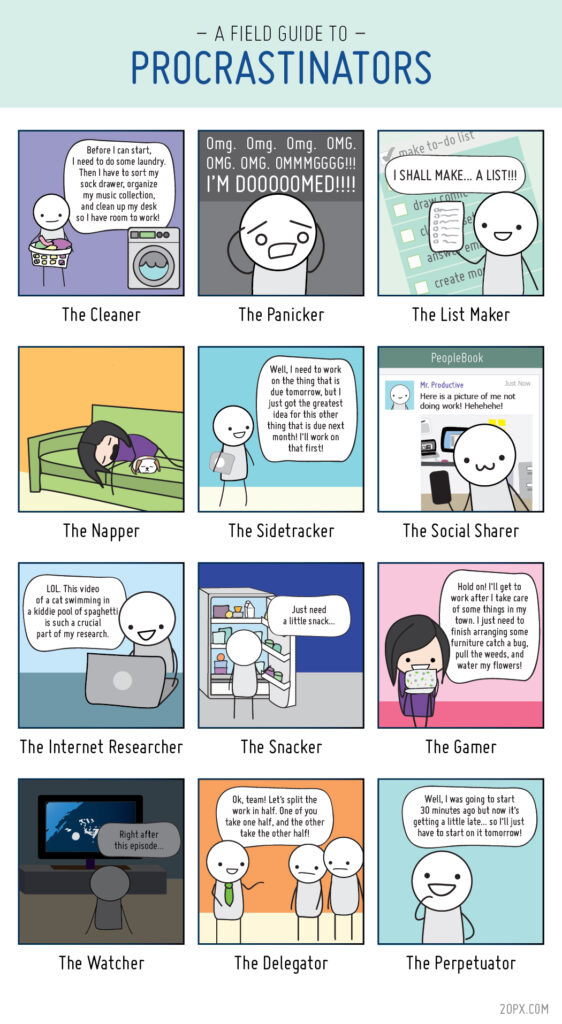
Procrastinating students are often misunderstood as being lazy or unmotivated. There’s more to it than that. Reflect on your own procrastination. Why do you do it? How does it make you feel? Does it lead to stress and guilt? Can you refocus and get the work done? Upon self-reflection you probably find that procrastination usually means you are stuck. Procrastination can lead to a myriad of emotions; regret, self-doubt, guilt, excitement, anxiety. Research suggest that students often are stuck for one of two reasons; fear of failure or confusion about the task.

It’s a common perception that students who procrastinate do so because they don’t care about the assignment – and that’s usually wrong.

Devon Price – Social Psychology Professor

Watch the video below about the types of procrastinators. Do you recognize yourself? Do you recognize some of your students? Think about the motivation behind each procrastinator and how that impacts their self-esteem and work production.

4 Types of Procrastinators by Michael Greschler

  • The Perfectionist/Overdoer: Everything has to be just right. It’s impossible to prioritize and work effectively.
  • The Defier: Resents authority and the loss of autonomy. Procrastinates to prove independence.
  • The Dreamer: Loves the big picture, gets lost in the details. Procrastination is a way to stay in the beautiful details and not ruin them by doing the work.
  • The Crisis Maker: Lives on the edge and does everything at the last second. Motivated by what’s immediate.

Watch this video on types of procrastination (5:54 minutes)

3 Reasons Students Procrastinate and How to Help them to Stop by Youki Terada. This article suggests 6 ways to help students NOT procrastinate:

  • Have clear instructions and examples: Students that are confused don’t know how to start. Teacher clarity matters greatly (0.75 effect size). Give clear expectations and requirements in writing and provide exemplars.
  • Spread out deadlines: Breaking down the assignments into mini-deadlines rather than one final deadline helps students prioritize.
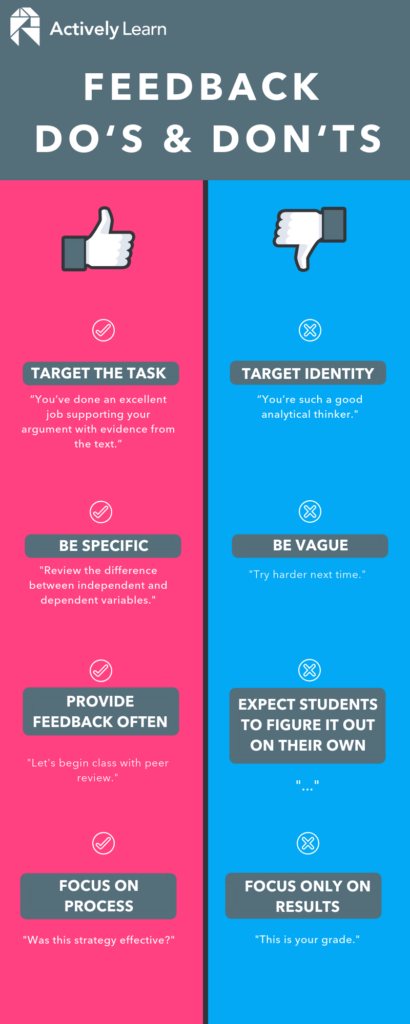
  • Provide supportive feedback: Students with low-self esteem or are self-conscious shut down with criticism or fear of failing. Provide supportive feedback about their task and process. (See previous Blog post on Feedback)
  • Model and practice study skills: Many student don’t know how to study and lack metacognitive skills. If they don’t recognize what they don’t know then they are lost. Don’t assume students learned study skills already or that they should know how to study. They need a variety of strategies in order to find the ones that work for them.
  • Explicitly teach time management: Teach students how to plan backwards from a due date. Practice scheduling a day and a week and then self-reflect on how well they estimated the time allotted for each task.
  • Be mindful of workload: There are predictable times when workloads are heavy (before breaks or the end of a grading period). Be mindful of the stress caused by the amount of work students are expected to juggle.

Just a little more…

Worth the Watch! Inside the Mind of a Procrastinator (14 minutes)

Types of Feedback that Moves Learning Forward

By Dean Richards

Last week’s blog focused on feedback and moving students forward in their learning. This week we look at John Hattie’s levels of Feedback.

Types of Feedback

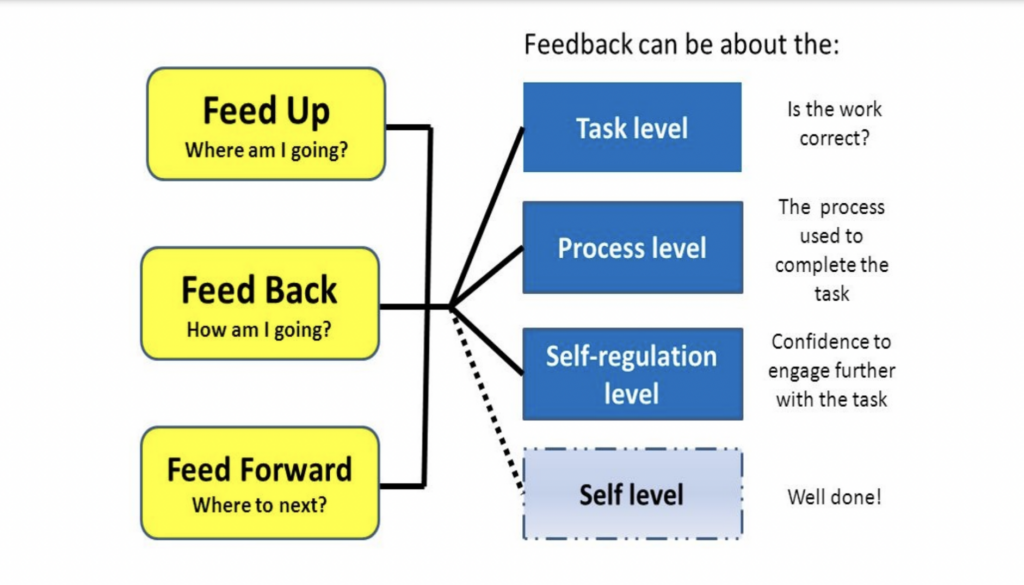
The content of the effective feedback that we provide students falls into 3 helpful categories.  

  • Feedback about the task
  • Feedback about the process
  • Feedback about the thinking during the task

“For the teacher, the art is knowing when to add in/move to the next level of feedback.”

Visible Learning

Task Level

Feedback about the task may be the most common and easiest feedback to provide to students.  This includes information about the errors that a student produces in the task. A teacher may also give feedback about the quality of the work. A rubric is a great way to provide that explicit feedback. The drawback of providing feedback only on the task is that the misconception(s) that are evident may be transferred to the student’s next task, thus the misconception continues.

Examples of prompts at the task level:
• Did you meet the success criteria?
• Is your correct/incorrect?
• How can you elaborate on the answer?
• What did you do well?
• Where did you go wrong?
• What other information is needed to meet the criteria?

Process Level

Some students, particularly those who are often the most successful in schools, will be able to transfer the feedback from the task to the process.  Providing feedback on the process, the steps taken to reach the final product, is a powerful way to move students to generalization.  Providing feedback on the quality of the process and giving alternative actions can be more powerful for students’ next task than feedback on the task alone.

Examples of prompts at the process level:
• What is wrong and why?
• What strategies did you use?
• What is the explanation for the correct answer?
• What other questions can you ask about the task?
• What are the relationships with other parts of the task?

Thinking/Self-regulation Level

The next powerful feedback, and possibly the most difficult, is to provide feedback on the thinking that occurred while the student engaged in the task. This helps students monitor their thinking and learning process. This is most commonly done in conversations with students. One of my favorite moves I used while tutoring students for the SAT was to say, “You got that right.  What were you thinking about when you did that?” Students often looked at me strangely, as they were not used to explaining their thinking.  Often they talked about their process, then I would ask about how they thought.  I would ask about their level of confidence. Forcing a student to metacognate about the task and process increases their self-efficacy.

Examples of prompts at the self-regulation level:
• How did you monitor your own work?
• What did you do to …?
• How can you account for …?
• What justification can be given for …?
• What further doubts do you have about?
• How does this compare with …?
• How have your ideas changed?
• Can you now teach another student how to …?

Diving in…

Feedback vs Feed Forward

When thinking about feedback, I am reminded of the hours spent writing detailed comments on science labs. In my mind, I pictured students looking at the comments and thoughtfully using the suggestion for improvement.  Often I watched students skim the comments, skip to the final grade,and then bury the assignment in their binder. I realized that I was spending more time making comments than the students spent reading them.  If students aren’t using the feedback, then what’s the point of it?  

“As soon as students get a grade, the learning stops. We may not like it, but the research reviewed shows that this is a relatively stable feature of how the human mind works.”

Dylan Wiliam

The purpose of feedback is to move students from where they are to where they need to be.  The research clearly establishes the importance of feedback (John Hattie 0.79 effect size) . When feedback is given and how it is given is critical.  As I learned in my own teaching, feedback given after an assignment is turned in rarely produces a change in student learning. For feedback to be effective, think about it as Feed Forward. It should be action oriented, require critical thinking to deepen understanding, and given throughout the learning process. (Video Dylan Wiliam Providing Feedback that Moves Learning Forward 14:57 minutes).

“The only important thing about feedback is what students do with it…”

Dylan wiliam

Importance for Feedback (video 3:00 minutes)

John Hattie’s three questions about feedback

  1. Feed up: Where am I going? Teacher clarity is critical (Hattie 0.75 effect size). Both the student and teacher need to agree on what is being assessed.
  2. Feedback: How am I going? Immediate feedback throughout the process guides learning. What is the student doing well? How is it related to the goal of the task?
  3. Feed Forward: Where to next? Ask open-ended questions that guide the student to the next-level of learning. Self-assessments and reflections is where the learning happens.

Tips for Effective Feedback (video 1:23 minutes)

  • Assess Less: Limit the learning goals to one skill or standard at a time and focus on it. Giving fewer, yet higher quality assessments reduces grading time and is easier for students to internalize.
  • Grade as they go: Have students submit small sections of a larger assignment. It’s more manageable for both the student and teacher. You can catch misconceptions sooner.
  • Record it: Record your feedback verbally in Canvas or with voice-to-text feature for google docs. Remember to edit before you submit.
  • Automate comments: Often similar mistakes are made for an assignment. Make a go-to-list of deeper thinking questions and comments that focus students on the task.
  • Feedback Partners: Assign partners for peer assessments. Establish a culture where peer feedback is the norm. Model how to provide feedback emphasizing the task, not the person. Provide sentence stems and practice how to do it.
  • Self-Assessment: Include student reflection on learning as part of the assignment. They need to actively reflect on what they learned and how they can apply it to future learning.
  • Give Students Choice: If the same skill/standard is assessed multiple times then have the student choose their best work to submit for grading. Include a self-reflection about why they chose it.

If you’re still hungry for more…

Black History Month Resources

This week’s blog is written by Christie Boen, District Librarian. She has curated a list of resources and text that may be helpful.

When you Google Black History Month, you’ll most likely see the name, Carter G. Woodson, known as the “Father of Black History”. In 1915, he created the Association for the Study of Negro Life and History. Then in 1926, he started the first “Negro History Week” on February 7th. It wasn’t until 1976 when Black History Month was officially recognized. It was then that President Gerald Ford urged Americans to “honor the too-often neglected accomplishments of Black Americans in every area of endeavor throughout our history.”

The theme for Black History Month 2022 is Black Health and Wellness. Some ways you can celebrate Black History Month:

  • Support Black-Owned Businesses
  • Learn About Noteworthy Black Figures and Their Contributions
  • Donate to Charities That Support Anti-Racism Equity and Equality
  • Purchase, Read, and Share Books by Black Authors
  • Support and Learn About Black Women

History

There are a plethora of Black History resources out there, but you may not have time to curate them for yourself or your students. This is where I come in.  Below are some fantastic resources to get you started.

Best Books of 2021 by Black Authors

Trailer for Instructions for Dancing

Trailer for Beasts of Prey

Trailer for Concrete Rose

Classroom Guide and Trailer for Born on the Water

Trailer for My Day with Panye

Trailer for Your Mama

Depending on your own identity and experiences, and those of your students, these topics can be sensitive to navigate.  Use this checklist from the LEAD Cohort to prepare appropriately, and/or reach out to a LEAD representative for collaboration. 

Educator Network Day Information

Happy New Year!


Next Wednesday is the second Educator Network Day. As you have likely heard from your administrators, this required training will be similar to October’s date. Teachers will be meeting in content area groups to discuss issues important to your discipline. While the agendas vary based on content, all will give some time to the upcoming Canvas syllabus requirement for second semester.
You can find a brief agenda and the location (all will have a virtual option) in the link below.

Agenda and location here

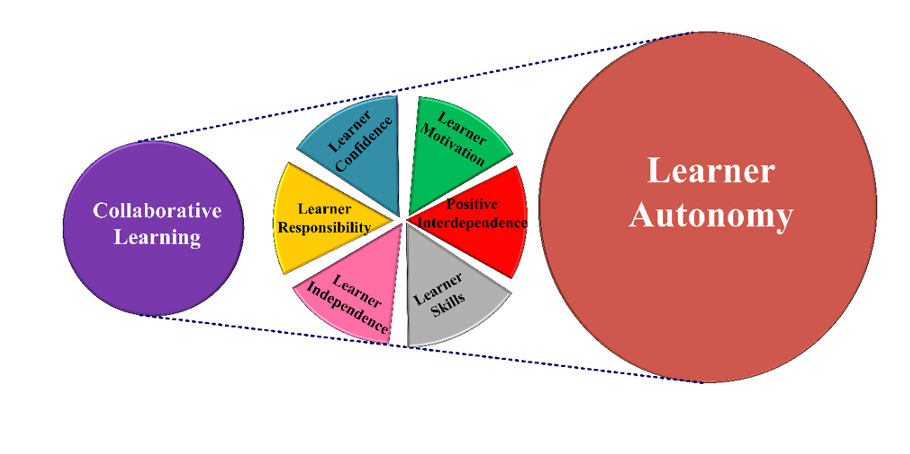
Key to Engagement and Ownership in Learning: Developing Student Autonomy

By: Julie Montoya

I don’t know about you, but for me, the hardest part of teaching virtually during the pandemic was the inability to create the same level of connection with my students.  It became painfully clear to me that this lack of connection had a devastating impact on my ability to teach and for students to learn.  This was multifaceted, no doubt.  One contributing factor to my change in teaching was the “over-accountability” of small, micro-managed assignments for students in Canvas and the gradebook.  I used small assignments and turn-ins just to see if my students were out there somewhere, logging in to their class.  This was the antithesis of my typical pedagogy which encouraged and scaffolded increased autonomy in language learning. I felt that I was devolving.  Ugh!

Now that we are back in the classroom, I am back to the drawing board to increase motivation specifically through student autonomy.  Autonomy is identified as one of three basic psychological needs for learning, along with competence and relatedness.  “The need for autonomy refers to learners need to be the initiator of their actions and to a sense of psychological freedom when engaging in a learning activity,” reports Leen Haerens, PhD for the Center for Self Determination Theory. To read more about the research behind these key factors, click here.

Tip #1: HOW AUTONOMY TRANSLATES TO MOTIVATION

Case: The Dreaded Class Presentation. 

Even prior to the pandemic, I was seeing more students become increasingly stressed when needing to give presentations in class.  Knowing that students are experiencing more anxiety in their learning environment due to the external stressors caused by the global pandemic, addressing this fear is key.  When students have agency over an experience, their stress will decrease.  We want to encourage students to gain presentational skills, but how can we still allow learner autonomy at the same time?

I developed an accommodations menu for presentations for my Spanish classes.  I offer some accommodations to all students and save some of the scaffolded steps for students who are expressing considerable anxiety or have a 504 for anxiety.  

For students working at the ‘Most Support’ level, we create a plan to move to down the menu to ‘Less Support’ throughout the year. I have found that students who would normally avoid a presentation, skip class, take a zero, or be perpetually absent will instead look at my menu, speak with me about what they feel they can manage, and create a plan for presenting.  When a student knows that their teacher can offer choice, they see their autonomy respected and acknowledges.  This builds confidence, trust, and motivation within the educational community.

Tip #2: ALLOWING FOR AUTONOMY WHEN DEMONSTRATING LEARNING

Case: Assessment Self-reflection

One way that I increase metacognition, which in turn increases autonomy and independence, is to ask students to do self-reflection on unit reviews prior to an assessment, and/or self-reflection after an assessment.  Rather than prescribing a required review of materials, I ask students to identify what aspects of the assessment are challenging and what they plan to do to learn and meet the objective of the unit of study.  If a student knows what is still challenging, they may not know how to study or fill in the gaps.  This is where the teacher can suggest strategies, resources, or peer help. Curating collections of resources that are available to all students takes time for the teacher up front, but it allows students to practice autonomy when deciding what, when, and where to review, study or practice knowledge and skills. When students are engaged in reflecting on their learning and contributing to the study plan, they learn valuable self-assessment skills and see themselves as the key decision-maker in their learning journey. 

The skills for learning a language are not always intrinsic.  I can see students’ maturity and growth in autonomous learning as they move from novice level to advanced proficiency through our language programs. I can see this growth at my AP Spanish students analyze rubrics, look for and highlight evidence in their argumentative essays and ask me for specific help or tools.  These are the skills we want our students to carry beyond the classroom into their jobs, advanced studies and into the greater community. 

If you are curious about more ways to increase student autonomy in the classroom, enjoy a deep-dive here.