
Tribal History/Shared History

Tribal history shared history

In 2017 SB13, Tribal History, Shared History was adopted into law.  This act brings the Native Oregonian history and experience, through the lens of the nine federally recognized tribes, into the forefront of Oregon Schools.  

The Department of Education has created a website that has lesson plans across several disciplines including Language Arts, Math, Social Studies, Science and Health in 8th grade and 10th grade

ODE has also created a series of Essential Understandings of Native Americans In Oregon  for Teachers to understand the experiences of Native People.  Much of this history was not taught in our schools prior to SB13.

The following are several resources that can be used to learn and teach more about those who have lived here since time immemorial.


Abby Hall, former student teacher at Bend High, created these videos about the Klamath Tribes, of which she is a member

Truth, Reconning, and Healing, the Klamath Tribes

This is an 8-minute video on the boarding school experience.  There will also be corresponding curriculum written for 11th grade students that can be found at the Klamath Tribes website as well as Oregon Department of Education website. 

We’re Still Here, The Termination and Restoration of the Klamath Tribes 

This is a 5-minute video on the Termination and Restoration of the Klamath Tribes.  There will also be corresponding curriculum written for 6th grade students that can be found at the Klamath Tribes website as well as Oregon Department of Education website.

Heal the Land, Heal the People 

This is a 5-minute video on the importance and cultural connections to the land. 


Learn more about specific tribes by visiting the websites of the 9 federally recognized tribes in Oregon

Tribal Websites


OPB did a great show on the native people of Oregon on the show Oregon Experience, Broken Treaties, An Oregon Experience.  It is an almost an hour long and rated G. Here is the summary:

Hundreds of books exist about the Lewis and Clark expedition and the decades of pioneers who followed them West.  But even today, most Oregonians don’t know much about the people who had settled here centuries before “the settlers” came.  “Broken Treaties” introduces viewers to the tribes of our state and explores a thread of the Oregon story that hasn’t been told very well over the years.   
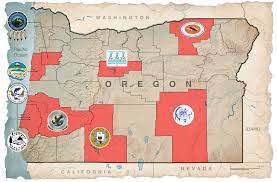

Teaching about Tribal History is not just a Social Studies thing! Here is a link about teaching STEM with Indigenous People in mind.

Teaching STEM In Ways that Respect and Build Upon Indigenous Peoples’ Rights


When thinking about the important pieces of our shared history, Leilani Sabzalian (Assistant Professor, Indigenous Studies in Education, University of Oregon) shares about the 6 P’s to keep in mind here.
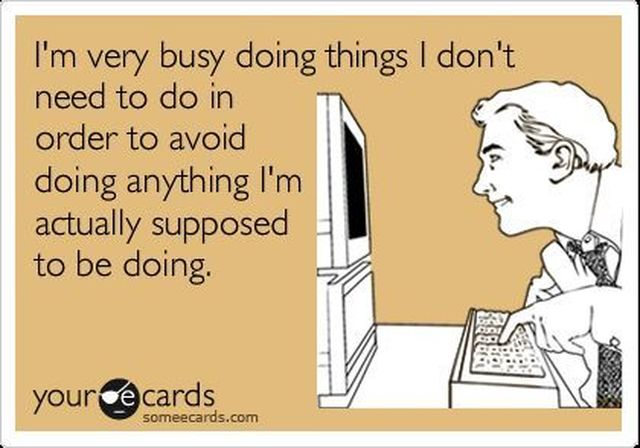
The Procrastinator – Lazy or Stuck?

Procrastinating students are often misunderstood as being lazy or unmotivated. There’s more to it than that. Reflect on your own procrastination. Why do you do it? How does it make you feel? Does it lead to stress and guilt? Can you refocus and get the work done? Upon self-reflection you probably find that procrastination usually means you are stuck. Procrastination can lead to a myriad of emotions; regret, self-doubt, guilt, excitement, anxiety. Research suggest that students often are stuck for one of two reasons; fear of failure or confusion about the task.

It’s a common perception that students who procrastinate do so because they don’t care about the assignment – and that’s usually wrong.

Devon Price – Social Psychology Professor

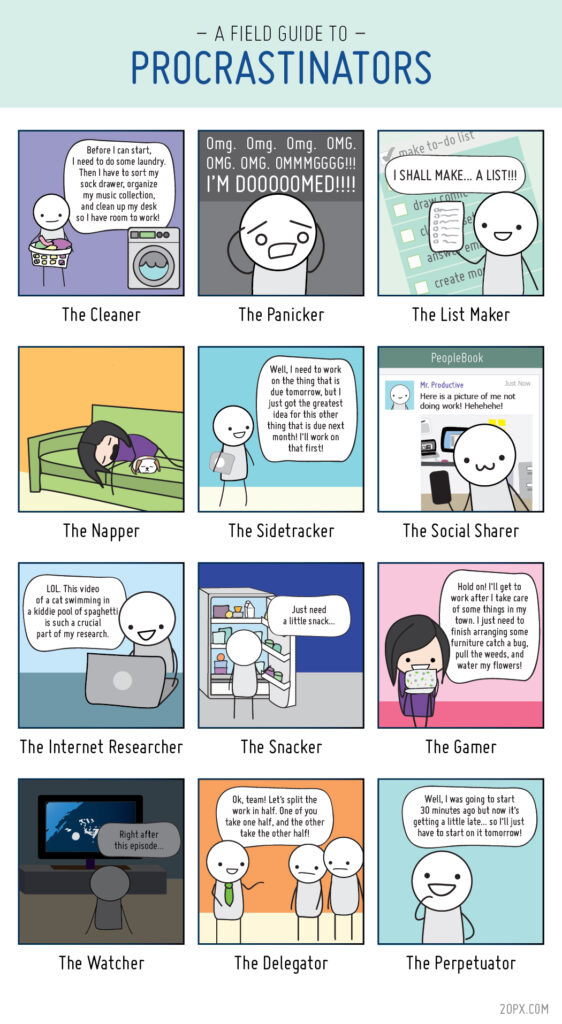
Watch the video below about the types of procrastinators. Do you recognize yourself? Do you recognize some of your students? Think about the motivation behind each procrastinator and how that impacts their self-esteem and work production.

4 Types of Procrastinators by Michael Greschler

  • The Perfectionist/Overdoer: Everything has to be just right. It’s impossible to prioritize and work effectively.
  • The Defier: Resents authority and the loss of autonomy. Procrastinates to prove independence.
  • The Dreamer: Loves the big picture, gets lost in the details. Procrastination is a way to stay in the beautiful details and not ruin them by doing the work.
  • The Crisis Maker: Lives on the edge and does everything at the last second. Motivated by what’s immediate.

Watch this video on types of procrastination (5:54 minutes)

3 Reasons Students Procrastinate and How to Help them to Stop by Youki Terada. This article suggests 6 ways to help students NOT procrastinate:

  • Have clear instructions and examples: Students that are confused don’t know how to start. Teacher clarity matters greatly (0.75 effect size). Give clear expectations and requirements in writing and provide exemplars.
  • Spread out deadlines: Breaking down the assignments into mini-deadlines rather than one final deadline helps students prioritize.
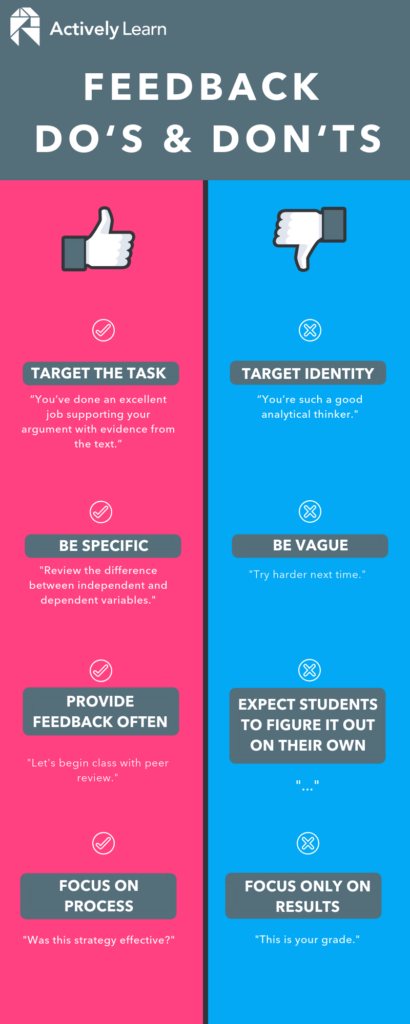
  • Provide supportive feedback: Students with low-self esteem or are self-conscious shut down with criticism or fear of failing. Provide supportive feedback about their task and process. (See previous Blog post on Feedback)
  • Model and practice study skills: Many student don’t know how to study and lack metacognitive skills. If they don’t recognize what they don’t know then they are lost. Don’t assume students learned study skills already or that they should know how to study. They need a variety of strategies in order to find the ones that work for them.
  • Explicitly teach time management: Teach students how to plan backwards from a due date. Practice scheduling a day and a week and then self-reflect on how well they estimated the time allotted for each task.
  • Be mindful of workload: There are predictable times when workloads are heavy (before breaks or the end of a grading period). Be mindful of the stress caused by the amount of work students are expected to juggle.

Just a little more…

Worth the Watch! Inside the Mind of a Procrastinator (14 minutes)

Types of Feedback that Moves Learning Forward

By Dean Richards

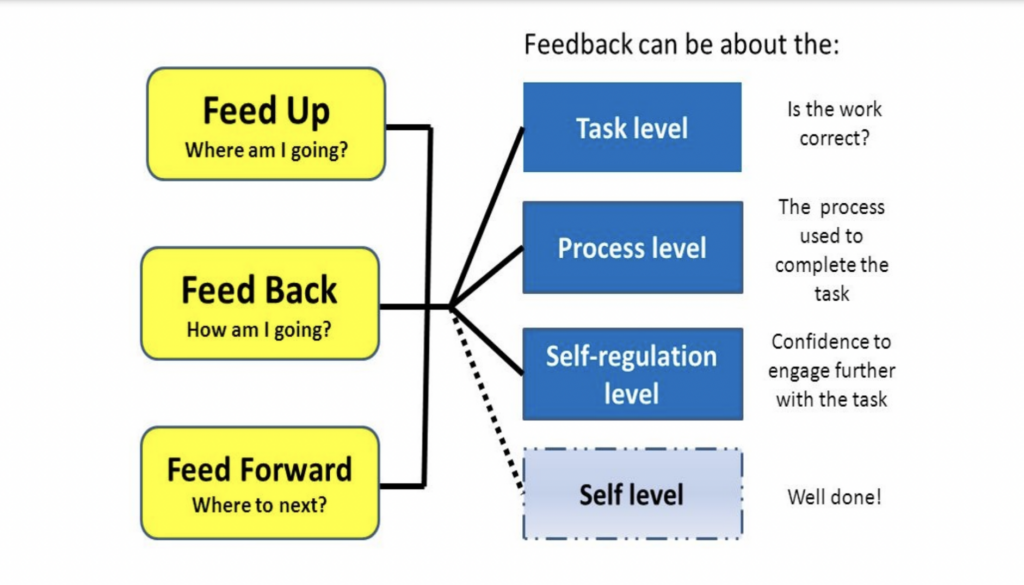
Last week’s blog focused on feedback and moving students forward in their learning. This week we look at John Hattie’s levels of Feedback.

Types of Feedback

The content of the effective feedback that we provide students falls into 3 helpful categories.  

  • Feedback about the task
  • Feedback about the process
  • Feedback about the thinking during the task

“For the teacher, the art is knowing when to add in/move to the next level of feedback.”

Visible Learning

Task Level

Feedback about the task may be the most common and easiest feedback to provide to students.  This includes information about the errors that a student produces in the task. A teacher may also give feedback about the quality of the work. A rubric is a great way to provide that explicit feedback. The drawback of providing feedback only on the task is that the misconception(s) that are evident may be transferred to the student’s next task, thus the misconception continues.

Examples of prompts at the task level:
• Did you meet the success criteria?
• Is your correct/incorrect?
• How can you elaborate on the answer?
• What did you do well?
• Where did you go wrong?
• What other information is needed to meet the criteria?

Process Level

Some students, particularly those who are often the most successful in schools, will be able to transfer the feedback from the task to the process.  Providing feedback on the process, the steps taken to reach the final product, is a powerful way to move students to generalization.  Providing feedback on the quality of the process and giving alternative actions can be more powerful for students’ next task than feedback on the task alone.

Examples of prompts at the process level:
• What is wrong and why?
• What strategies did you use?
• What is the explanation for the correct answer?
• What other questions can you ask about the task?
• What are the relationships with other parts of the task?

Thinking/Self-regulation Level

The next powerful feedback, and possibly the most difficult, is to provide feedback on the thinking that occurred while the student engaged in the task. This helps students monitor their thinking and learning process. This is most commonly done in conversations with students. One of my favorite moves I used while tutoring students for the SAT was to say, “You got that right.  What were you thinking about when you did that?” Students often looked at me strangely, as they were not used to explaining their thinking.  Often they talked about their process, then I would ask about how they thought.  I would ask about their level of confidence. Forcing a student to metacognate about the task and process increases their self-efficacy.

Examples of prompts at the self-regulation level:
• How did you monitor your own work?
• What did you do to …?
• How can you account for …?
• What justification can be given for …?
• What further doubts do you have about?
• How does this compare with …?
• How have your ideas changed?
• Can you now teach another student how to …?

Diving in…

Feedback vs Feed Forward

When thinking about feedback, I am reminded of the hours spent writing detailed comments on science labs. In my mind, I pictured students looking at the comments and thoughtfully using the suggestion for improvement.  Often I watched students skim the comments, skip to the final grade,and then bury the assignment in their binder. I realized that I was spending more time making comments than the students spent reading them.  If students aren’t using the feedback, then what’s the point of it?  

“As soon as students get a grade, the learning stops. We may not like it, but the research reviewed shows that this is a relatively stable feature of how the human mind works.”

Dylan Wiliam

The purpose of feedback is to move students from where they are to where they need to be.  The research clearly establishes the importance of feedback (John Hattie 0.79 effect size) . When feedback is given and how it is given is critical.  As I learned in my own teaching, feedback given after an assignment is turned in rarely produces a change in student learning. For feedback to be effective, think about it as Feed Forward. It should be action oriented, require critical thinking to deepen understanding, and given throughout the learning process. (Video Dylan Wiliam Providing Feedback that Moves Learning Forward 14:57 minutes).

“The only important thing about feedback is what students do with it…”

Dylan wiliam

Importance for Feedback (video 3:00 minutes)

John Hattie’s three questions about feedback

  1. Feed up: Where am I going? Teacher clarity is critical (Hattie 0.75 effect size). Both the student and teacher need to agree on what is being assessed.
  2. Feedback: How am I going? Immediate feedback throughout the process guides learning. What is the student doing well? How is it related to the goal of the task?
  3. Feed Forward: Where to next? Ask open-ended questions that guide the student to the next-level of learning. Self-assessments and reflections is where the learning happens.

Tips for Effective Feedback (video 1:23 minutes)

  • Assess Less: Limit the learning goals to one skill or standard at a time and focus on it. Giving fewer, yet higher quality assessments reduces grading time and is easier for students to internalize.
  • Grade as they go: Have students submit small sections of a larger assignment. It’s more manageable for both the student and teacher. You can catch misconceptions sooner.
  • Record it: Record your feedback verbally in Canvas or with voice-to-text feature for google docs. Remember to edit before you submit.
  • Automate comments: Often similar mistakes are made for an assignment. Make a go-to-list of deeper thinking questions and comments that focus students on the task.
  • Feedback Partners: Assign partners for peer assessments. Establish a culture where peer feedback is the norm. Model how to provide feedback emphasizing the task, not the person. Provide sentence stems and practice how to do it.
  • Self-Assessment: Include student reflection on learning as part of the assignment. They need to actively reflect on what they learned and how they can apply it to future learning.
  • Give Students Choice: If the same skill/standard is assessed multiple times then have the student choose their best work to submit for grading. Include a self-reflection about why they chose it.

If you’re still hungry for more…

Black History Month Resources

This week’s blog is written by Christie Boen, District Librarian. She has curated a list of resources and text that may be helpful.

When you Google Black History Month, you’ll most likely see the name, Carter G. Woodson, known as the “Father of Black History”. In 1915, he created the Association for the Study of Negro Life and History. Then in 1926, he started the first “Negro History Week” on February 7th. It wasn’t until 1976 when Black History Month was officially recognized. It was then that President Gerald Ford urged Americans to “honor the too-often neglected accomplishments of Black Americans in every area of endeavor throughout our history.”

The theme for Black History Month 2022 is Black Health and Wellness. Some ways you can celebrate Black History Month:

  • Support Black-Owned Businesses
  • Learn About Noteworthy Black Figures and Their Contributions
  • Donate to Charities That Support Anti-Racism Equity and Equality
  • Purchase, Read, and Share Books by Black Authors
  • Support and Learn About Black Women

History

There are a plethora of Black History resources out there, but you may not have time to curate them for yourself or your students. This is where I come in.  Below are some fantastic resources to get you started.

Best Books of 2021 by Black Authors

Trailer for Instructions for Dancing

Trailer for Beasts of Prey

Trailer for Concrete Rose

Classroom Guide and Trailer for Born on the Water

Trailer for My Day with Panye

Trailer for Your Mama

Depending on your own identity and experiences, and those of your students, these topics can be sensitive to navigate.  Use this checklist from the LEAD Cohort to prepare appropriately, and/or reach out to a LEAD representative for collaboration. 

Fostering Executive Function Skills

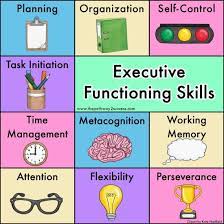
picture source: Pathway 2 Success

This is a guest post by Tara Butler, Mathematics teacher at Cascade Middle School and finalist for the Oregon Presidential Award for Excellence in Mathematics and Science Teaching in 2021.

“Executive function is a set of mental skills that include working memory, flexible thinking, and self-control. We use these skills every day to learn, work, and manage daily life. Trouble with executive function can make it hard to focus, follow directions, and handle emotions, among other things.” 

Understood.org

In addition to teaching middle school students math, I see my life’s work as the opportunity to develop problem solving, critical thinking, communication, creativity, and collaboration through the vehicle of mathematics.  This charge also includes intentionally building Executive Function skills.  We want to prepare students not just for our subject area but for every facet of their lives.  

I’ve thought about the vitality to bring awareness to and to develop Executive Function skills in students, especially with the challenges the last year and a half has thrown their way.  I came across this article in Edutopia by Sarah Kesty, “Supporting Executive Function Skills by Asking Questions.”  I was inspired to deliver research based practices for my students to apply rather than my good faith efforts that weren’t giving each student what they deserve.

Following is a summary of what I uncovered:

  1.  Ask genuine questions rather than giving directives.  

We don’t want students guessing what they are to be doing but if directions have been given and/or the expectations have been made clear, we can ask a question to jog their memory about their next best step.  This relays high expectations and shows students we believe in their ability to solve problems and be self-sufficient.  

  1. Coach students to be their own coach.  

For example, in solving a challenging math problem they can ask themselves:

It can seem easy or time saving in the moment to answer a student’s question or tell them how to do something rather than the long game of teaching them to turn to themselves first as a resource. 

  • How is this structure similar to a simpler problem?
  • How can I draw this visually?
  • How can I look at this problem another way?
  • I will give myself time to think about this problem before asking for help.  
  1. Equip students with a set of general questions they can utilize in any situation*
  1. What do you notice?
  2. What parts do you understand?
  3. What do you think you might need right now?
  4. How can you tell?
  5. Where could you look for that information?
  6. How will you remember to use that strategy or take that action?

When we’re tired, overwhelmed, or stuck; what an honor for us to step back, put the content on the back burner for a moment, and remember that we play a critical role in shaping human lives.  

Educator Network Day Information

Happy New Year!


Next Wednesday is the second Educator Network Day. As you have likely heard from your administrators, this required training will be similar to October’s date. Teachers will be meeting in content area groups to discuss issues important to your discipline. While the agendas vary based on content, all will give some time to the upcoming Canvas syllabus requirement for second semester.
You can find a brief agenda and the location (all will have a virtual option) in the link below.

Agenda and location here

Key to Engagement and Ownership in Learning: Developing Student Autonomy

By: Julie Montoya

I don’t know about you, but for me, the hardest part of teaching virtually during the pandemic was the inability to create the same level of connection with my students.  It became painfully clear to me that this lack of connection had a devastating impact on my ability to teach and for students to learn.  This was multifaceted, no doubt.  One contributing factor to my change in teaching was the “over-accountability” of small, micro-managed assignments for students in Canvas and the gradebook.  I used small assignments and turn-ins just to see if my students were out there somewhere, logging in to their class.  This was the antithesis of my typical pedagogy which encouraged and scaffolded increased autonomy in language learning. I felt that I was devolving.  Ugh!

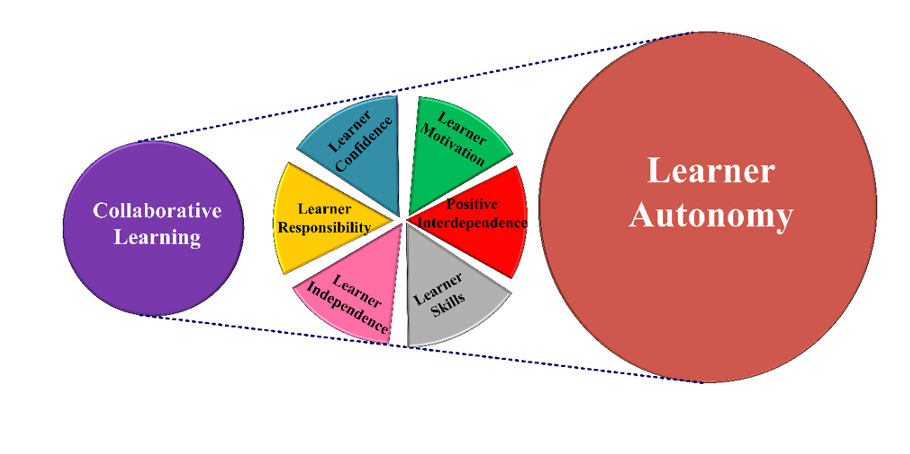
Now that we are back in the classroom, I am back to the drawing board to increase motivation specifically through student autonomy.  Autonomy is identified as one of three basic psychological needs for learning, along with competence and relatedness.  “The need for autonomy refers to learners need to be the initiator of their actions and to a sense of psychological freedom when engaging in a learning activity,” reports Leen Haerens, PhD for the Center for Self Determination Theory. To read more about the research behind these key factors, click here.

Tip #1: HOW AUTONOMY TRANSLATES TO MOTIVATION

Case: The Dreaded Class Presentation. 

Even prior to the pandemic, I was seeing more students become increasingly stressed when needing to give presentations in class.  Knowing that students are experiencing more anxiety in their learning environment due to the external stressors caused by the global pandemic, addressing this fear is key.  When students have agency over an experience, their stress will decrease.  We want to encourage students to gain presentational skills, but how can we still allow learner autonomy at the same time?

I developed an accommodations menu for presentations for my Spanish classes.  I offer some accommodations to all students and save some of the scaffolded steps for students who are expressing considerable anxiety or have a 504 for anxiety.  

For students working at the ‘Most Support’ level, we create a plan to move to down the menu to ‘Less Support’ throughout the year. I have found that students who would normally avoid a presentation, skip class, take a zero, or be perpetually absent will instead look at my menu, speak with me about what they feel they can manage, and create a plan for presenting.  When a student knows that their teacher can offer choice, they see their autonomy respected and acknowledges.  This builds confidence, trust, and motivation within the educational community.

Tip #2: ALLOWING FOR AUTONOMY WHEN DEMONSTRATING LEARNING

Case: Assessment Self-reflection

One way that I increase metacognition, which in turn increases autonomy and independence, is to ask students to do self-reflection on unit reviews prior to an assessment, and/or self-reflection after an assessment.  Rather than prescribing a required review of materials, I ask students to identify what aspects of the assessment are challenging and what they plan to do to learn and meet the objective of the unit of study.  If a student knows what is still challenging, they may not know how to study or fill in the gaps.  This is where the teacher can suggest strategies, resources, or peer help. Curating collections of resources that are available to all students takes time for the teacher up front, but it allows students to practice autonomy when deciding what, when, and where to review, study or practice knowledge and skills. When students are engaged in reflecting on their learning and contributing to the study plan, they learn valuable self-assessment skills and see themselves as the key decision-maker in their learning journey. 

The skills for learning a language are not always intrinsic.  I can see students’ maturity and growth in autonomous learning as they move from novice level to advanced proficiency through our language programs. I can see this growth at my AP Spanish students analyze rubrics, look for and highlight evidence in their argumentative essays and ask me for specific help or tools.  These are the skills we want our students to carry beyond the classroom into their jobs, advanced studies and into the greater community. 

If you are curious about more ways to increase student autonomy in the classroom, enjoy a deep-dive here.

Curious about Curiosity? Creating a Community of Curious Learners

by: Linda Adams

This morning I was curious. Where does “curiosity killed the cat” come from and what does it mean? Was it related to the naughty little monkey, Curious George?

I consulted my pocket computer…an idiom used to warn of the dangers of unnecessary investigation or experimentation? REALLY, what dangers?

For many, there is the belief that curiosity provides intrinsic motivation for learning. Sometimes that means Googling your question, and other times it involves digging deeper, letting yourself fall down “rabbit holes” and learning other new and related ideas.

We all know what a powerful learning tool curiosity is! We all know cultivating that curiosity is one of our highest goals as teachers. (Curious to know more about this? Here’s a one-page read from Edutopia: https://www.edutopia.org/blog/why-curiosity-enhances-learning-marianne-stenger#:~:text=Why%20Curiosity%20Enhances%20Learning.%20A%20neurological%20study%20has,we%20learn%2C%20we%20enjoy%20the%20sensation%20of%20learning.)

In essence, we are ALL wired to be curious. Curiosity prepares our brains for learning and makes learning rewarding. Curiosity = Engagement!

Modelling curiosity is the first step to recognising and valuing it in your classroom. Teachers do this instinctively, asking questions to elicit thinking in our lessons, and showing enthusiasm and joy when we discover new things with our students.

One of my favorite ways to engage a lesson with curiosity is to start with a picture, graph, cartoon or quote and add 2 questions; “What do you notice?” and “What do you wonder?“

9:53 – Kathy explain the instructional routine in her classroom. Kathy’s math routine is applicable across content areas.

The beautiful thing about Kathy’s routine is that, while students notice and wonder you are validating all student responses and giving all students a voice, whether it is a content-specific wondering or whether it is purely an observation about what they are seeing.

Here is a second, holiday example:

What do you notice? What do you wonder? A New Zealand couple has dug up a monster-sized potato. It weighs 17.4 lbs and has been nicknamed Doug. Here’s my curiosity-driven math question for students: potatoes typically have a density of 1.08g/ml. About how many cups of mashed potatoes would Doug provide for a holiday dinner? 

By the way, in case you were still wondering…

The earliest reference of the proverb “Curiosity killed the cat” came from William Shakespeare in his play Much Ado About Nothing. In the original form it meant “care or worry or sorry killed the cat,” not curiosity. I agree! For teachers, curiosity is too powerful an instructional tool to kill anything. Let’s celebrate what makes us curious!

What do you notice? What do you wonder?

Ready to Implement Now…Reading Strategies for all Subjects

The weight of the past two years feels heavy on our shoulders. Teachers are reporting that students are lacking skills in social-emotional areas and academic skills. Many teachers are asking, “How do we support our students and the gaps in learning we are seeing with them right now?”

Taking a “we are all in this together” approach, it seems imperative that we, as a school community of educators, tackle what we’re seeing in our students head on, and collaboratively.

In the 2019 book Disciplinary Literacy Inquiry & Instruction by Jacy Ippolito, Christina L. Dobbs, and Megin Charner-Laird, the case for teaching literacy across disciplines is strongly made. All teachers should view themselves as playing significant roles in developing a student’s literacy.

One way teachers can support students is by pointing out ways in which texts look very different in each class.  The text that students engage with in Language Arts looks very different from text in a Career and Technical Education course.  The lens that a reader must take for a Social Studies text, which is filled with bias, is different from many texts in a Science course.  

AdLit: All About Student Literacy has a website has a slew of amazing, simple, & ready-to-implement-today reading strategies that all teachers can use in their next lessons. The strategies emphasized are: Comprehension, Vocabulary, and Writing. What I like most about the way the website organizes these are in when you would implement these strategies in the reading process: BEFORE reading, DURING reading, and AFTER reading. I want to highlight a favorite from each stage of the reading process. If you’re intrigued, the website is easy to navigate and will offer many more!

Before Reading – Concept Sorts

One of my favorite reading strategies is Concept Sorts — using this technique, you can develop some prior knowledge and connections you want kids to make on their own. As an added bonus, the format is simple and will reach all students.

(Concept Sorting is a way of engaging students in Hexagonal Thinking, which has become a new rage in education – If you’d like to learn more about it, I’ll link an interesting blog post from The Cult of Pedagogy.)

During Reading – Concept Maps & Highlighting

The first one you might want to consider trying while students are reading is a Concept Map (I like to call them Brain Webs) — it’s low-stake writing and thinking, perfect for students with skills that are limited. The limited amount of writing and focus on single words and phrases helps students organize their thoughts quickly.

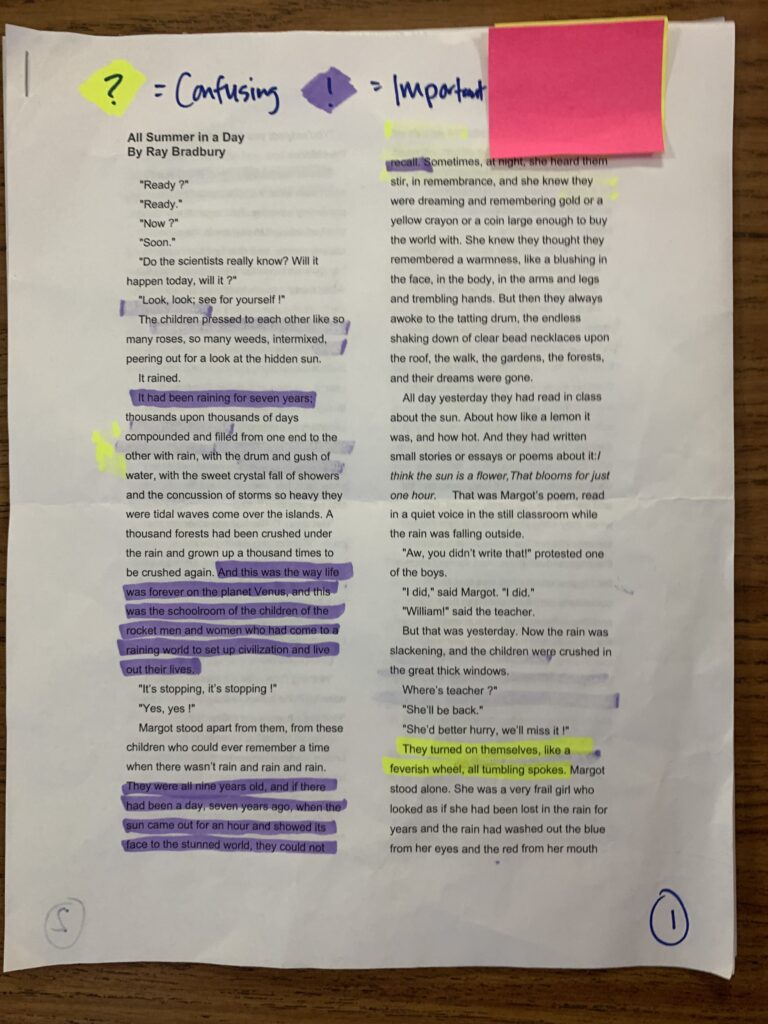
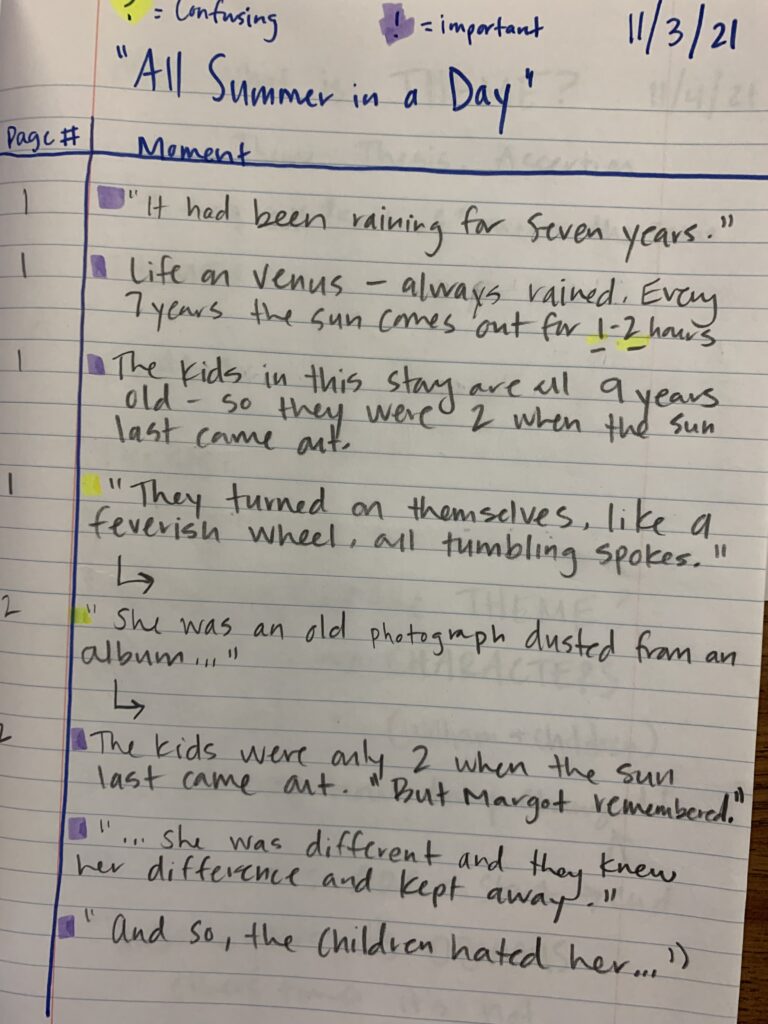
Another strategy I love and slightly adapted from the website version is Two Highlighters: Important and Confusing – I love telling my students, “It’s a sign of intelligence to be able to admit what you don’t know or understand.” The idea is in one color, they highlight words and moments that they don’t understand. The other color is for those moments that make us think, “Wow, this seems really important. I may not know why exactly yet, but I want to remember to look back at this later.” When I model this in front of them, chart it on a simple table in my reader’s notebook, and show them how to resolve simple issues that may be tripping them up, it increases reading comprehension by so much. It forces students to go back and re-read, to think deeply, and shows them a strategy they can use in any class, with any text. Once students have these moments organized, teachers can help strategize ways to resolve the difficult moments. If it’s vocabulary, would defining it help? Finding a synonym to replace the difficult vocabulary term? Is it a context issue?

After Reading – Summarizing

Summarizing is a tough skill for students, but we know it helps build comprehension. Generally, we see students write too much or pull out less-important information. Using this strategy, teachers can hone in prior knowledge and help build vocabulary. One way you could guide students into a more-targeted approach is the  

How to implement this right away: ​​Begin by reading OR have students listen to the text selection. 

  1. Ask students to write a summary of the target text based on the following framework questions:
    • What are the main ideas?
    • What are the crucial details necessary for supporting the ideas?
    • What information is irrelevant or unnecessary?
  2. Guide students throughout the summary writing process. Have them use keywords or phrases to identify the main points from the text.
  3. Encourage students to write successively shorter summaries, constantly refining their written piece until only the most essential and relevant information remains. I like the “Summarizing 5-3-1” method. Give students a task to summarize a passage or text in five sentences. Then practice with three sentences. And finally, challenge students to write a one-sentence summary. They will improve on identifying the most important details quickly with this strategy.

Questions about these strategies? Reach out to [email protected]